
补充和替代医学的使用及其与炎症性肠病和其他胃肠道疾病药物依从性的关系。
Complementary and alternative medicine use and its association with medication adherence in inflammatory bowel disease and other gastrointestinal diseases.
机构信息
Department of Population Health Sciences, King's College London, Riyadh, Saudi Arabia.
College of Medicine, Alfaisal University, Riyadh, Saudi Arabia.
出版信息
Saudi J Gastroenterol. 2023 Jul-Aug;29(4):233-239. doi: 10.4103/sjg.sjg_468_22.
BACKGROUND
The use of complementary and alternative medicines (CAMs) has been embedded in populations for decades. In this study, we aimed to determine the rate of their usage among inflammatory bowel disease (IBD) patients and their association with adherence to conventional therapies.
METHODS
In this cross sectional, survey-based study, IBD patients' (n=226) adherence and compliance were evaluated using the Morisky Medication Adherence Scale-8. A control sample of 227 patients with other gastrointestinal diseases was included to compare trends of CAM use.
RESULTS
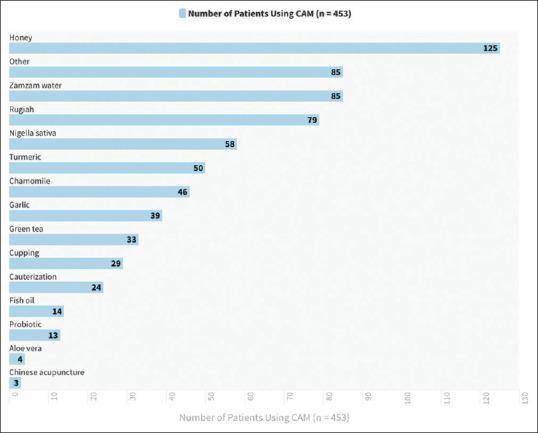
Crohn's disease represented 66.4% of those with IBD, with a mean age of 35 ± 13.0 years (54% males). The control group had either chronic viral hepatitis B, gastroesophageal reflux disease, Celiac disease, or other non-IBD diseases, with a mean age of 43.5 ± 16.8 years (55% males). Overall, 49% of patients reported using CAMs (54% in IBD group and 43% in the non-IBD group, P =0.024). Across both groups, the most used CAMs were honey (28%) and Zamzam water (19%). There was no significant association between the severity of the illness and use of CAMs. Patients who used CAMs had a lower adherence to conventional therapies vs. those who did not use CAMs (39% vs. 23%, P =0.038). Using the Morisky Medication Adherence Scale-8, low adherence to medications was reported in 35% of the IBD group vs. 11% of non-IBD group (P = 0.01).
CONCLUSION
In our population, patients with IBD are more likely to use CAMs and are less adherent to medications. Furthermore, the use of CAMs was associated with a lower adherence rate to conventional therapies. Consequently, further studies assessing the causes associated with the use of CAMs and nonadherence to conventional therapies should be explored and interventions designed to mitigate nonadherence.
背景
几十年来,人们一直将补充和替代医学(CAM)应用于各种人群。在本研究中,我们旨在确定炎症性肠病(IBD)患者使用 CAM 的比率及其与传统疗法依从性的关系。
方法
在这项横断面、基于调查的研究中,我们使用 Morisky 药物依从性量表-8 评估 IBD 患者(n=226)的依从性和顺应性。纳入了 227 例患有其他胃肠道疾病的对照样本,以比较 CAM 使用趋势。
结果
克罗恩病占 IBD 患者的 66.4%,平均年龄为 35 ± 13.0 岁(54%为男性)。对照组为慢性乙型肝炎病毒、胃食管反流病、乳糜泻或其他非 IBD 疾病,平均年龄为 43.5 ± 16.8 岁(55%为男性)。总体而言,49%的患者报告使用 CAM(IBD 组为 54%,非 IBD 组为 43%,P=0.024)。在两个组中,使用最多的 CAM 是蜂蜜(28%)和扎姆扎姆水(19%)。疾病严重程度与使用 CAM 之间无显著关联。与未使用 CAM 的患者相比,使用 CAM 的患者对传统疗法的依从性更低(39%对 23%,P=0.038)。使用 Morisky 药物依从性量表-8,IBD 组中报告有 35%的患者药物依从性低,而非 IBD 组中为 11%(P=0.01)。
结论
在我们的人群中,IBD 患者更有可能使用 CAM,对药物的依从性也更低。此外,CAM 的使用与对传统疗法的依从率降低相关。因此,应进一步研究评估与 CAM 使用和对传统疗法不依从相关的原因,并设计干预措施以减轻不依从。

 Zotero 插件