
足月健康婴儿在围产期和产后接触邻苯二甲酸酯与 6 个月时的早期神经发育。
Perinatal and postnatal exposure to phthalates and early neurodevelopment at 6 months in healthy infants born at term.
机构信息
Pediatric Unit, Department of Medical and Surgical Sciences of the Mother, Children and Adults, University of Modena and Reggio Emilia, Modena, Italy.
Department of Biomedical, Metabolic and Neural Sciences, University of Modena and Reggio Emilia, Modena, Italy.
出版信息
Front Endocrinol (Lausanne). 2023 May 24;14:1172743. doi: 10.3389/fendo.2023.1172743. eCollection 2023.
BACKGROUND
Phthalates are non-persistent chemicals largely used as plasticizers and considered ubiquitous pollutants with endocrine disrupting activity. The exposure during sensible temporal windows as pregnancy and early childhood, may influence physiological neurodevelopment.
AIMS AND SCOPE
The aim of this study is to analyze the relationship between the urinary levels of phthalate metabolites in newborn and infants and the global development measured by the Griffiths Scales of Children Development (GSCD) at six months.
METHODS
Longitudinal cohort study in healthy Italian term newborn and their mothers from birth to the first 6 months of life. Urine samples were collected at respectively 0 (T0), 3 (T3), 6 (T6) months, and around the delivery for mothers. Urine samples were analyzed for a total of 7 major phthalate metabolites of 5 of the most commonly used phthalates. At six months of age a global child development assessment using the third edition of the Griffith Scales of Child Development (GSCD III) was performed in 104 participants.
RESULTS
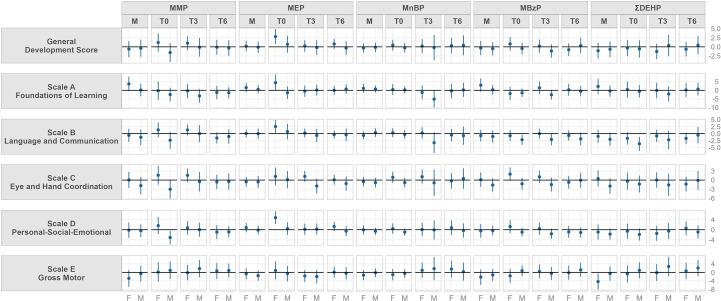
In a total of 387 urine samples, the seven metabolites analyzed appeared widespread and were detected in most of the urine samples collected at any time of sampling (66-100%). At six months most of the Developmental Quotients (DQs) falls in average range, except for the subscale B, which presents a DQ median score of 87 (85-95). Adjusted linear regressions between DQs and urinary phthalate metabolite concentrations in mothers at T0 and in infants at T0, T3 and T6 identified several negative associations both for infants' and mothers especially for DEHP and MBzP. Moreover, once stratified by children's sex, negative associations were found in boys while positive in girls.
CONCLUSIONS
Phthalates exposure is widespread, especially for not regulated compounds. Urinary phthalate metabolites were found to be associated to GSCD III scores, showing inverse association with higher phthalate levels related to lower development scores. Our data suggested differences related to the child's sex.
背景
邻苯二甲酸酯是非持久性化学物质,主要用作增塑剂,被认为是具有内分泌干扰活性的普遍存在的污染物。在妊娠和幼儿期等敏感时间段暴露,可能会影响生理神经发育。
目的和范围
本研究旨在分析新生儿和婴儿尿液中邻苯二甲酸酯代谢物水平与六个月时儿童发展综合量表(GSCD)测量的整体发展之间的关系。
方法
对意大利健康足月新生儿及其母亲进行纵向队列研究,从出生到生命的前 6 个月。分别在 0(T0)、3(T3)和 6(T6)个月时以及母亲分娩前后采集尿液样本。对尿液样本进行了 7 种主要邻苯二甲酸酯代谢物的分析,涉及 5 种最常用的邻苯二甲酸酯。在 104 名参与者中,6 个月时使用儿童发展综合量表(GSCD III)的第三版进行了全面的儿童发展评估。
结果
在总共 387 个尿液样本中,分析的 7 种代谢物广泛存在,在任何采样时间采集的大多数尿液样本中都有检出(66-100%)。在 6 个月时,大多数发展商数(DQ)处于平均值范围,除了 B 分量表,其 DQ 中位数为 87(85-95)。对母亲 T0 和婴儿 T0、T3 和 T6 尿液中邻苯二甲酸酯代谢物浓度与 DQ 之间的调整线性回归,确定了几种负相关关系,既涉及婴儿也涉及母亲,尤其是 DEHP 和 MBzP。此外,一旦按儿童性别分层,在男孩中发现了负相关关系,而在女孩中发现了正相关关系。
结论
邻苯二甲酸酯的暴露很普遍,特别是对不受监管的化合物。尿液中邻苯二甲酸酯代谢物与 GSCD III 评分相关,与较高的邻苯二甲酸酯水平相关,提示发育评分较低。我们的数据表明,这与儿童的性别有关。

 Zotero 插件