
从工业食品废弃物到生物活性成分:植物源食品废弃物可持续管理与转化综述
From Industrial Food Waste to Bioactive Ingredients: A Review on the Sustainable Management and Transformation of Plant-Derived Food Waste.
作者信息
Jaouhari Yassine, Travaglia F, Giovannelli L, Picco A, Oz E, Oz F, Bordiga M
机构信息
Department of Pharmaceutical Sciences, Università degli Studi del Piemonte Orientale "A. Avogadro", Largo Donegani 2, 28100 Novara, Italy.
Department of Food Engineering, Faculty of Agriculture, Ataturk University, Erzurum 25240, Türkiye.
出版信息
Foods. 2023 May 29;12(11):2183. doi: 10.3390/foods12112183.
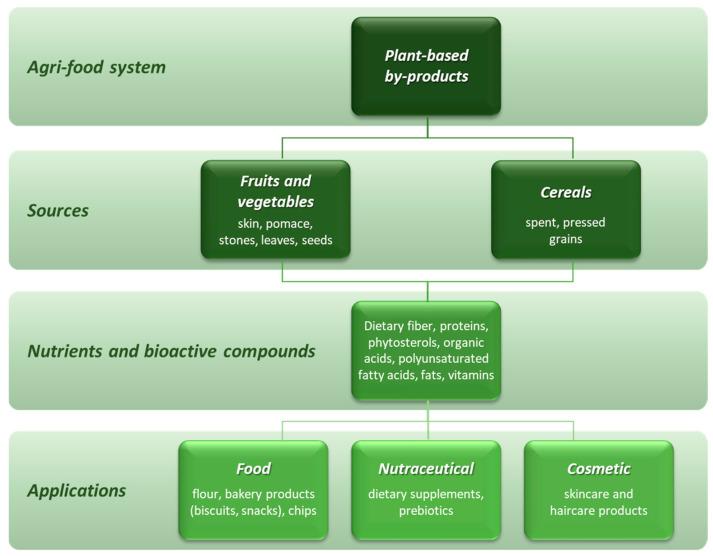
According to the United Nations, approximately one-third of the food produced for human consumption is wasted. The actual linear "Take-Make-Dispose" model is nowadays obsolete and uneconomical for societies and the environment, while circular thinking in production systems and its effective adoption offers new opportunities and benefits. Following the "Waste Framework Directive" (2008/98/CE), the European Green Deal, and the actual Circular Economy Action Plan, when prevention is not possible, recovering an unavoidable food waste as a by-product represents a most promising pathway. Using last year's by-products, which are rich in nutrients and bioactive compounds, such as dietary fiber, polyphenols, and peptides, offer a wake-up call to the nutraceutical and cosmetic industry to invest and develop value-added products generated from food waste ingredients.
据联合国统计,供人类消费的食品约有三分之一被浪费。如今,实际的线性“取-制-弃”模式对社会和环境而言已过时且不经济,而生产系统中的循环思维及其有效应用提供了新的机遇和益处。遵循《废物框架指令》(2008/98/CE)、《欧洲绿色协议》以及实际的《循环经济行动计划》,在无法预防的情况下,将不可避免产生的食物垃圾作为副产品回收利用是一条最具前景的途径。利用去年富含营养成分和生物活性化合物(如膳食纤维、多酚和肽)的副产品,给营养保健品和化妆品行业敲响了警钟,促使其投资并开发由食物垃圾成分制成的增值产品。
 Zotero 插件