
生理应激水平和营养不良筛查作为胰腺手术术后并发症的术前预测指标:一项回顾性研究。
Physiological stress level and screening for malnutrition as preoperative predictors of postoperative complications in pancreatic surgery: a retrospective study.
机构信息
Department of Surgery No.2, Kharkiv National Medical University, Nezalezhnosti Avenue, Kharkiv, 61022, Ukraine.
Krankenhaus Sachsenhausen, 60594, SchulstraßeFrankfurt Am Main, Germany.
出版信息
BMC Surg. 2023 Jun 10;23(1):156. doi: 10.1186/s12893-023-02062-y.
BACKGROUND
Assessment of 'physiological stress levels' and 'nutritional status' before surgery is important for predicting complications and indirect interventions on the pancreas. The aim of this study was to determine neutrophil-lymphocyte ratio (NLR) and nutritional risk index (NRI) indicators before surgery to predict 90-day complications and mortality in a cohort of patients with complicated chronic pancreatitis and cancer of the head of the pancreas.
METHODS
We evaluated preoperative levels of NLR and NRI among 225 subjects treated at different centres located in three countries. Short-term outcomes included length of hospital stay, postoperative complications, and mortality at 90 days and were appreciated based on NLR and NRI. The level of physiological stress was divided according by the formulas: neutrophil-lymphocyte ratio (NLR) = (neutrophil count, %)/(lymphocyte count, %). The nutritional state of the patients was divided according to the INR: NRI = (1.519 × serum albumin, g/L) + (41.7 × present weight, kg / usual weight, kg)].
RESULTS
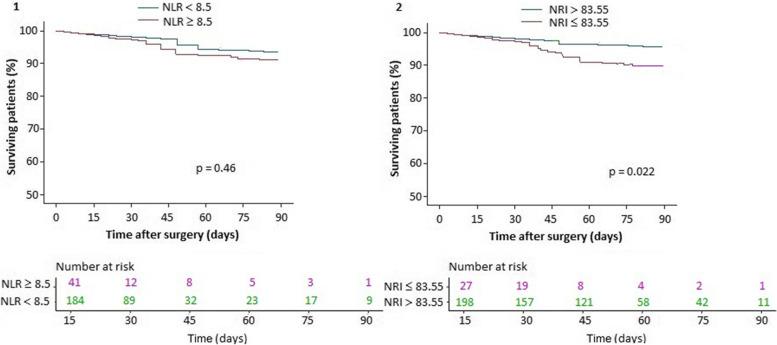
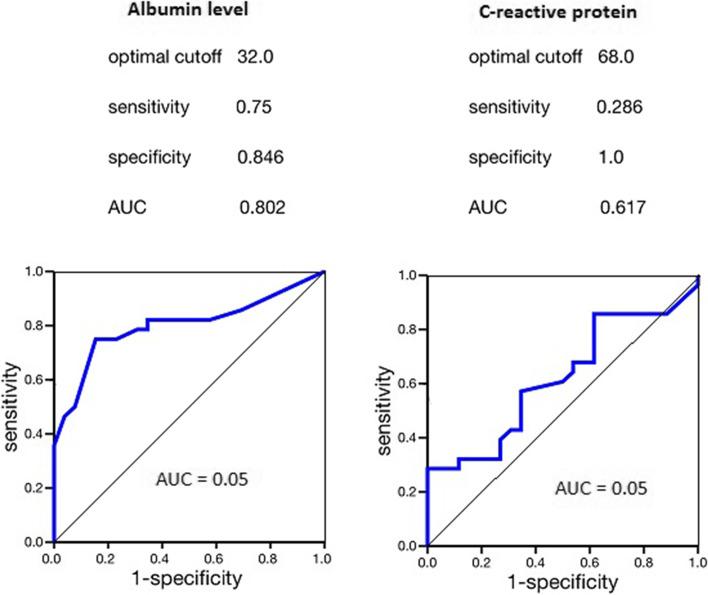
All patients were operated. An analysis of the operations performed in three institutions demonstrated mortality in chronic pancreatitis and pancreatic pseudocysts in 1.4%, in chronic pancreatitis and the presence of an inflammatory mass mainly in the pancreatic head in 1.2%, and in cancer of the pancreatic head in 5.9%. The mean preoperative NLR was normal in 33.8% of the patients, the mild physiologic stress level was 54.7%, and the moderate was 11.5% before surgery. 10.2% of patients had a normal nutritional status, 20% had mild, 19.6% had moderate, and 50.2% had severe malnutrition. In a univariate analysis, at the cutoff of NLR ≥ 9.5 (AUC = 0.803) and the cutoff of NRI ≤ 98.5 (AUC = 0.801), increasing the risk of complications was observed (hazard ratio, 2.01; 95% CI, 1.247-3.250, p = 0.006), but at the cutoff of NRI ≤ 83.55 (AUC = 0.81), we observed a survival difference in operated patients (hazard ratio, 2.15; 95% CI, 1.334-3.477, p = 0.0025).
CONCLUSIONS
Our study demonstrated that NLR and NRI were predictors of postoperative complications, but only NRI was a predictor of 90-day mortality in patients after surgery.
背景
在手术前评估“生理应激水平”和“营养状况”对于预测并发症和对胰腺进行间接干预很重要。本研究的目的是确定术前中性粒细胞与淋巴细胞比值(NLR)和营养风险指数(NRI)指标,以预测 225 例患有复杂慢性胰腺炎和胰头癌患者队列中的 90 天并发症和死亡率。
方法
我们评估了来自三个国家不同中心的 225 名患者的 NLR 和 NRI 术前水平。短期结果包括住院时间、术后并发症和 90 天死亡率,并根据 NLR 和 NRI 进行评估。生理应激水平根据公式进行划分:中性粒细胞与淋巴细胞比值(NLR)=(中性粒细胞计数%)/(淋巴细胞计数%)。患者的营养状况根据 INR 进行划分:NRI=(1.519×血清白蛋白,g/L)+(41.7×目前体重,kg/标准体重,kg)]。
结果
所有患者均接受了手术。对三个机构进行的手术分析表明,慢性胰腺炎和胰腺假性囊肿的死亡率为 1.4%,慢性胰腺炎和胰头主要为炎症肿块的死亡率为 1.2%,胰头癌的死亡率为 5.9%。术前,33.8%的患者 NLR 正常,54.7%的患者轻度生理应激,11.5%的患者中度生理应激。10.2%的患者营养状况正常,20%的患者轻度营养不良,19.6%的患者中度营养不良,50.2%的患者重度营养不良。在单因素分析中,当 NLR≥9.5(AUC=0.803)和 NRI≤98.5(AUC=0.801)时,观察到并发症风险增加(危险比,2.01;95%置信区间,1.247-3.250,p=0.006),但当 NRI≤83.55(AUC=0.81)时,我们观察到手术患者的生存差异(危险比,2.15;95%置信区间,1.334-3.477,p=0.0025)。
结论
我们的研究表明,NLR 和 NRI 是术后并发症的预测指标,但只有 NRI 是术后患者 90 天死亡率的预测指标。

 Zotero 插件