
两栖动物对壶菌病的感染耐受。
Amphibian infection tolerance to chytridiomycosis.
机构信息
Centre for Planetary Health and Food Security, and School of Environment and Science, Griffith University, Gold Coast Campus, Parklands Drive, Southport, Queensland 4222, Australia.
出版信息
Philos Trans R Soc Lond B Biol Sci. 2023 Jul 31;378(1882):20220133. doi: 10.1098/rstb.2022.0133. Epub 2023 Jun 12.
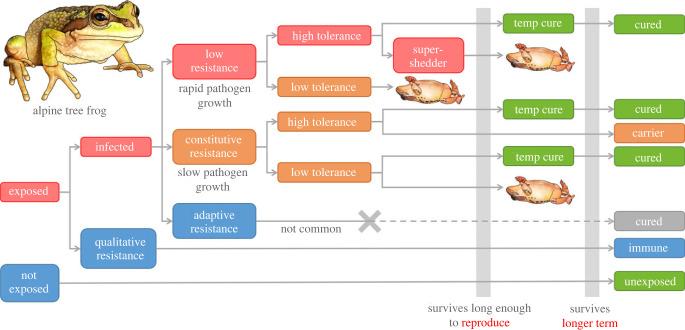
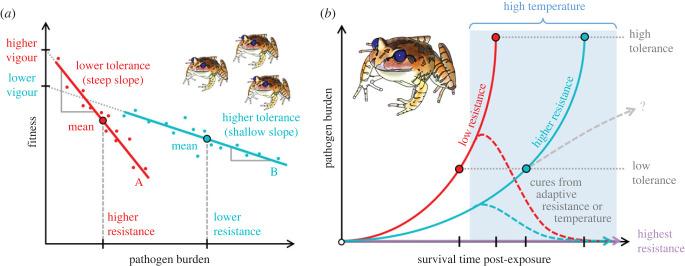
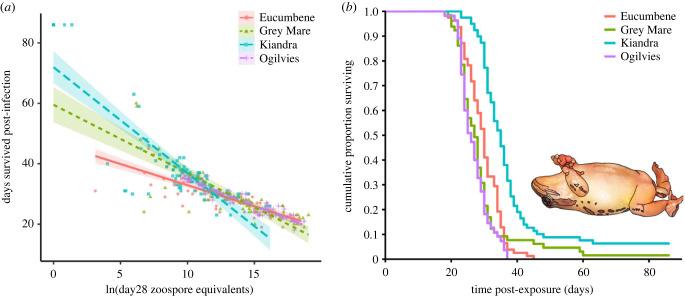
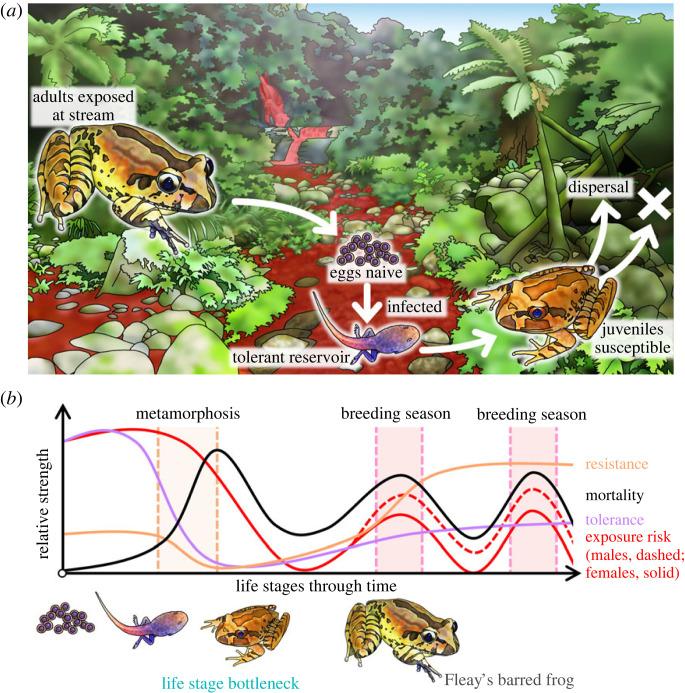
Animal defences against infection involve two distinct but complementary mechanisms: tolerance and resistance. Tolerance measures the animal's ability to limit detrimental effects from a given infection, whereas resistance is the ability to limit the intensity of that infection. Tolerance is a valuable defence for highly prevalent, persistent or endemic infections where mitigation strategies based on traditional resistance mechanisms are less effective or evolutionarily stable. Selective breeding of amphibians for enhanced tolerance to spp has been suggested as a strategy for mitigating the impacts of the fungal disease, chytridiomycosis. Here, we define infection tolerance and resistance in the context of chytridiomycosis, present evidence for variation in tolerance to chytridiomycosis, and explore epidemiological, ecological and evolutionary implications of tolerance to chytridiomycosis. We found that exposure risk and environmental moderation of infection burdens are major confounders of resistance and tolerance, chytridiomycosis is primarily characterized by variation in constitutive rather than adaptive resistance, tolerance is epidemiologically important in driving pathogen spread and maintenance, heterogeneity of tolerance leads to ecological trade-offs, and natural selection for resistance and tolerance is likely to be dilute. Improving our understanding of infection tolerance broadens our capacity for mitigating the ongoing impacts of emerging infectious diseases such as chytridiomycosis. This article is part of the theme issue 'Amphibian immunity: stress, disease and ecoimmunology'.
动物防御感染涉及两种截然不同但互补的机制
耐受和抵抗。耐受衡量动物从特定感染中限制有害影响的能力,而抵抗是限制感染强度的能力。对于高度流行、持续或地方性的感染,耐受是一种有价值的防御机制,因为基于传统抵抗机制的缓解策略效果较差或在进化上稳定。有人建议,选择性繁殖对 spp 具有更高耐受能力的两栖动物,是减轻真菌病壶菌病影响的一种策略。在这里,我们在壶菌病的背景下定义感染耐受和抵抗,提出对壶菌病耐受能力变化的证据,并探讨对壶菌病的耐受能力的流行病学、生态学和进化意义。我们发现,感染负担的暴露风险和环境调节是抵抗和耐受的主要混杂因素,壶菌病主要表现为组成型而不是适应性抵抗的变化,在驱动病原体传播和维持方面,耐受具有重要的流行病学意义,耐受的异质性导致生态权衡,对抵抗和耐受的自然选择可能很微弱。提高我们对感染耐受的理解,扩大了我们减轻正在发生的传染病如壶菌病的影响的能力。本文是主题为“两栖动物免疫:应激、疾病和生态免疫学”的一部分。
 Zotero 插件