
急性奥希替尼暴露通过同步抑制心脏离子通道电流诱导心电变化。
Acute osimertinib exposure induces electrocardiac changes by synchronously inhibiting the currents of cardiac ion channels.
作者信息
Li Peiwen, Tian Xiaohui, Wang Gongxin, Jiang Enshe, Li Yanming, Hao Guoliang
机构信息
Department of Cardiology, Huaihe Hospital of Henan University, Kaifeng, China.
Department of Pharmacy, Huaihe Hospital of Henan University, Kaifeng, China.
出版信息
Front Pharmacol. 2023 May 30;14:1177003. doi: 10.3389/fphar.2023.1177003. eCollection 2023.
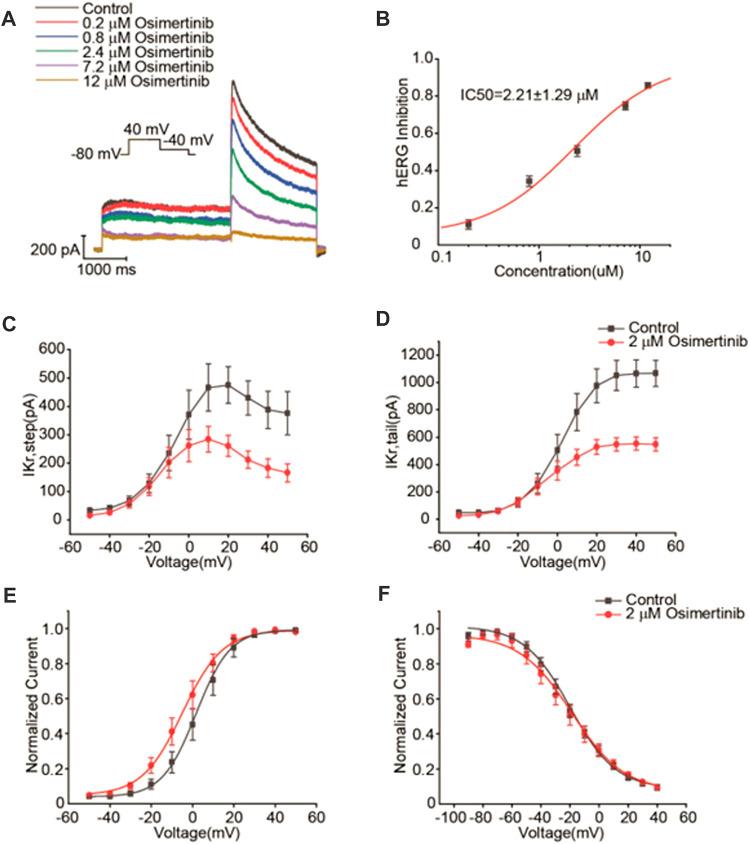
As the third generation of epidermal growth factor receptor tyrosine kinase inhibitor (EGFR-TKI), osimertinib has demonstrated more significant cardiotoxicity than previous generations of EGFR-TKIs. Investigating the mechanism of osimertinib cardiotoxicity can provide a reference for a comprehensive understanding of osimertinib-induced cardiotoxicity and the safety of the usage of this drug in clinical practice. Multichannel electrical mapping with synchronous ECG recording was used to investigate the effects of varying osimertinib concentrations on electrophysiological indicators in isolated Langendorff-perfused hearts of guinea pigs. Additionally, a whole-cell patch clamp was used to detect the impact of osimertinib on the currents of hERG channels transfected into HEK293 cells and the Nav1.5 channel transfected into Chinese hamster ovary cells and acute isolated ventricular myocytes from SD rats. Acute exposure to varying osimertinib concentrations produced prolongation in the PR interval, QT interval, and QRS complex in isolated hearts of guinea pigs. Meanwhile, this exposure could concentration-dependently increase the conduction time in the left atrium, left ventricle, and atrioventricular without affecting the left ventricle conduction velocity. Osimertinib inhibited the hERG channel in a concentration-dependent manner, with an IC of 2.21 ± 1.29 μM. Osimertinib also inhibited the Nav1.5 channel in a concentration-dependent manner, with IC values in the absence of inactivation, 20% inactivation, and 50% inactivation of 15.58 ± 0.83 μM, 3.24 ± 0.09 μM, and 2.03 ± 0.57 μM, respectively. Osimertinib slightly inhibited the currents of L-type Ca channels in a concentration-dependent manner in acutely isolated rat ventricular myocytes. Osimertinib could prolong the QT interval; PR interval; QRS complex; left atrium, left ventricle, and atrioventricular conduction time in isolated guinea pig hearts. Furthermore, osimertinib could block the hERG, Nav1.5, and L-type Ca channels in concentration-dependent manners. Therefore, these findings might be the leading cause of the cardiotoxicity effects, such as QT prolongation and decreased left ventricular ejection fraction.
作为第三代表皮生长因子受体酪氨酸激酶抑制剂(EGFR-TKI),奥希替尼已显示出比前几代EGFR-TKI更显著的心脏毒性。研究奥希替尼心脏毒性的机制可为全面了解奥希替尼引起的心脏毒性以及该药物在临床实践中的使用安全性提供参考。采用同步心电图记录的多通道电标测技术,研究不同浓度奥希替尼对豚鼠离体Langendorff灌流心脏电生理指标的影响。此外,采用全细胞膜片钳技术检测奥希替尼对转染到HEK293细胞中的hERG通道电流、转染到中国仓鼠卵巢细胞中的Nav1.5通道电流以及SD大鼠急性分离心室肌细胞中Nav1.5通道电流的影响。急性暴露于不同浓度的奥希替尼会使豚鼠离体心脏的PR间期、QT间期和QRS波群延长。同时,这种暴露可浓度依赖性地增加左心房、左心室和房室结的传导时间,而不影响左心室传导速度。奥希替尼以浓度依赖性方式抑制hERG通道,IC50为2.21±1.29μM。奥希替尼也以浓度依赖性方式抑制Nav1.5通道,在无失活、20%失活和50%失活时的IC50值分别为15.58±0.83μM、3.24±0.09μM和2.03±0.57μM。奥希替尼在急性分离的大鼠心室肌细胞中以浓度依赖性方式轻微抑制L型钙通道电流。奥希替尼可延长豚鼠离体心脏的QT间期、PR间期、QRS波群以及左心房、左心室和房室结的传导时间。此外,奥希替尼可浓度依赖性地阻断hERG、Nav1.5和L型钙通道。因此,这些发现可能是QT间期延长和左心室射血分数降低等心脏毒性作用的主要原因。



 Zotero 插件