
利用自然语言处理技术从韩国不良事件报告系统的不良药物事件叙述中自动提取全面的药物安全信息。
Automatic Extraction of Comprehensive Drug Safety Information from Adverse Drug Event Narratives in the Korea Adverse Event Reporting System Using Natural Language Processing Techniques.
机构信息
Biomedical Research Institute, Seoul National University Hospital, Seoul, South Korea.
Department of Electrical and Computer Engineering, Seoul National University, Room 1005 Building 301, 1 Gwanak-ro, Gwanak-gu, Seoul, 151-744, Republic of Korea.
出版信息
Drug Saf. 2023 Aug;46(8):781-795. doi: 10.1007/s40264-023-01323-2. Epub 2023 Jun 17.
INTRODUCTION
Concerns have been raised over the quality of drug safety information, particularly data completeness, collected through spontaneous reporting systems (SRS), although regulatory agencies routinely use SRS data to guide their pharmacovigilance programs. We expected that collecting additional drug safety information from adverse event (ADE) narratives and incorporating it into the SRS database would improve data completeness.
OBJECTIVE
The aims of this study were to define the extraction of comprehensive drug safety information from ADE narratives reported through the Korea Adverse Event Reporting System (KAERS) as natural language processing (NLP) tasks and to provide baseline models for the defined tasks.
METHODS
This study used ADE narratives and structured drug safety information from individual case safety reports (ICSRs) reported through KAERS between 1 January 2015 and 31 December 2019. We developed the annotation guideline for the extraction of comprehensive drug safety information from ADE narratives based on the International Conference on Harmonisation (ICH) E2B(R3) guideline and manually annotated 3723 ADE narratives. Then, we developed a domain-specific Korean Bidirectional Encoder Representations from Transformers (KAERS-BERT) model using 1.2 million ADE narratives in KAERS and provided baseline models for the task we defined. In addition, we performed an ablation experiment to investigate whether named entity recognition (NER) models were improved when a training dataset contained more diverse ADE narratives.
RESULTS
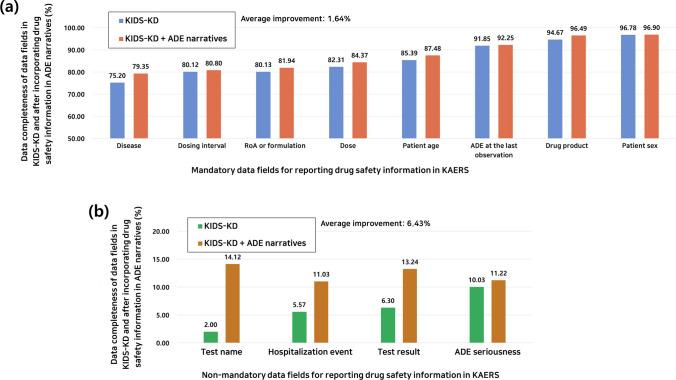
We defined 21 types of word entities, six types of entity labels, and 49 types of relations to formulate the extraction of comprehensive drug safety information as NLP tasks. We obtained a total of 86,750 entities, 81,828 entity labels, and 45,107 relations from manually annotated ADE narratives. The KAERS-BERT model achieved F1-scores of 83.81 and 76.62% on the NER and sentence extraction tasks, respectively, while outperforming other baseline models on all the NLP tasks we defined except the sentence extraction task. Finally, utilizing the NER model for extracting drug safety information from ADE narratives resulted in an average increase of 3.24% in data completeness for KAERS structured data fields.
CONCLUSIONS
We formulated the extraction of comprehensive drug safety information from ADE narratives as NLP tasks and developed the annotated corpus and strong baseline models for the tasks. The annotated corpus and models for extracting comprehensive drug safety information can improve the data quality of an SRS database.
简介
尽管监管机构通常使用 SRS 数据来指导其药物警戒计划,但人们对通过自发报告系统 (SRS) 收集的药物安全性信息的质量,特别是数据完整性,提出了担忧。我们预计,从不良事件 (AE) 叙述中收集额外的药物安全性信息并将其纳入 SRS 数据库将提高数据完整性。
目的
本研究旨在将通过韩国不良事件报告系统 (KAERS) 报告的 AE 叙述中的综合药物安全性信息的提取定义为自然语言处理 (NLP) 任务,并为定义的任务提供基准模型。
方法
本研究使用了 2015 年 1 月 1 日至 2019 年 12 月 31 日期间通过 KAERS 报告的个体病例安全报告 (ICSR) 中的 AE 叙述和结构化药物安全性信息。我们基于国际人用药品注册技术协调会 (ICH) E2B(R3) 指南制定了从 AE 叙述中提取综合药物安全性信息的注释指南,并手动注释了 3723 个 AE 叙述。然后,我们使用 KAERS 中的 120 万条 AE 叙述开发了一个特定于领域的韩国双向编码器表示从变压器 (KAERS-BERT) 模型,并为我们定义的任务提供了基准模型。此外,我们进行了一项消融实验,以研究当训练数据集包含更多样化的 AE 叙述时,命名实体识别 (NER) 模型是否会得到改进。
结果
我们定义了 21 种词实体、6 种实体标签和 49 种关系,将综合药物安全性信息的提取表述为 NLP 任务。我们从手动注释的 AE 叙述中总共获得了 86750 个实体、81828 个实体标签和 45107 个关系。KAERS-BERT 模型在 NER 和句子提取任务上的 F1 得分为 83.81%和 76.62%,而在我们定义的所有其他 NLP 任务中,除了句子提取任务之外,都优于其他基准模型。最后,利用 NER 模型从 AE 叙述中提取药物安全性信息,使 KAERS 结构化数据字段的数据完整性平均提高了 3.24%。
结论
我们将从 AE 叙述中提取综合药物安全性信息表述为 NLP 任务,并为任务开发了带注释的语料库和强大的基准模型。用于提取综合药物安全性信息的带注释的语料库和模型可以提高 SRS 数据库的数据质量。


 Zotero 插件