
产前多环芳烃暴露与儿童早期认知
Prenatal exposure to polycyclic aromatic hydrocarbons and cognition in early childhood.
机构信息
Division of Pulmonary Medicine, Boston Children's Hospital, Boston, MA, USA.
Department of Environmental and Occupational Health Sciences, School of Public Health, University of Washington, Seattle, WA, USA.
出版信息
Environ Int. 2023 Aug;178:108009. doi: 10.1016/j.envint.2023.108009. Epub 2023 Jun 2.
BACKGROUND
Epidemiological evidence for gestational polycyclic aromatic hydrocarbon (PAH) exposure and adverse child cognitive outcomes is mixed; little is known about critical windows of exposure.
OBJECTIVE
We investigated associations between prenatal PAH exposure and child cognition in a large, multi-site study.
METHODS
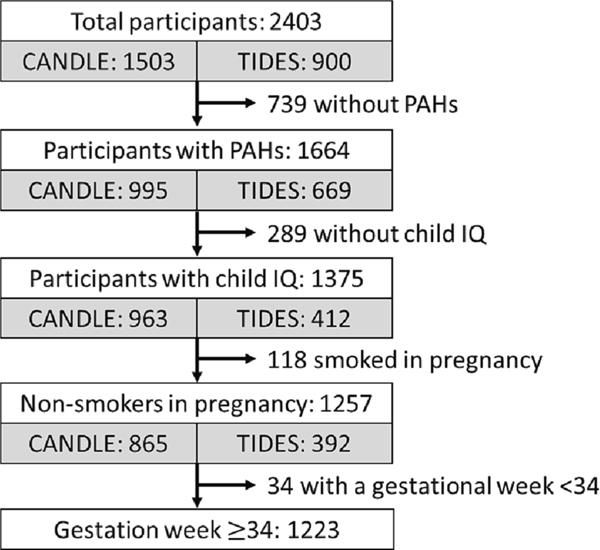
We included mother-child dyads from two pooled prospective pregnancy cohorts (CANDLE and TIDES, N = 1,223) in the ECHO-PATHWAYS Consortium. Seven urinary mono-hydroxylated PAH metabolites were measured in mid-pregnancy in both cohorts as well as early and late pregnancy in TIDES. Child intelligence quotient (IQ) was assessed between ages 4-6. Associations between individual PAH metabolites and IQ were estimated with multivariable linear regression. Interaction terms were used to examine effect modification by child sex and maternal obesity. We explored associations of PAH metabolite mixtures with IQ using weighted quantile sum regression. In TIDES, we averaged PAH metabolites over three periods of pregnancy and by pregnancy period to investigate associations between PAH metabolites and IQ.
RESULTS
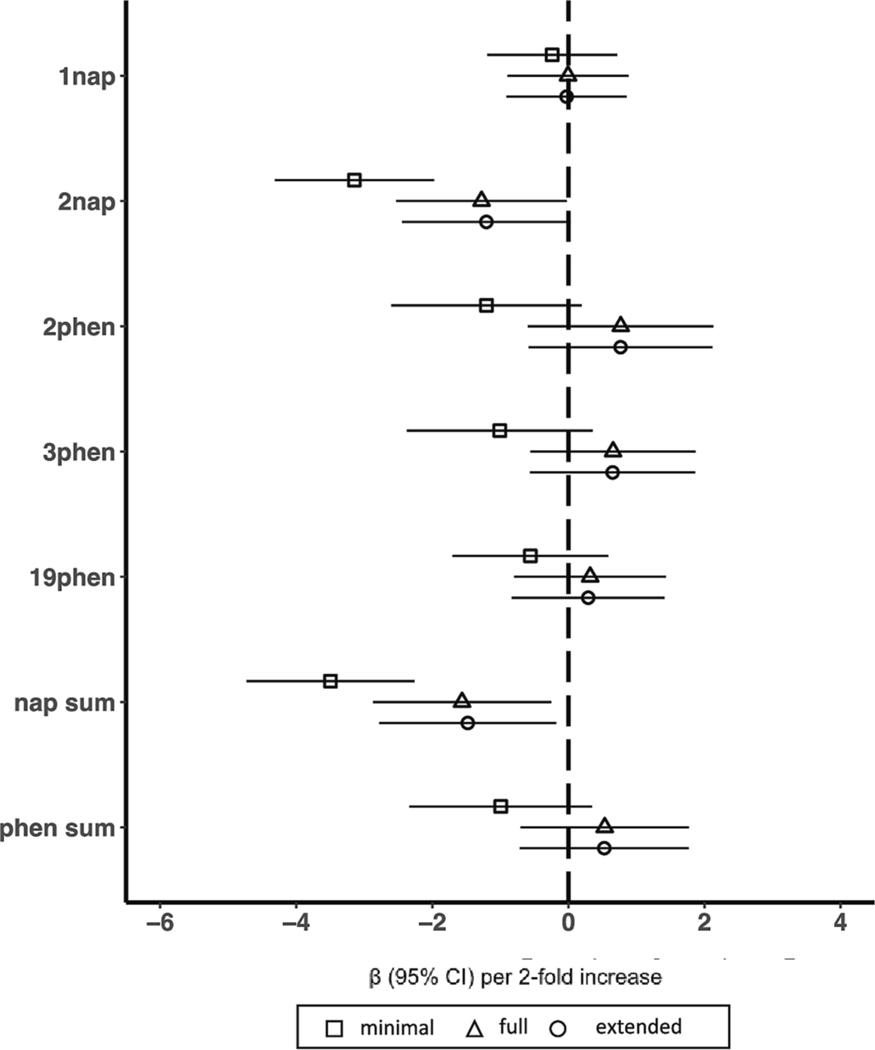
In the combined sample, PAH metabolites were not associated with IQ after full adjustment, nor did we observe associations with PAH mixtures. Tests of effect modification were null except for the association between 2-hydroxynaphthalene and IQ, which was negative in males (β = -0.67 [95%CI:-1.47,0.13]) and positive in females (β = 0.31 [95%CI:-0.52,1.13])(p = 0.04). In analyses across pregnancy (TIDES-only), inverse associations with IQ were observed for 2-hydroxyphenanthrene averaged across pregnancy (β = -1.28 [95%CI:-2.53,-0.03]) and in early pregnancy (β = -1.14 [95%CI:-2.00,-0.28]).
SIGNIFICANCE
In this multi-cohort analysis, we observed limited evidence of adverse associations of early pregnancy PAHs with child IQ. Analyses in the pooled cohorts were null. However, results also indicated that utilizing more than one exposure measures across pregnancy could improve the ability to detect associations by identifying sensitive windows and improving the reliability of exposure measurement. More research with multiple timepoints of PAH assessment is warranted.
背景
关于妊娠期多环芳烃(PAH)暴露与儿童认知不良结局之间的流行病学证据存在差异;对于关键的暴露窗口期知之甚少。
目的
我们在 ECHO-PATHWAYS 联盟的两个大型多地点前瞻性妊娠队列(CANDLE 和 TIDES)中研究了产前 PAH 暴露与儿童认知之间的关系。在这两个队列中,我们在妊娠中期以及 TIDES 队列的妊娠早期和晚期测量了 7 种尿液单羟基 PAH 代谢物。在 4-6 岁之间评估儿童的智商(IQ)。我们使用多变量线性回归估计了单个 PAH 代谢物与 IQ 之间的关系。使用交互项来检验儿童性别和母亲肥胖对效应修饰的影响。我们使用加权分位数总和回归法来探索 PAH 代谢物混合物与 IQ 的关系。在 TIDES 中,我们将 PAH 代谢物在妊娠的三个时期以及每个妊娠时期进行平均处理,以研究 PAH 代谢物与 IQ 之间的关系。
结果
在合并样本中,在充分调整后,PAH 代谢物与 IQ 无关,我们也没有观察到与 PAH 混合物有关的关联。除了 2-羟基萘与 IQ 之间的关联外,其他效应修饰的检验均为阴性,而 2-羟基萘与 IQ 的关联在男性中为负相关(β=-0.67[95%CI:-1.47,0.13]),在女性中为正相关(β=0.31[95%CI:-0.52,1.13])(p=0.04)。在跨孕期的分析(仅限 TIDES)中,我们观察到整个孕期平均的 2-羟基菲(β=-1.28[95%CI:-2.53,-0.03])和孕早期(β=-1.14[95%CI:-2.00,-0.28])与 IQ 呈负相关。
意义
在这项多队列分析中,我们观察到早期妊娠 PAHs 与儿童 IQ 不良结局之间的关联证据有限。在合并队列的分析中为阴性。然而,结果还表明,通过在整个孕期使用多个暴露测量指标,可以通过确定敏感窗口和提高暴露测量的可靠性来提高检测关联的能力。需要进行更多具有多个 PAH 评估时间点的研究。


 Zotero 插件