
感染不同的甲型人流感亚型会影响雪貂对继发性细菌感染的易感性时期。
Infection with different human influenza A subtypes affects the period of susceptibility to secondary bacterial infections in ferrets.
作者信息
Mifsud Edin J, Farrukee Rubaiyea, Hurt Aeron C, Reading Patrick C, Barr Ian G
机构信息
WHO Collaborating Centre for Reference and Research on Influenza, Peter Doherty Institute for Infection and Immunity, Victoria 3010, Australia.
Department of Microbiology and Immunology, Peter Doherty Institute for Infection and Immunity, University of Melbourne, Victoria 3010, Australia.
出版信息
FEMS Microbes. 2022 Apr 29;3:xtac011. doi: 10.1093/femsmc/xtac011. eCollection 2022.
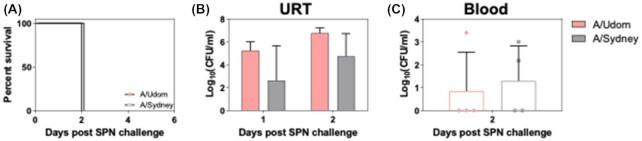
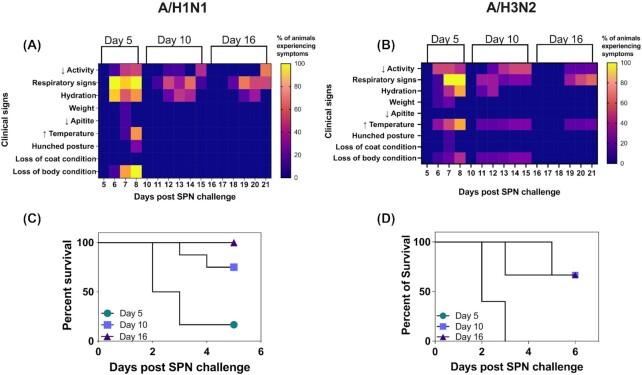
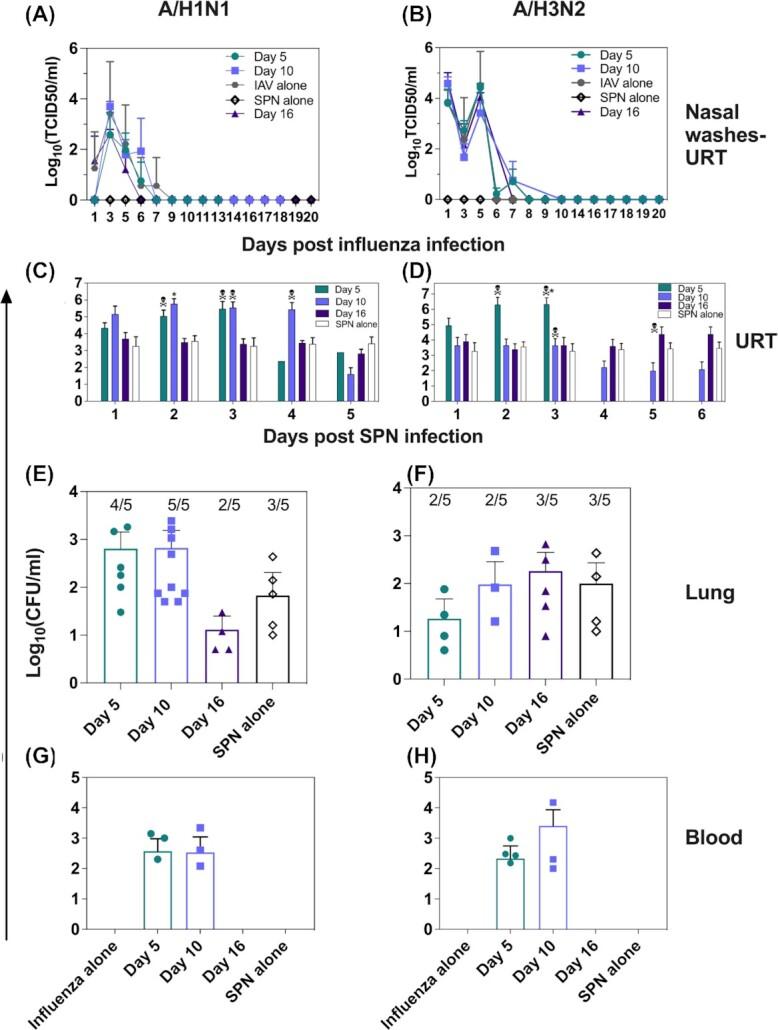
It is well-established that influenza virus infections predispose individuals to secondary bacterial infections (SBIs), which may result in a range of clinical outcomes from relatively mild (e.g. sinusitis and otitis media) to severe (e.g. pneumonia and septicaemia). The most common bacterial pathogen associated with SBI following influenza virus infections is (SPN). Of circulating human seasonal influenza viruses, influenza A viruses (IAV) of both the A(H1N1)pdm09 and A(H3N2) subtypes are associated with severe disease but have differing hospitalisation and complication rates. To study the interplay of these two IAV subtypes with SBI, we used a ferret model of influenza infection followed by secondary challenge with a clinical strain of SPN to determine the severity and the period of susceptibility for SBI. Ferrets challenged with SPN 5 days after infection with A(H3N2) or A(H1N1)pdm09 viruses developed severe disease that required euthanasia. When the time between viral infection and bacterial challenge was extended, A/H1N1pdm09-infected animals remained susceptible to SBI- for up to 10 days after the viral infection. For A(H3N2)- but not A(H1N1)pdm09-infected ferrets, susceptibility to SBI-associated disease could be extended out to 16 days postviral infection. While caution should be taken when extrapolating animal models to human infections, the differences between A(H3N2) and A(H1N1)pdm09 strains in duration of susceptibility to SBI observed in the ferret model, may provide some insight regarding the higher rates of SBI-associated disease associated with some strains of A(H3N2) viruses in humans.
众所周知,流感病毒感染会使个体易患继发性细菌感染(SBI),这可能导致一系列临床结果,从相对轻微的(如鼻窦炎和中耳炎)到严重的(如肺炎和败血症)。流感病毒感染后与SBI相关的最常见细菌病原体是肺炎链球菌(SPN)。在流行的人类季节性流感病毒中,A(H1N1)pdm09和A(H3N2)亚型的甲型流感病毒(IAV)都与严重疾病有关,但住院率和并发症率有所不同。为了研究这两种IAV亚型与SBI之间的相互作用,我们使用了流感感染雪貂模型,随后用临床肺炎链球菌菌株进行二次攻击,以确定SBI的严重程度和易感性时期。用A(H3N2)或A(H1N1)pdm09病毒感染5天后用肺炎链球菌攻击的雪貂出现了需要实施安乐死的严重疾病。当病毒感染和细菌攻击之间的时间延长时,A/H1N1pdm09感染的动物在病毒感染后长达10天仍易患SBI。对于A(H3N2)感染而非A(H1N1)pdm09感染的雪貂,对SBI相关疾病的易感性可延长至病毒感染后16天。虽然将动物模型外推至人类感染时应谨慎,但在雪貂模型中观察到的A(H3N2)和A(H1N1)pdm09菌株在对SBI易感性持续时间上的差异,可能为人类中某些A(H3N2)病毒株与SBI相关疾病的较高发病率提供一些见解。
 Zotero 插件