
在流感相关的继发性细菌感染期间,病毒传播增加会导致更严重的肺损伤,但不会引发炎症。
Increased virus dissemination leads to enhanced lung injury but not inflammation during influenza-associated secondary bacterial infection.
作者信息
Smith Amanda P, Lane Lindey C, Ramirez Zuniga Ivan, Moquin David M, Vogel Peter, Smith Amber M
机构信息
Department of Pediatrics, University of Tennessee Health Science Center, Memphis, TN, United States.
Department of Anesthesiology, Washington University School of Medicine, St. Louis, MO, United States.
出版信息
FEMS Microbes. 2022 Jul 25;3:xtac022. doi: 10.1093/femsmc/xtac022. eCollection 2022.
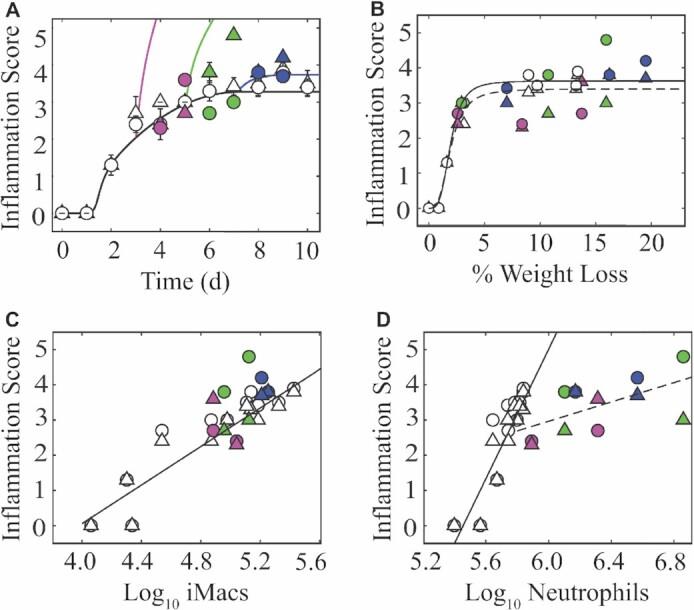
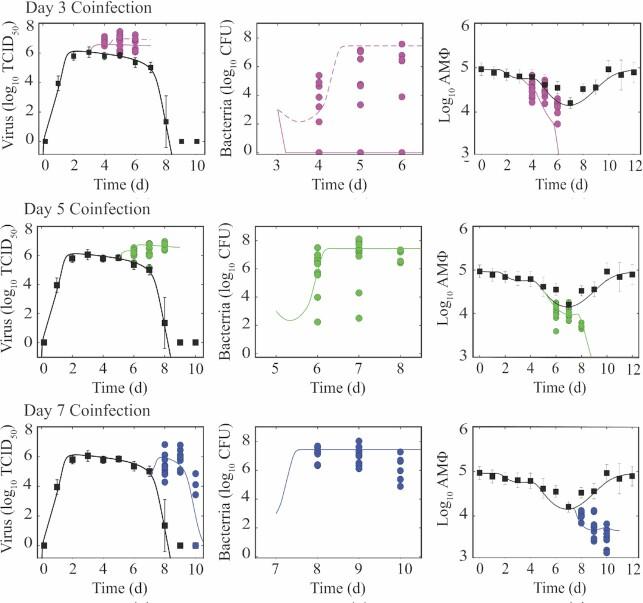
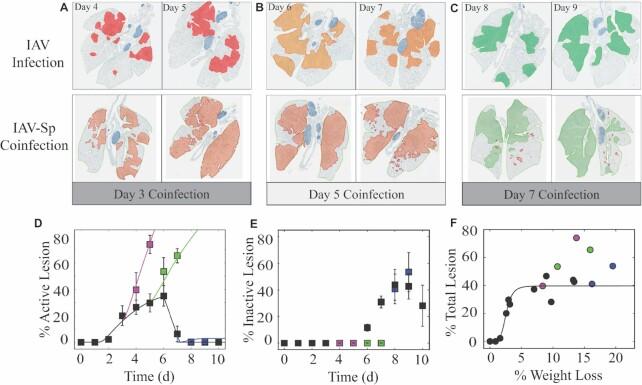
Secondary bacterial infections increase influenza-related morbidity and mortality, particularly if acquired after 5-7 d from the viral onset. Synergistic host responses and direct pathogen-pathogen interactions are thought to lead to a state of hyperinflammation, but the kinetics of the lung pathology have not yet been detailed, and identifying the contribution of different mechanisms to disease is difficult because these may change over time. To address this gap, we examined host-pathogen and lung pathology dynamics following a secondary bacterial infection initiated at different time points after influenza within a murine model. We then used a mathematical approach to quantify the increased virus dissemination in the lung, coinfection time-dependent bacterial kinetics, and virus-mediated and postbacterial depletion of alveolar macrophages. The data showed that viral loads increase regardless of coinfection timing, which our mathematical model predicted and histomorphometry data confirmed was due to a robust increase in the number of infected cells. Bacterial loads were dependent on the time of coinfection and corresponded to the level of IAV-induced alveolar macrophage depletion. Our mathematical model suggested that the additional depletion of these cells following the bacterial invasion was mediated primarily by the virus. Contrary to current belief, inflammation was not enhanced and did not correlate with neutrophilia. The enhanced disease severity was correlated to inflammation, but this was due to a nonlinearity in this correlation. This study highlights the importance of dissecting nonlinearities during complex infections and demonstrated the increased dissemination of virus within the lung during bacterial coinfection and simultaneous modulation of immune responses during influenza-associated bacterial pneumonia.
继发性细菌感染会增加流感相关的发病率和死亡率,尤其是在病毒感染发病5至7天后发生的感染。协同的宿主反应和病原体-病原体之间的直接相互作用被认为会导致一种炎症反应亢进状态,但肺部病理变化的动力学尚未详细阐明,而且由于这些机制可能随时间变化,因此很难确定不同机制对疾病的影响。为了填补这一空白,我们在小鼠模型中研究了流感后不同时间点引发继发性细菌感染后的宿主-病原体及肺部病理动态变化。然后,我们采用数学方法来量化肺部病毒传播的增加、共感染时间依赖性细菌动力学以及病毒介导的和细菌感染后肺泡巨噬细胞的消耗。数据显示,无论共感染时间如何,病毒载量都会增加,我们的数学模型预测并经组织形态计量学数据证实,这是由于受感染细胞数量的强劲增加所致。细菌载量取决于共感染时间,并与IAV诱导的肺泡巨噬细胞消耗水平相对应。我们的数学模型表明,细菌入侵后这些细胞的额外消耗主要由病毒介导。与当前的观点相反,炎症并未增强,也与中性粒细胞增多无关。疾病严重程度的增加与炎症相关,但这是由于这种相关性存在非线性。这项研究强调了在复杂感染过程中剖析非线性的重要性,并证明了在细菌共感染期间肺部病毒传播增加以及在流感相关细菌性肺炎期间免疫反应的同时调节。
 Zotero 插件