
类器官研究中定制水凝胶的最新进展。
Recent advances in defined hydrogels in organoid research.
作者信息
Gan Zhongqiao, Qin Xinyuan, Liu Haitao, Liu Jiayue, Qin Jianhua
机构信息
Division of Biotechnology, Dalian Institute of Chemical Physics, Chinese Academy of Sciences, Dalian, 116023, China.
University of Chinese Academy of Science, Beijing, 100049, China.
出版信息
Bioact Mater. 2023 Jun 13;28:386-401. doi: 10.1016/j.bioactmat.2023.06.004. eCollection 2023 Oct.
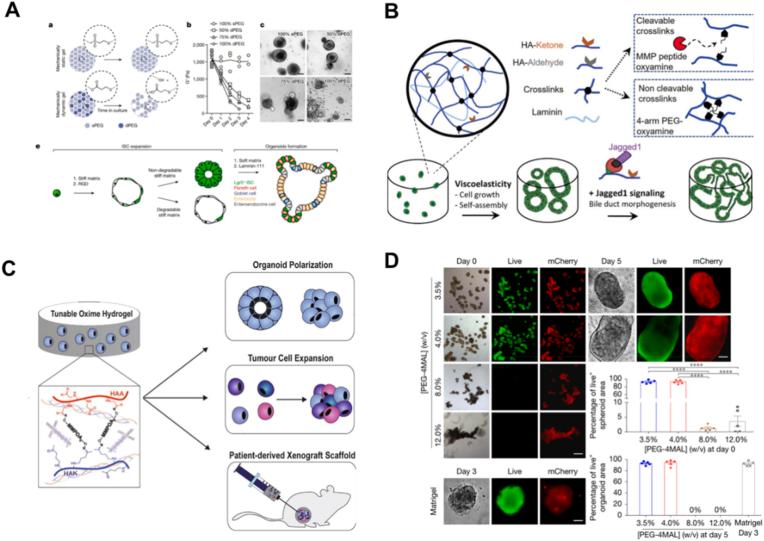
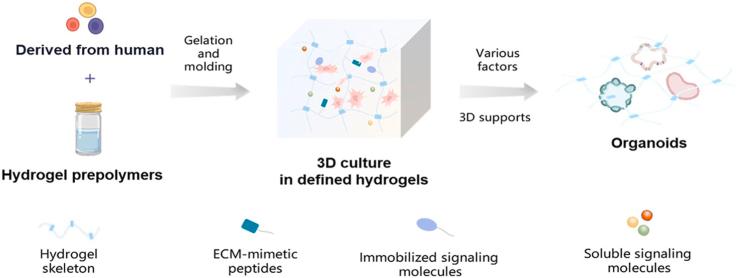
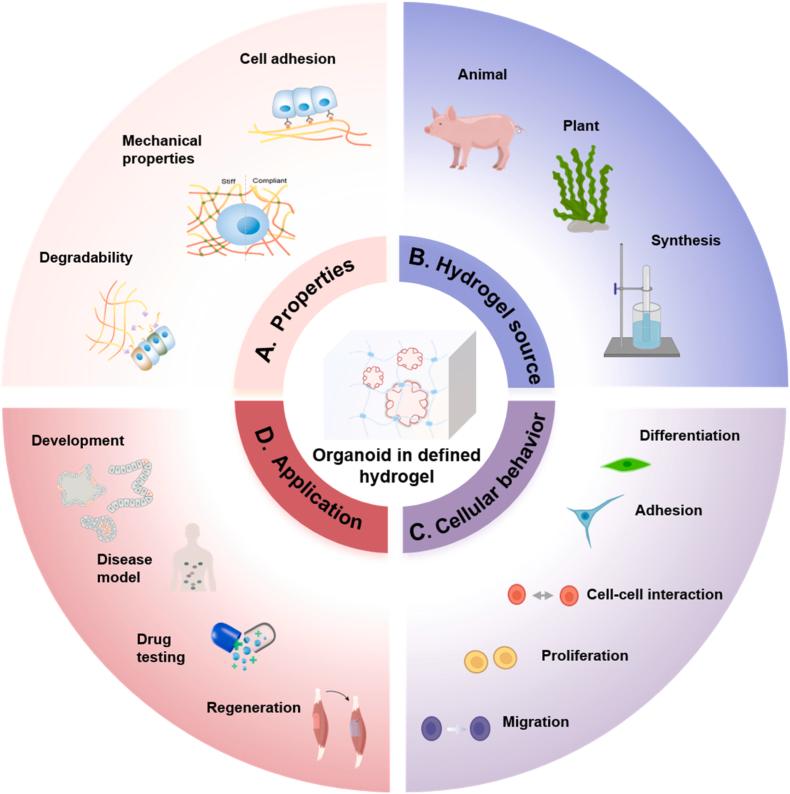
Organoids are in model systems that mimic the complexity of organs with multicellular structures and functions, which provide great potential for biomedical and tissue engineering. However, their current formation heavily relies on using complex animal-derived extracellular matrices (ECM), such as Matrigel. These matrices are often poorly defined in chemical components and exhibit limited tunability and reproducibility. Recently, the biochemical and biophysical properties of defined hydrogels can be precisely tuned, offering broader opportunities to support the development and maturation of organoids. In this review, the fundamental properties of ECM and critical strategies to design matrices for organoid culture are summarized. Two typically defined hydrogels derived from natural and synthetic polymers for their applicability to improve organoids formation are presented. The representative applications of incorporating organoids into defined hydrogels are highlighted. Finally, some challenges and future perspectives are also discussed in developing defined hydrogels and advanced technologies toward supporting organoid research.
类器官存在于模拟具有多细胞结构和功能的器官复杂性的模型系统中,这为生物医学和组织工程提供了巨大潜力。然而,它们目前的形成严重依赖于使用复杂的动物源性细胞外基质(ECM),如基质胶。这些基质的化学成分往往定义不明确,并且表现出有限的可调性和可重复性。最近,可定义水凝胶的生化和生物物理特性可以得到精确调节,为支持类器官的发育和成熟提供了更广泛的机会。在这篇综述中,总结了细胞外基质的基本特性以及设计用于类器官培养的基质的关键策略。介绍了两种典型的由天然和合成聚合物衍生的可定义水凝胶在改善类器官形成方面的适用性。强调了将类器官整合到可定义水凝胶中的代表性应用。最后,还讨论了在开发可定义水凝胶和支持类器官研究的先进技术方面的一些挑战和未来展望。


 Zotero 插件