
1990年至2019年间全球、区域和国家间间皮瘤负担的趋势以及未来二十年的预测。
Global, regional, and national trends in mesothelioma burden from 1990 to 2019 and the predictions for the next two decades.
作者信息
Zhu Wenmin, Liu Jialin, Li Yiling, Shi Ziwei, Wei Sheng
机构信息
Department of Epidemiology and Biostatistics, School of Public Health, Tongji Medical College, Huazhong University of Science and Technology, 13 Hangkong Road, Wuhan, Hubei, 430030, China.
出版信息
SSM Popul Health. 2023 Jun 3;23:101441. doi: 10.1016/j.ssmph.2023.101441. eCollection 2023 Sep.
OBJECTIVES
We aimed to analyze the secular trends in mesothelioma burden, the effect of age, period, and birth cohort, and project the global burden over time.
MATERIAL AND METHODS
Based on the mesothelioma incidence, mortality, and Disability-Adjusted Life Years (DALYs) data from 1990 to 2019 in Global Burden of Diseases (GBD) database, the annual percentage change (APC) and average annual percent change (AAPC), calculated from joinpoint regression model, was used to describe the burden trends. An age-period-cohort model was utilized to disentangle age, period, and birth cohort effects on mesothelioma incidence and mortality trends. The mesothelioma burden was projected by the Bayesian age-period-cohort (BAPC) model.
RESULTS
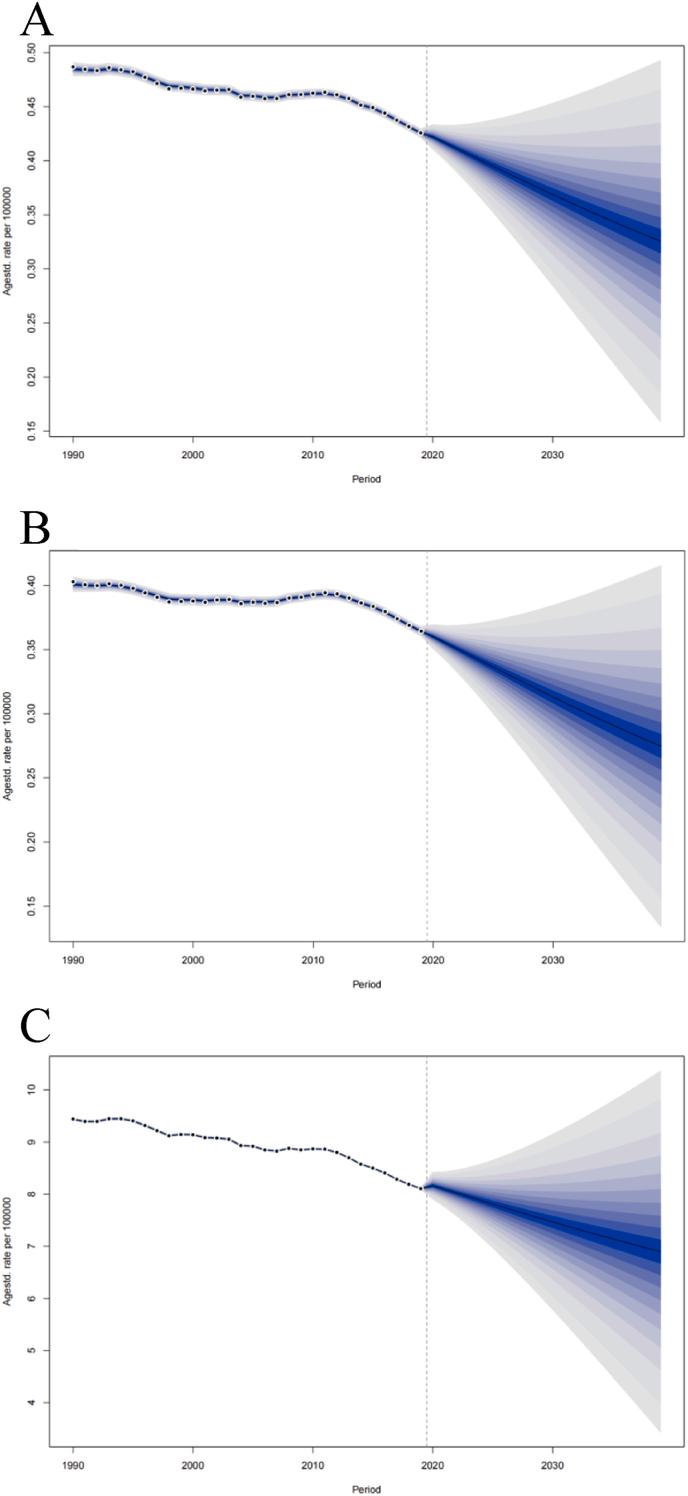
Globally, there were the significant declines in age-standardized incidence rate (ASIR) (AAPC = -0.4, 95%CI: -0.6,-0.3, < 0.001), age-standardized mortality rate (ASMR) (AAPC = -0.3, 95%CI: -0.4,-0.2, < 0.001), and age-standardized DALY rate (ASDR) (AAPC = -0.5, 95%CI: -0.6,-0.4, < 0.001) of mesothelioma overall 30 years. For regions, Central Europe presented the most distinct increases and the most substantial decrease was observed in Andean Latin America on all ASRs (age-standardized rates) from 1990 to 2019. At national level, the largest annualized growth for full-range trends of incidence, mortality, and DALYs was in Georgia. Conversely, the fastest descent of all ASRs was observed in Peru. The ASIR, ASMR, and ASDR in 2039 predicted 0.33, 0.27, and 6.90 per 100,000, respectively.
CONCLUSIONS
The global burden of mesothelioma declined over the past 30 years, with variability across regions and countries/territories, and this trend will continue in the future.
目的
我们旨在分析间皮瘤负担的长期趋势、年龄、时期和出生队列的影响,并预测全球间皮瘤负担随时间的变化。
材料与方法
基于全球疾病负担(GBD)数据库中1990年至2019年间皮瘤的发病率、死亡率和伤残调整生命年(DALYs)数据,采用连接点回归模型计算的年度百分比变化(APC)和平均年度百分比变化(AAPC)来描述负担趋势。利用年龄 - 时期 - 队列模型来剖析年龄、时期和出生队列对间皮瘤发病率和死亡率趋势的影响。通过贝叶斯年龄 - 时期 - 队列(BAPC)模型预测间皮瘤负担。
结果
在全球范围内,30年间皮瘤的年龄标准化发病率(ASIR)(AAPC = -0.4,95%CI:-0.6,-0.3,P < 0.001)、年龄标准化死亡率(ASMR)(AAPC = -0.3,95%CI:-0.4,-0.2,P < 0.001)和年龄标准化伤残调整生命年率(ASDR)(AAPC = -0.5,95%CI:-0.6,-0.4,P < 0.001)均有显著下降。对于各地区,1990年至2019年期间,中欧的所有年龄标准化率(ASRs)呈现出最明显的上升,而安第斯拉丁美洲的下降最为显著。在国家层面,格鲁吉亚的发病率、死亡率和伤残调整生命年的全范围趋势年度增长最大。相反,秘鲁的所有年龄标准化率下降最快。预计2039年的年龄标准化发病率、年龄标准化死亡率和年龄标准化伤残调整生命年率分别为每10万人0.33、0.27和6.90。
结论
过去30年间皮瘤的全球负担有所下降,各地区和国家/地区存在差异,且这一趋势在未来将持续。


 Zotero 插件