
使用三维打印定制假体治疗手足肿瘤切除术后患者的 MSTS 评分和并发症有哪些?
What Are the MSTS Scores and Complications Associated With the Use of Three-dimensional Printed, Custom-made Prostheses in Patients Who Had Resection of Tumors of the Hand and Foot?
机构信息
Department of Orthopaedic Surgery, Faculty of Medicine, Siriraj Hospital, Mahidol University, Bangkok, Thailand.
Department of Orthopaedics, Phramongkutklao Hospital and College of Medicine, Bangkok, Thailand.
出版信息
Clin Orthop Relat Res. 2023 Nov 1;481(11):2223-2235. doi: 10.1097/CORR.0000000000002730. Epub 2023 Jun 20.
BACKGROUND
There are a few good options for restoring bone defects in the hand and foot. 3D-printed implants have been used in the pelvis and elsewhere, but to our knowledge, they have not been evaluated in the hand and foot. The functional outcome, complications, and longevity of 3D-printed prostheses in small bones are not well known.
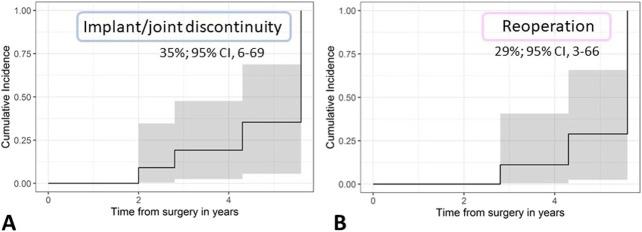
QUESTIONS/PURPOSES: (1) What are the functional outcomes of patients with hand or foot tumors who were treated with tumor resection and reconstruction with a 3D-printed custom prosthesis? (2) What complications are associated with using these prostheses? (3) What is the 5-year Kaplan-Meier cumulative incidence of implant breakage and reoperation?
METHODS
Between January 2017 and October 2020, we treated 276 patients who had tumors of the hands or feet. Of those, we considered as potentially eligible patients who might have extensive loss in their joint that could not be fixed with a bone graft, cement, or any prostheses available on the market. Based on this, 93 patients were eligible; a further 77 were excluded because they received nonoperative treatment such as chemoradiation, resection without reconstruction, reconstruction using other materials, or ray amputation; another three were lost before the minimum study follow-up of 2 years and two had incomplete datasets, leaving 11 for analysis in this retrospective study. There were seven women and four men. The median age was 29 years (range 11 to 71 years). There were five hand tumors and six tumors of the feet. Tumor types were giant cell tumor of bone (five), chondroblastoma (two), osteosarcoma (two), neuroendocrine tumor (one), and squamous cell carcinoma (one). Margin status after resection was ≥ 1 mm. All patients were followed for a minimum of 24 months. The median follow-up time was 47 months (range 25 to 67 months). Clinical data; function according to the Musculoskeletal Tumor Society, DASH, and American Orthopedic Foot and Ankle Society scores; complications; and survivorship of implants were recorded during follow-up in the clinic, or patients with complete charts and recorded data were interviewed on the telephone by our research associates, orthopaedic oncology fellows, or the surgeons who performed the surgery. The cumulative incidence of implant breakage and reoperation was assessed using a Kaplan-Meier analysis.
RESULTS
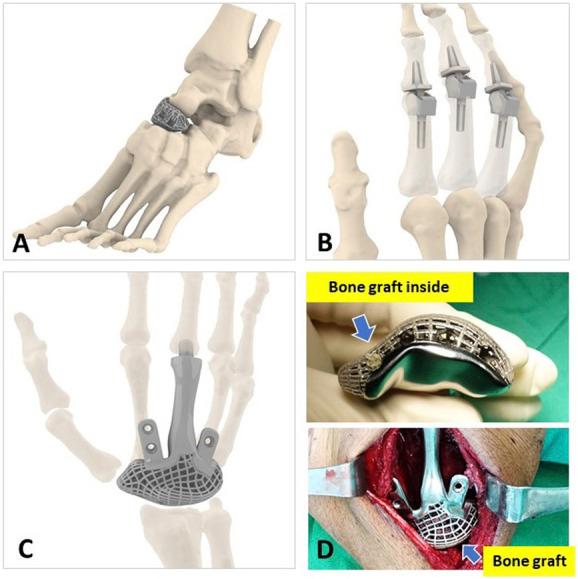
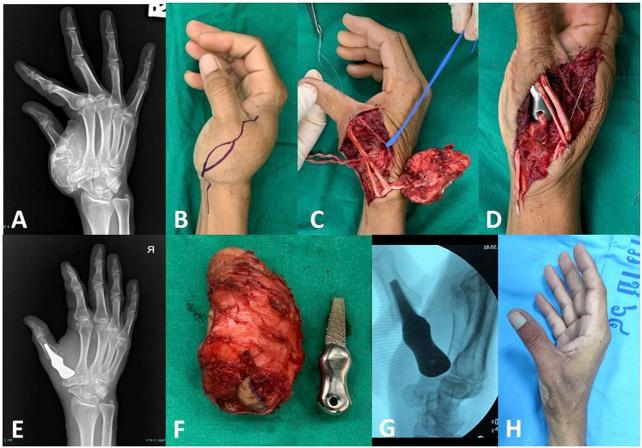
The median Musculoskeletal Tumor Society score was 28 of 30 (range 21 to 30). Seven of 11 patients experienced postoperative complications, primarily including hyperextension deformity and joint stiffness (three patients), joint subluxation (two), aseptic loosening (one), broken stem (one), and broken plate (one), but no infection or local recurrence occurred. Subluxations of the metacarpophalangeal and proximal interphalangeal joints in two patients' hands were caused by the design of the prosthesis without a joint or stem. These prostheses were revised to a second-generation prosthesis with joint and stem, leading to improved dexterity. The cumulative incidence of implant breakage and reoperation in the Kaplan-Meier analysis was 35% (95% CI 6% to 69%) and 29% (95% CI 3% to 66%) at 5 years, respectively.
CONCLUSION
These preliminary findings suggest that 3D implants may be an option for reconstruction after resections that leave large bone and joint defects in the hand and foot. Although the functional results generally appeared to be good to excellent, complications and reoperations were frequent; thus, we believe this approach could be considered when patients have few or no alternatives other than amputation. Future studies will need to compare this approach to bone grafting or bone cementation.
LEVEL OF EVIDENCE
Level IV, therapeutic study.
背景
在手和脚的骨缺损修复方面有几种较好的选择。3D 打印植入物已用于骨盆和其他部位,但据我们所知,尚未在手部和足部进行评估。在小骨中,3D 打印假体的功能结果、并发症和长期效果尚不清楚。
问题/目的:(1)接受 3D 打印定制假体肿瘤切除和重建治疗的手部和足部肿瘤患者的功能结果如何?(2)使用这些假体有哪些并发症?(3)假体断裂和再次手术的 5 年 Kaplan-Meier 累积发生率是多少?
方法
2017 年 1 月至 2020 年 10 月,我们治疗了 276 例手部或足部肿瘤患者。其中,我们认为可能存在广泛关节丧失的患者有资格接受治疗,这些患者的关节丧失无法通过骨移植、水泥或市场上任何现有的假体固定。基于此,93 名患者符合条件;另有 77 名患者因接受非手术治疗(如放化疗、切除后未重建、使用其他材料重建或射线截肢)而被排除在外;另外 3 名患者在至少 2 年的最低研究随访前丢失,2 名患者数据集不完整,因此 11 名患者被纳入本回顾性研究进行分析。其中有 7 名女性和 4 名男性。中位年龄 29 岁(范围 11 至 71 岁)。手部肿瘤 5 例,足部肿瘤 6 例。肿瘤类型为骨巨细胞瘤(5 例)、软骨母细胞瘤(2 例)、骨肉瘤(2 例)、神经内分泌肿瘤(1 例)和鳞状细胞癌(1 例)。切除后切缘≥1mm。所有患者均至少随访 24 个月。中位随访时间为 47 个月(范围 25 至 67 个月)。在门诊随访中记录临床数据、肌肉骨骼肿瘤学会评分、DASH 评分和美国矫形足踝协会评分、并发症和植入物的生存率,或通过我们的研究助理、骨科肿瘤研究员或进行手术的外科医生对有完整病历和记录数据的患者进行电话访谈。使用 Kaplan-Meier 分析评估假体断裂和再次手术的累积发生率。
结果
肌肉骨骼肿瘤学会评分中位数为 30 分(范围 21 至 30 分)。11 名患者中有 7 名发生术后并发症,主要包括过伸畸形和关节僵硬(3 名患者)、关节半脱位(2 名患者)、无菌性松动(1 名患者)、假体柄断裂(1 名患者)和假体板断裂(1 名患者),但无感染或局部复发。两名手部患者的掌指关节和近侧指间关节半脱位是由于假体无关节或假体柄设计所致。这些假体被修改为带有关节和假体柄的第二代假体,从而提高了灵活性。在 Kaplan-Meier 分析中,假体断裂和再次手术的累积发生率分别为 35%(95%CI 6%至 69%)和 29%(95%CI 3%至 66%),在 5 年时。
结论
这些初步结果表明,3D 植入物可能是手部和足部大骨和关节缺损切除后重建的一种选择。尽管功能结果通常表现为良好至优秀,但并发症和再次手术很常见;因此,我们认为当患者除截肢外别无选择时,可以考虑这种方法。未来的研究需要将这种方法与骨移植或骨水泥固定进行比较。
证据水平
IV 级,治疗性研究。

 Zotero 插件