
手术口罩对儿童与成人的生理影响。
Physiologic effects of surgical masking in children versus adults.
机构信息
School of Anesthesia, Missouri State University, Springfield, Missouri, United States.
Department of Biomedical Sciences, Missouri State University, Springfield, Missouri, United States.
出版信息
PeerJ. 2023 Jun 16;11:e15474. doi: 10.7717/peerj.15474. eCollection 2023.
BACKGROUND
Surgical masks remain a focal part of the CDC guidelines to decrease COVID-19 transmission. Evidence refuting significant effects of masking on ventilation is mostly limited to small studies, with a paucity of studies on children, and none comparing children to adults.
METHODS
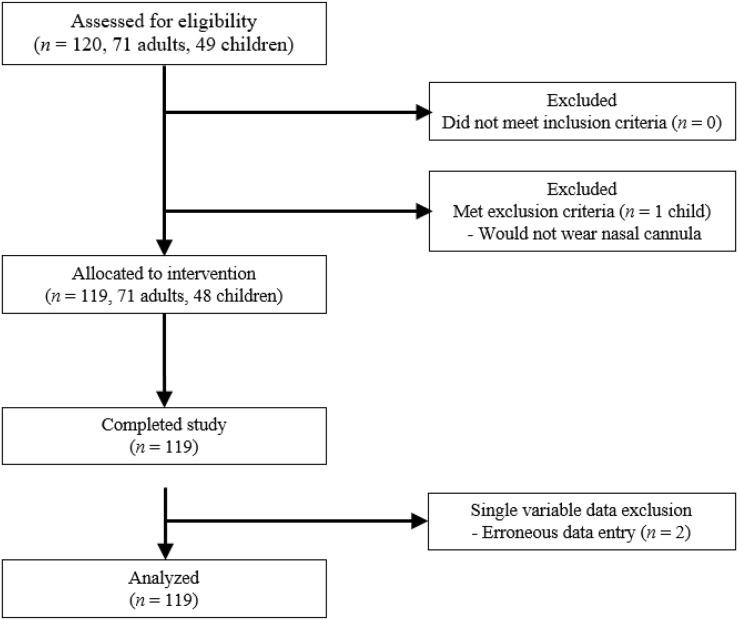
A total of 119 subjects were enrolled (71 adults, 49 children) in a prospective interventional study with each subject serving as their own mask-free control. End tidal CO2 (ETCO2), inspired CO2 (ICO2), and respiratory rate were measured by nasal cannula attached to an anesthesia machine D-fend module. Pulse oximetry and heart rate were also followed. After the mask-free period, an ASTM Level 3 disposable surgical mask was donned and 15 min of mask-worn data were collected.
RESULTS
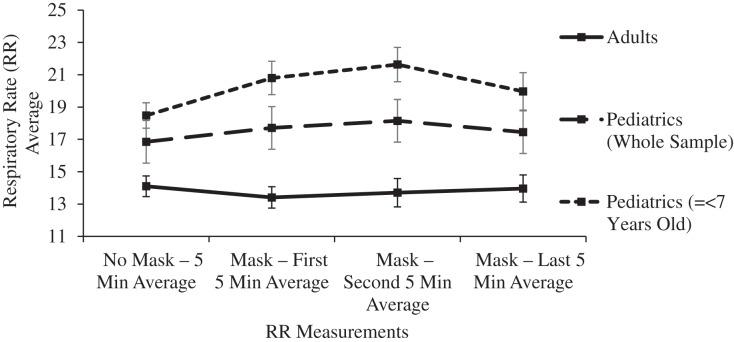
A steady state was confirmed for ETCO2 and ICO2 over the masked period, and mean ICO2 levels rose significantly ( < 0.001) after masking in all age groups. The increase in ICO2 for the 2- to 7-year-old group of 4.11 mmHg (3.23-4.99), was significantly higher ( < 0.001) than the final ΔICO2 levels for both the 7- to 14-year-old group, 2.45 mmHg (1.79-3.12), and adults, 1.47 mmHg (1.18-1.76). For the pediatric group there was a negative, significant correlation between age and ΔICO2, r = -0.49, < 0.001. Masking resulted in a statistically significant ( < 0.01) rise in ETCO2 levels of 1.30 mmHg in adults and 1.36 mmHg in children. The final respective ETCO2 levels, 34.35 (33.55-35.15) and 35.07 (34.13-36.01), remained within normal limits. Pulse oximetry, heart rate, and respiratory rate were not significantly affected.
DISCUSSION
The physiology of mechanical dead space is discussed, including the inverse relationship of subject age ICO2. The methodology and results are compared to previously published studies which detracted from the physiologic safety of surgical masking.
CONCLUSIONS
The wearing of a surgical mask results in a statistically significant rise in ICO2 and a smaller rise in ETCO2. Because ETCO2 and other variables remain well within normal limits, these changes are clinically insignificant.
背景
外科口罩仍然是疾控中心降低 COVID-19 传播指南的重点部分。反驳口罩对通风有显著影响的证据主要局限于小型研究,针对儿童的研究很少,且没有将儿童与成人进行比较。
方法
本前瞻性干预研究共纳入 119 名受试者(71 名成人,49 名儿童),每名受试者均作为自身的无口罩对照。通过附在麻醉机 D-fend 模块上的鼻插管测量呼气末二氧化碳(ETCO2)、吸入二氧化碳(ICO2)和呼吸频率。同时还监测脉搏血氧饱和度和心率。无口罩期结束后,戴上 ASTM 级别 3 一次性外科口罩,收集 15 分钟的口罩佩戴数据。
结果
在戴口罩期间,ETCO2 和 ICO2 达到稳定状态,所有年龄段的 ICO2 水平在戴口罩后均显著升高(<0.001)。2 至 7 岁组的 ICO2 升高 4.11mmHg(3.23-4.99),明显高于 7 至 14 岁组的最终 ΔICO2 水平 2.45mmHg(1.79-3.12)和成人组的 1.47mmHg(1.18-1.76)。对于儿科组,年龄与 ΔICO2 呈负相关,r=-0.49,<0.001。口罩导致成人 ETCO2 水平升高 1.30mmHg(<0.01),儿童升高 1.36mmHg(<0.01)。最终的 ETCO2 水平分别为 34.35(33.55-35.15)和 35.07(34.13-36.01),仍在正常范围内。脉搏血氧饱和度、心率和呼吸频率无明显变化。
讨论
讨论了机械无效腔的生理学,包括受试者年龄与 ICO2 的反比关系。方法和结果与先前发表的研究进行了比较,这些研究削弱了外科口罩的生理安全性。
结论
佩戴外科口罩会导致 ICO2 显著升高,ETCO2 略有升高。由于 ETCO2 和其他变量仍在正常范围内,这些变化在临床上无意义。




 Zotero 插件