
前哨淋巴结活检(SLNB)阳性黑色素瘤患者的当前治疗趋势和生存模式:一项全国多中心研究
The Current Treatment Trends and Survival Patterns in Melanoma Patients with Positive Sentinel Lymph Node Biopsy (SLNB): A Multicenter Nationwide Study.
作者信息
Ziętek Marcin, Teterycz Paweł, Wierzbicki Jędrzej, Jankowski Michał, Las-Jankowska Manuela, Zegarski Wojciech, Piekarski Janusz, Nejc Dariusz, Drucis Kamil, Cybulska-Stopa Bożena, Łobaziewicz Wojciech, Galwas Katarzyna, Kamińska-Winciorek Grażyna, Zdzienicki Marcin, Sryukina Tatsiana, Ziobro Anna, Kluz Agnieszka, Czarnecka Anna M, Rutkowski Piotr
机构信息
Department of Oncology, Wroclaw Medical University, 50-367 Wroclaw, Poland.
Department of Surgical Oncology, Lower Silesian Oncology, Pulmonology and Hematology Center, 53-413 Wroclaw, Poland.
出版信息
Cancers (Basel). 2023 May 9;15(10):2667. doi: 10.3390/cancers15102667.
BACKGROUND
In melanoma treatment, an approach following positive sentinel lymph node biopsy (SLNB) has been recently deescalated from completion lymph node dissection (CLND) to active surveillance based on phase III trials data. In this study, we aim to evaluate treatment strategies in SLNB-positive melanoma patients in real-world practice.
METHODS
Five-hundred-fifty-seven melanoma SLNB-positive patients from seven comprehensive cancer centers treated between 2017 and 2021 were included. Kaplan-Meier methods and the Cox Proportional-Hazards Model were used for analysis.
RESULTS
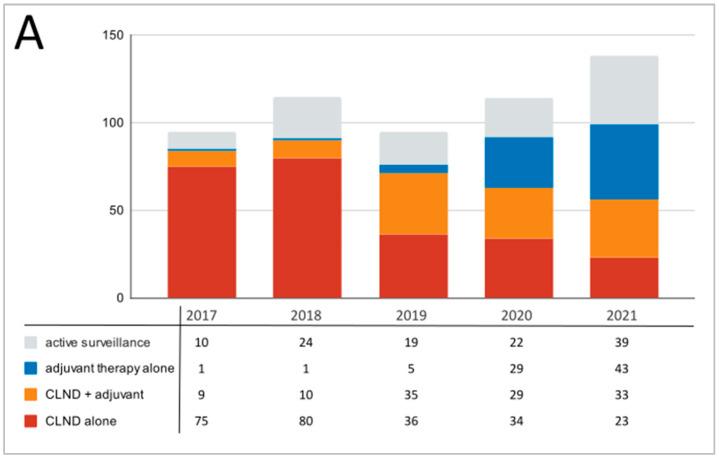
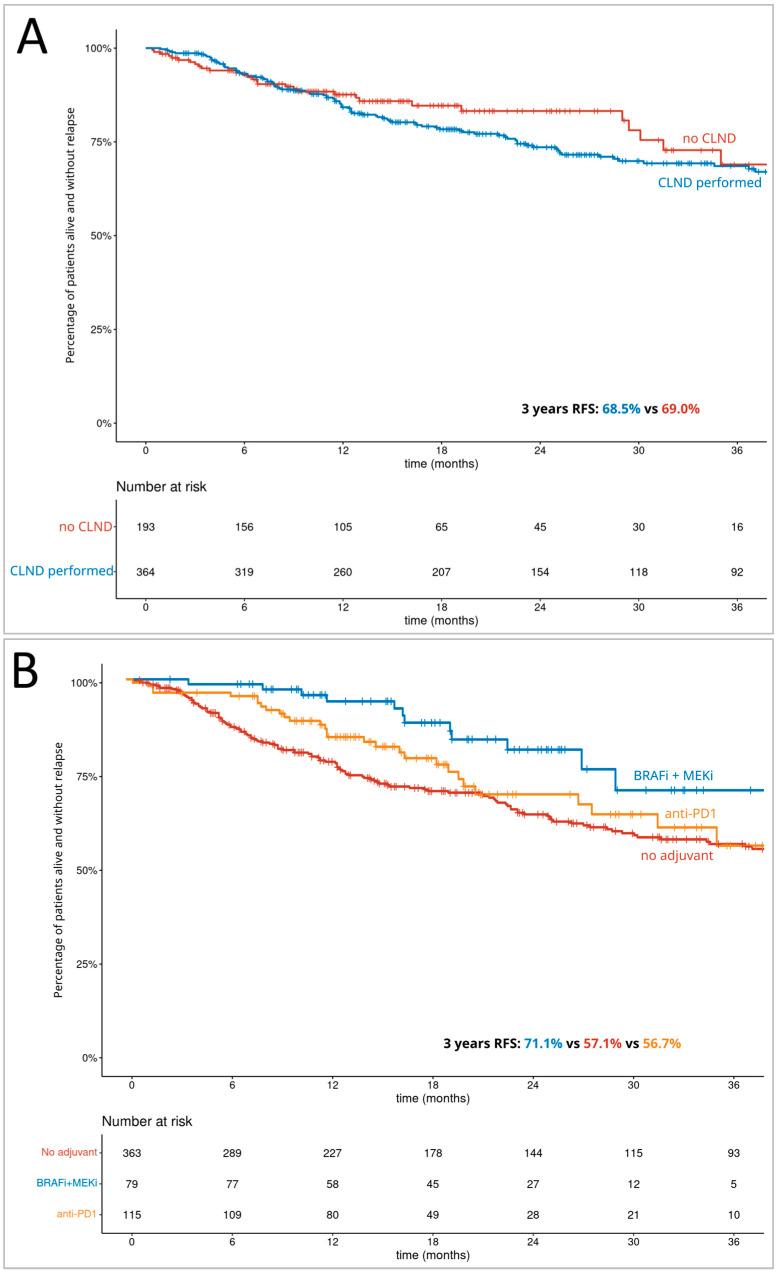
The median follow-up was 25 months. Between 2017 and 2021, the percentage of patients undergoing CLND decreased (88-41%), while the use of adjuvant treatment increased (11-51%). The 3-year OS and RFS rates were 77.9% and 59.6%, respectively. Adjuvant therapy prolonged RFS (HR:0.69, 0.036)), but CLND did not (HR:1.22, 0.272). There were no statistically significant differences in OS for either adjuvant systemic treatment or CLND. Lower progression risk was also found, and time-dependent hazard ratios estimation in patients treated with systemic adjuvant therapy was confirmed (HR:0.20, 0.002 for BRAF inhibitors and HR:0.50, 0.015 for anti-PD-1 inhibitors).
CONCLUSIONS
Treatment of SLNB-positive melanoma patients is constantly evolving, and the role of surgery is currently rather limited. Whether CLND has been performed or not, in a group of SLNB-positive patients, adjuvant systemic treatment should be offered to all eligible patients.
背景
在黑色素瘤治疗中,基于III期试验数据,前哨淋巴结活检(SLNB)阳性后的治疗方法最近已从完全淋巴结清扫术(CLND)降级为主动监测。在本研究中,我们旨在评估现实世界中SLNB阳性黑色素瘤患者的治疗策略。
方法
纳入了2017年至2021年间在七个综合癌症中心接受治疗的557例SLNB阳性黑色素瘤患者。采用Kaplan-Meier方法和Cox比例风险模型进行分析。
结果
中位随访时间为25个月。在2017年至2021年间,接受CLND的患者百分比下降(88%-41%),而辅助治疗的使用增加(11%-51%)。3年总生存率(OS)和无复发生存率(RFS)分别为77.9%和59.6%。辅助治疗延长了RFS(风险比[HR]:0.69,P = 0.036),但CLND未延长(HR:1.22,P = 0.272)。辅助全身治疗或CLND的OS均无统计学显著差异。还发现进展风险较低,并证实了接受全身辅助治疗患者的时间依赖性风险比估计(BRAF抑制剂的HR:0.20,P = 0.002;抗PD-1抑制剂的HR:0.50,P = 0.015)。
结论
SLNB阳性黑色素瘤患者的治疗在不断发展,目前手术的作用相当有限。无论是否进行了CLND,在一组SLNB阳性患者中,都应向所有符合条件的患者提供辅助全身治疗。

 Zotero 插件