
用于结直肠癌管理中CMS分类的分子效用原则
Principles of Molecular Utility for CMS Classification in Colorectal Cancer Management.
作者信息
Rejali Leili, Seifollahi Asl Romina, Sanjabi Fatemeh, Fatemi Nayeralsadat, Asadzadeh Aghdaei Hamid, Saeedi Niasar Mahsa, Ketabi Moghadam Pardis, Nazemalhosseini Mojarad Ehsan, Mini Enrico, Nobili Stefania
机构信息
Basic and Molecular Epidemiology of Gastrointestinal Disorders Research Center, Research Institute for Gastroenterology and Liver Diseases, Shahid Beheshti University of Medical Sciences, Tehran P.O. Box 19875-17411, Iran.
Department of Medical Biotechnology, School of Allied Medicine, Iran University of Medical Sciences, Tehran P.O. Box 14496-14535, Iran.
出版信息
Cancers (Basel). 2023 May 13;15(10):2746. doi: 10.3390/cancers15102746.
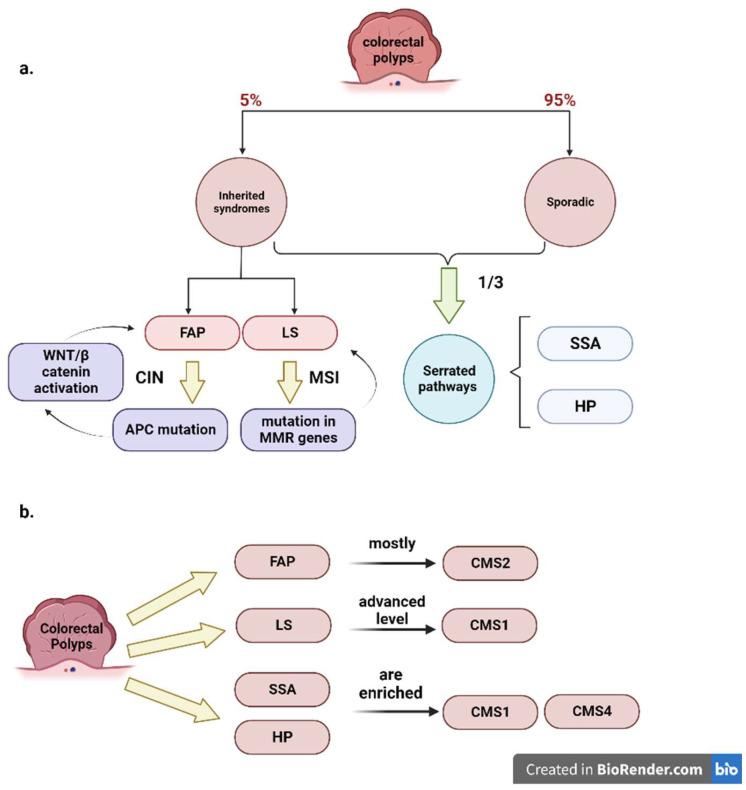
Colorectal cancer (CRC) is the second cause of cancer-related deaths in both sexes globally and presents different clinical outcomes that are described by a range of genomic and epigenomic alterations. Despite the advancements in CRC screening plans and treatment strategies, the prognosis of CRC is dismal. In the last two decades, molecular biomarkers predictive of prognosis have been identified in CRC, although biomarkers predictive of treatment response are only available for specific biological drugs used in stage IV CRC. Translational clinical trials mainly based on "omic" strategies allowed a better understanding of the biological heterogeneity of CRCs. These studies were able to classify CRCs into subtypes mainly related to prognosis, recurrence risk, and, to some extent, also to treatment response. Accordingly, the comprehensive molecular characterizations of CRCs, including The Cancer Genome Atlas (TCGA) and consensus molecular subtype (CMS) classifications, were presented to improve the comprehension of the genomic and epigenomic landscapes of CRCs for a better patient management. The CMS classification obtained by the CRC subtyping consortium categorizes CRC into four consensus molecular subtypes (CMS1-4) characterized by different prognoses. In this review, we discussed the CMS classification in different settings with a focus on its relationships with precursor lesions, tumor immunophenotype, and gut microbiota, as well as on its role in predicting prognosis and/or response to pharmacological treatments, as a crucial step towards precision medicine.
结直肠癌(CRC)是全球男女癌症相关死亡的第二大原因,呈现出由一系列基因组和表观基因组改变所描述的不同临床结果。尽管CRC筛查计划和治疗策略取得了进展,但其预后仍然不佳。在过去二十年中,已在CRC中鉴定出预测预后的分子生物标志物,尽管仅对于IV期CRC中使用的特定生物药物才有预测治疗反应的生物标志物。主要基于“组学”策略的转化临床试验使人们对CRC的生物学异质性有了更好的理解。这些研究能够将CRC分为主要与预后、复发风险以及在一定程度上还与治疗反应相关的亚型。因此,提出了CRC的全面分子特征,包括癌症基因组图谱(TCGA)和共识分子亚型(CMS)分类,以提高对CRC基因组和表观基因组格局的理解,从而实现更好的患者管理。由CRC亚型研究联盟获得的CMS分类将CRC分为四种具有不同预后特征的共识分子亚型(CMS1 - 4)。在本综述中,我们讨论了不同情况下的CMS分类,重点关注其与癌前病变、肿瘤免疫表型和肠道微生物群的关系,以及其在预测预后和/或对药物治疗反应中的作用,这是迈向精准医学的关键一步。

 Zotero 插件