
利用空间转录组学解析哺乳动物生殖。
Dissecting mammalian reproduction with spatial transcriptomics.
机构信息
Cecil H. and Ida Green Center for Reproductive Biology Sciences, University of Texas Southwestern Medical Center, Dallas, TX, USA.
Department of Obstetrics and Gynecology, University of Texas Southwestern Medical Center, Dallas, TX, USA.
出版信息
Hum Reprod Update. 2023 Nov 2;29(6):794-810. doi: 10.1093/humupd/dmad017.
BACKGROUND
Mammalian reproduction requires the fusion of two specialized cells: an oocyte and a sperm. In addition to producing gametes, the reproductive system also provides the environment for the appropriate development of the embryo. Deciphering the reproductive system requires understanding the functions of each cell type and cell-cell interactions. Recent single-cell omics technologies have provided insights into the gene regulatory network in discrete cellular populations of both the male and female reproductive systems. However, these approaches cannot examine how the cellular states of the gametes or embryos are regulated through their interactions with neighboring somatic cells in the native tissue environment owing to tissue disassociations. Emerging spatial omics technologies address this challenge by preserving the spatial context of the cells to be profiled. These technologies hold the potential to revolutionize our understanding of mammalian reproduction.
OBJECTIVE AND RATIONALE
We aim to review the state-of-the-art spatial transcriptomics (ST) technologies with a focus on highlighting the novel biological insights that they have helped to reveal about the mammalian reproductive systems in the context of gametogenesis, embryogenesis, and reproductive pathologies. We also aim to discuss the current challenges of applying ST technologies in reproductive research and provide a sneak peek at what the field of spatial omics can offer for the reproduction community in the years to come.
SEARCH METHODS
The PubMed database was used in the search for peer-reviewed research articles and reviews using combinations of the following terms: 'spatial omics', 'fertility', 'reproduction', 'gametogenesis', 'embryogenesis', 'reproductive cancer', 'spatial transcriptomics', 'spermatogenesis', 'ovary', 'uterus', 'cervix', 'testis', and other keywords related to the subject area. All relevant publications until April 2023 were critically evaluated and discussed.
OUTCOMES
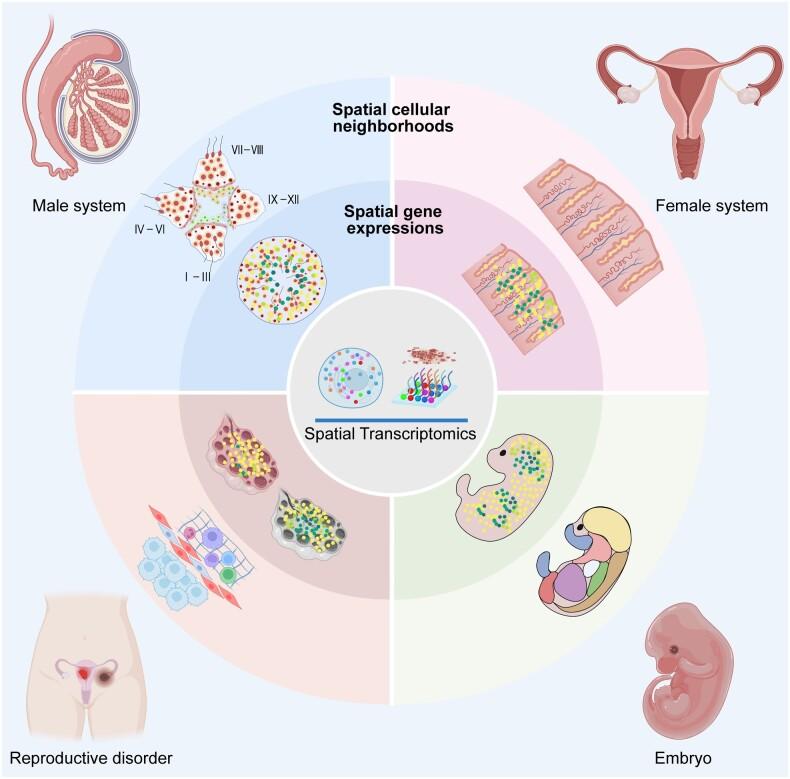
First, an overview of the ST technologies that have been applied to studying the reproductive systems was provided. The basic design principles and the advantages and limitations of these technologies were discussed and tabulated to serve as a guide for researchers to choose the best-suited technologies for their own research. Second, novel biological insights into mammalian reproduction, especially human reproduction revealed by ST analyses, were comprehensively reviewed. Three major themes were discussed. The first theme focuses on genes with non-random spatial expression patterns with specialized functions in multiple reproductive systems; The second theme centers around functionally interacting cell types which are often found to be spatially clustered in the reproductive tissues; and the thrid theme discusses pathological states in reproductive systems which are often associated with unique cellular microenvironments. Finally, current experimental and computational challenges of applying ST technologies to studying mammalian reproduction were highlighted, and potential solutions to tackle these challenges were provided. Future directions in the development of spatial omics technologies and how they will benefit the field of human reproduction were discussed, including the capture of cellular and tissue dynamics, multi-modal molecular profiling, and spatial characterization of gene perturbations.
WIDER IMPLICATIONS
Like single-cell technologies, spatial omics technologies hold tremendous potential for providing significant and novel insights into mammalian reproduction. Our review summarizes these novel biological insights that ST technologies have provided while shedding light on what is yet to come. Our review provides reproductive biologists and clinicians with a much-needed update on the state of art of ST technologies. It may also facilitate the adoption of cutting-edge spatial technologies in both basic and clinical reproductive research.
背景
哺乳动物的繁殖需要两个特化细胞的融合:卵子和精子。除了产生配子外,生殖系统还为胚胎的适当发育提供了环境。破译生殖系统需要了解每种细胞类型的功能和细胞间的相互作用。最近的单细胞组学技术为我们提供了关于雄性和雌性生殖系统离散细胞群的基因调控网络的见解。然而,由于组织分离,这些方法无法研究配子或胚胎的细胞状态如何通过与原生组织环境中的邻近体细胞相互作用来调节。新兴的空间组学技术通过保留要分析的细胞的空间背景来解决这一挑战。这些技术有可能彻底改变我们对哺乳动物繁殖的理解。
目的和理由
我们旨在回顾空间转录组学(ST)技术的最新进展,重点强调它们在配子发生、胚胎发生和生殖病理学背景下对哺乳动物生殖系统所揭示的新的生物学见解。我们还旨在讨论在生殖研究中应用 ST 技术的当前挑战,并预览空间组学领域在未来几年将为生殖界带来的好处。
搜索方法
使用 PubMed 数据库,结合以下术语搜索同行评审的研究文章和综述:“空间组学”、“生育力”、“生殖”、“配子发生”、“胚胎发生”、“生殖癌症”、“空间转录组学”、“精子发生”、“卵巢”、“子宫”、“子宫颈”、“睾丸”和其他与主题领域相关的关键词。对所有相关出版物进行了批判性评估和讨论,直到 2023 年 4 月。
结果
首先,提供了已应用于研究生殖系统的 ST 技术概述。讨论了这些技术的基本设计原则以及它们的优点和局限性,并将其制成表格,作为研究人员为自己的研究选择最合适技术的指南。其次,全面综述了 ST 分析揭示的哺乳动物繁殖的新生物学见解,尤其是人类繁殖。讨论了三个主要主题。第一个主题侧重于具有专门功能的基因在多个生殖系统中具有非随机的空间表达模式;第二个主题围绕功能上相互作用的细胞类型展开,这些细胞类型通常在生殖组织中发现是空间聚类的;第三个主题讨论了生殖系统中的病理状态,这些状态通常与独特的细胞微环境有关。最后,强调了在应用 ST 技术研究哺乳动物繁殖方面当前的实验和计算挑战,并提供了应对这些挑战的潜在解决方案。讨论了空间组学技术的未来发展方向以及它们将如何使人类生殖领域受益,包括捕获细胞和组织动态、多模式分子分析以及基因扰动的空间特征。
广泛影响
与单细胞技术一样,空间组学技术在为哺乳动物繁殖提供重要的新见解方面具有巨大潜力。我们的综述总结了 ST 技术提供的这些新的生物学见解,同时也揭示了未来的发展方向。我们的综述为生殖生物学家和临床医生提供了急需的关于 ST 技术最新进展的更新。它还可能促进在基础和临床生殖研究中采用最先进的空间技术。


 Zotero 插件