
现在是医疗机构投资发展锻炼项目,将其作为标准护理的一部分的时候了": 一项多案例研究,旨在探讨实施肿瘤运动干预措施。
"Now is the time for institutions to be investing in growing exercise programs as part of standard of care": a multiple case study examining the implementation of exercise oncology interventions.
机构信息
Mary MacKillop Institute for Health Research, Australian Catholic University, Melbourne, Victoria, Australia.
Faculty of Medicine and Health, University of Sydney, Sydney, New South Wales, Australia.
出版信息
Support Care Cancer. 2023 Jun 26;31(7):422. doi: 10.1007/s00520-023-07844-x.
BACKGROUND
Implementation science seeks to systematically identify determinants, strategies, and outcomes within a causal pathway to help explain successful implementation. This process is applied to evidence-based interventions (EBIs) to improve their adoption, implementation, and sustainment. However, this method has not been applied to exercise oncology services, meaning we lack knowledge about implementing exercise EBIs in routine practice. This study aimed to develop causal pathways from the determinants, strategies (including mechanism of change), and implementation outcomes to explain exercise EBIs implementation in routine cancer care.
METHODS
A multiple-case study was conducted across three healthcare sites in Australia. Sites selected had implemented exercise within routine care for people diagnosed with cancer and sustained the delivery of services for at least 12 months. Four data sources informed the study: semi-structured interviews with staff, document reviews, observations, and the Program Sustainability Assessment Tool (survey). Framework analysis was applied to understand the findings. The Implementation Research Logic Model was used to identify commonalities in implementation across sites and develop causal pathways.
RESULTS
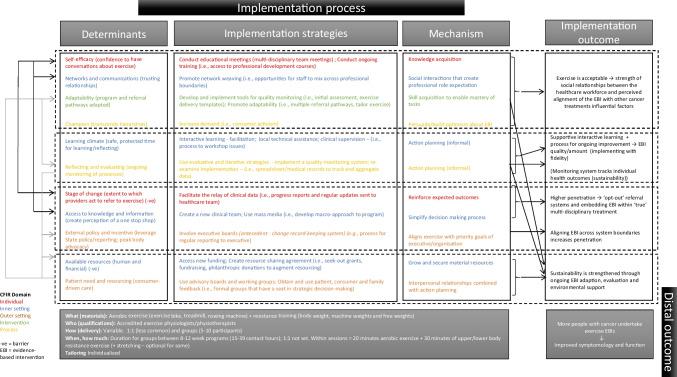
Two hundred and eighteen data points informed our findings. Across sites, 18 determinants and 22 implementation strategies were consistent. Sixteen determinants and 24 implementation strategies differed across sites and results of implementation outcomes varied. We identified 11 common pathways that when combined, help explain implementation processes. The mechanisms of implementation strategies operating within the pathways included (1) knowledge, (2) skills, (3) secure resources, (4) optimism, and (5) simplified decision-making processes associated with exercise; (6) relationships (social and professional) and support for the workforce; (7) reinforcing positive outcomes; (8) capability to action plan through evaluations and (9) interactive learning; (10) aligned goals between the organisation and the EBI; and (11) consumer-responsiveness.
CONCLUSION
This study developed causal pathways that explain the how and why of successful implementation of exercise EBIs in cancer care. These findings can support future planning and optimisation activities by creating more opportunities for people with cancer to access evidence-based exercise oncology services.
IMPLICATIONS FOR CANCER SURVIVORS
Understanding how to implement exercise within routine cancer care successfully is important so cancer survivors can experience the benefits of exercise.
背景
实施科学旨在系统地确定因果途径中的决定因素、策略和结果,以帮助解释成功实施的原因。该方法适用于循证干预措施(EBIs),以提高其采用、实施和维持的效果。然而,这种方法尚未应用于运动肿瘤学服务,这意味着我们缺乏在常规实践中实施运动 EBI 的知识。本研究旨在从决定因素、策略(包括变化机制)和实施结果中制定因果途径,以解释常规癌症护理中实施运动 EBI。
方法
在澳大利亚的三个医疗保健地点进行了多案例研究。选择的地点已经在常规护理中为癌症患者实施了运动,并至少持续了 12 个月的服务提供。有四个数据源为研究提供信息:员工的半结构化访谈、文件审查、观察和计划可持续性评估工具(调查)。应用框架分析来理解研究结果。实施研究逻辑模型用于识别各地点实施的共同之处并制定因果途径。
结果
有 218 个数据点为我们的研究结果提供了信息。在各个地点,有 18 个决定因素和 22 个实施策略是一致的。16 个决定因素和 24 个实施策略在各地点存在差异,实施结果也有所不同。我们确定了 11 条共同途径,这些途径结合在一起有助于解释实施过程。实施策略在途径中运作的机制包括(1)知识,(2)技能,(3)安全资源,(4)乐观,(5)与运动相关的简化决策过程;(6)与劳动力相关的关系(社会和专业)和支持;(7)加强积极成果;(8)通过评估和(9)互动学习制定行动计划的能力;(10)组织和 EBI 之间目标的一致性;(11)消费者响应能力。
结论
本研究制定了因果途径,解释了成功实施癌症护理中运动 EBI 的原因和方式。这些发现可以通过为癌症患者提供更多获得循证运动肿瘤学服务的机会来支持未来的规划和优化活动。
对癌症幸存者的影响
了解如何成功地在常规癌症护理中实施运动对于癌症幸存者体验运动的益处非常重要。

 Zotero 插件