
补充营养援助计划的获得情况与粮食不安全方面的种族差异。
Supplemental Nutrition Assistance Program Access and Racial Disparities in Food Insecurity.
机构信息
Johns Hopkins School of Nursing, Baltimore, Maryland.
Division of Nephrology, Johns Hopkins School of Medicine, Baltimore, Maryland.
出版信息
JAMA Netw Open. 2023 Jun 1;6(6):e2320196. doi: 10.1001/jamanetworkopen.2023.20196.
IMPORTANCE
Racially minoritized people experience disproportionately high rates of food insecurity. The Supplemental Nutrition Assistance Program (SNAP) reduces food insecurity.
OBJECTIVE
To evaluate SNAP access with regard to racial disparities in food insecurity.
DESIGN, SETTING, AND PARTICIPANTS: This cross-sectional study used data from the 2018 Survey of Income and Program Participation (SIPP). On the basis of random sampling strategies, 44 870 households were eligible for the SIPP, and 26 215 (58.4%) participated. Sampling weights accounted for survey design and nonresponse. Data were analyzed from February 25 to December 12, 2022.
EXPOSURES
This study examined disparities based on household racial composition (entirely Asian, entirely Black, entirely White, and multiple races or multirace based on SIPP categories).
MAIN OUTCOMES AND MEASURES
Food insecurity during the prior year was measured using the validated 6-item US Department of Agriculture Food Security Survey Module. SNAP participation during the prior year was classified based on whether anyone in the household received SNAP benefits. Modified Poisson regression tested hypothesized disparities in food insecurity.
RESULTS
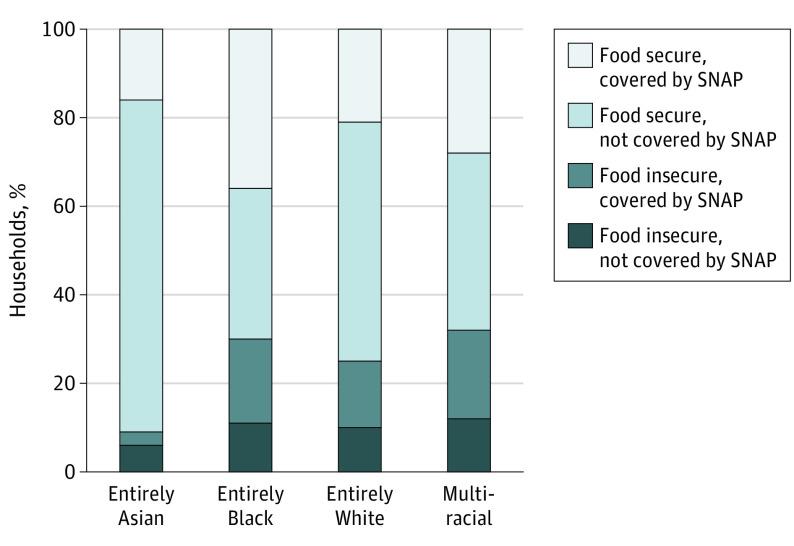
A total of 4974 households that were eligible for SNAP (income ≤130% of the poverty threshold) were included in this study. A total of 218 households (5%) were entirely Asian, 1014 (22%) were entirely Black, 3313 (65%) were entirely White, and 429 (8%) were multiracial or of other racial groups. Adjusting for household characteristics, households that were entirely Black (prevalence rate [PR], 1.18; 95% CI, 1.04-1.33) or multiracial (PR, 1.25; 95% CI, 1.06-1.46) were more likely to be food insecure than entirely White households, but associations differed depending on SNAP participation. Among households that did not participate in SNAP, those that were entirely Black (PR, 1.52; 97.5% CI, 1.20-1.93) or multiracial (PR, 1.42; 97.5% CI, 1.04-1.94) were more likely to be food insecure than White households; however, among SNAP participants, Black households were less likely than White households to be food insecure (PR, 0.84; 97.5% CI, 0.71-0.99).
CONCLUSIONS AND RELEVANCE
In this cross-sectional study, racial disparities in food insecurity were found among low-income households that do not participate in SNAP but not among those that do, suggesting that access to SNAP should be improved. These results also highlight the need to examine the structural and systemic racism in food systems and in access to food assistance that may contribute to disparities.
重要性
少数族裔人群经历不成比例的高粮食不安全率。补充营养援助计划(SNAP)可减少粮食不安全。
目的
评估 SNAP 准入与粮食不安全方面的种族差异。
设计、地点和参与者:本横断面研究使用了 2018 年收入和计划参与调查(SIPP)的数据。根据随机抽样策略,有 44870 户家庭符合 SIPP 的条件,其中 26215 户(58.4%)参与了调查。抽样权重考虑了调查设计和无回应。数据于 2022 年 2 月 25 日至 12 月 12 日进行分析。
暴露
本研究根据家庭种族构成(完全亚裔、完全非裔、完全白人,以及基于 SIPP 类别的多种族或多族裔)来检查差异。
主要结果和措施
使用经验证的美国农业部 6 项食品安全调查模块,对前一年的粮食不安全情况进行了衡量。在前一年中,根据家庭中是否有人获得 SNAP 福利,对 SNAP 参与情况进行了分类。修正后的泊松回归检验了粮食不安全方面的假设差异。
结果
本研究共纳入了 4974 户符合 SNAP 条件(收入≤贫困线 130%)的家庭。共有 218 户(5%)为完全亚裔,1014 户(22%)为完全非裔,3313 户(65%)为完全白人,429 户(8%)为多种族或其他种族群体。调整家庭特征后,与完全白人家庭相比,完全非裔(流行率 [PR],1.18;95%CI,1.04-1.33)或多种族(PR,1.25;95%CI,1.06-1.46)的家庭更有可能粮食不安全,但关联取决于 SNAP 的参与情况。在未参与 SNAP 的家庭中,完全非裔(PR,1.52;97.5%CI,1.20-1.93)或多种族(PR,1.42;97.5%CI,1.04-1.94)的家庭比白人家庭更有可能粮食不安全;然而,在 SNAP 参与者中,非裔家庭比白人家庭更不可能粮食不安全(PR,0.84;97.5%CI,0.71-0.99)。
结论和相关性
在这项横断面研究中,未参与 SNAP 的低收入家庭中存在粮食不安全方面的种族差异,但参与 SNAP 的家庭则没有这种差异,这表明应该改善 SNAP 的获取。这些结果还强调需要检查粮食系统和获得粮食援助方面的结构性和系统性种族主义,这些因素可能导致了差异。
 Zotero 插件