
AMD 患者血浆末端补体复合物水平升高:对 RPE 细胞的潜在功能影响。
Increased plasma level of terminal complement complex in AMD patients: potential functional consequences for RPE cells.
机构信息
Department of Ophthalmology, University Hospital Leipzig, Leipzig, Germany.
Experimental Ophthalmology, Department of Ophthalmology, Charité - Universitätsmedizin Berlin, Corporate Member of Freie Universität, Berlin Institute of Health, Humboldt-University, Berlin, Germany.
出版信息
Front Immunol. 2023 Jun 8;14:1200725. doi: 10.3389/fimmu.2023.1200725. eCollection 2023.
PURPOSE
Polymorphisms in complement genes are risk-associated for age-related macular degeneration (AMD). Functional analysis revealed a common deficiency to control the alternative complement pathway by risk-associated gene polymorphisms. Thus, we investigated the levels of terminal complement complex (TCC) in the plasma of wet AMD patients with defined genotypes and the impact of the complement activation of their plasma on second-messenger signaling, gene expression, and cytokine/chemokine secretion in retinal pigment epithelium (RPE) cells.
DESIGN
Collection of plasma from patients with wet AMD (n = 87: 62% female and 38% male; median age 77 years) and controls (n = 86: 39% female and 61% male; median age 58 years), grouped for risk factor smoking and genetic risk alleles 402HH and rs3750846, determination of TCC levels in the plasma, analysis on RPE function during exposure to patients' or control plasma as a complement source.
METHODS
Genotyping, measurement of TCC concentrations, ARPE-19 cell culture, Ca imaging, gene expression by qPCR, secretion by multiplex bead analysis of cell culture supernatants.
MAIN OUTCOME MEASURES
TCC concentration in plasma, intracellular free Ca, relative mRNA levels, cytokine secretion.
RESULTS
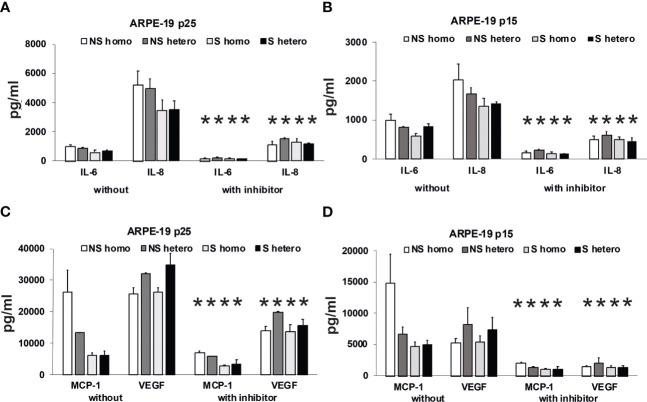
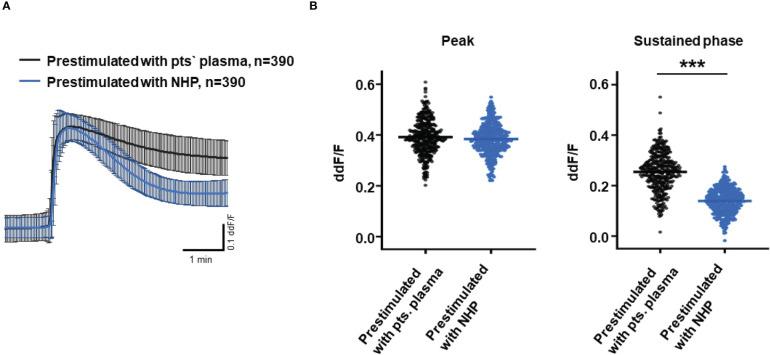
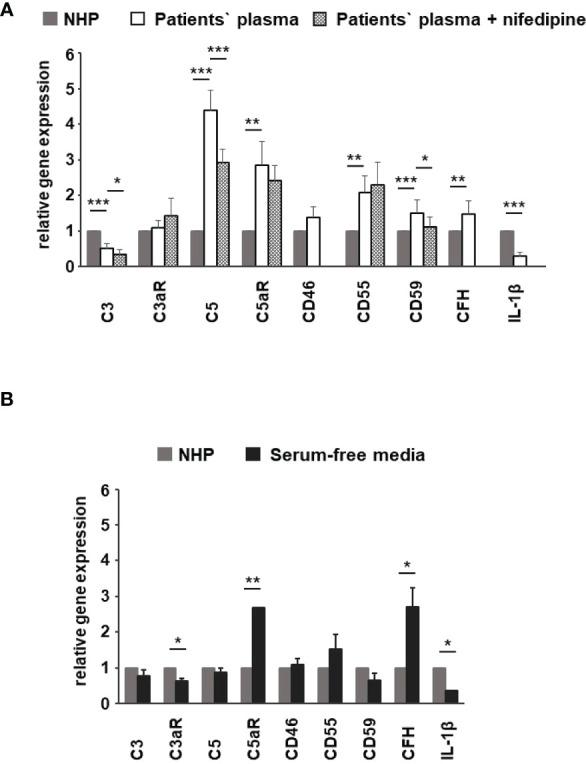
TCC levels in the plasma of AMD patients were five times higher than in non-AMD controls but did not differ in plasma from carriers of the two risk alleles. Complement-evoked Ca elevations in RPE cells differed between patients and controls with a significant correlation between TCC levels and peak amplitudes. Comparing the Ca signals, only between the plasma of smokers and non-smokers, as well as heterozygous () and patients, revealed differences in the late phase. Pre-stimulation with complement patients' plasma led to sensitization for complement reactions by RPE cells. Gene expression for surface molecules protective against TCC and pro-inflammatory cytokines increased after exposure to patients' plasma. Patients' plasma stimulated the secretion of pro-inflammatory cytokines in the RPE.
CONCLUSION
TCC levels were higher in AMD patients but did not depend on genetic risk factors. The Ca responses to patients' plasma as second-messenger represent a shift of RPE cells to a pro-inflammatory phenotype and protection against TCC. We conclude a substantial role of high TCC plasma levels in AMD pathology.
目的
补体基因多态性与年龄相关性黄斑变性(AMD)相关。功能分析显示,风险相关基因多态性导致补体替代途径的控制普遍不足。因此,我们研究了具有明确基因型的湿性 AMD 患者血浆中的末端补体复合物(TCC)水平,以及其血浆中补体激活对视网膜色素上皮(RPE)细胞中二信使信号、基因表达和细胞因子/趋化因子分泌的影响。
设计
收集 87 例湿性 AMD 患者(62%为女性,38%为男性;中位年龄 77 岁)和 86 例对照者(39%为女性,61%为男性;中位年龄 58 岁)的血浆,根据危险因素吸烟和遗传风险等位基因 402HH 和 rs3750846 分组,测定血浆中的 TCC 水平,分析作为补体来源的患者或对照者血浆暴露于 RPE 功能的情况。
方法
基因分型,TCC 浓度测定,ARPE-19 细胞培养,钙成像,qPCR 基因表达,细胞培养上清液的多重珠分析细胞因子分泌。
主要观察指标
血浆 TCC 浓度、细胞内游离 Ca、相对 mRNA 水平、细胞因子分泌。
结果
AMD 患者的血浆 TCC 水平是非 AMD 对照者的五倍,但携带两个风险等位基因的患者血浆中 TCC 水平没有差异。RPE 细胞中补体诱导的 Ca 升高在患者和对照者之间存在差异,TCC 水平与峰值幅度之间存在显著相关性。仅在吸烟者和非吸烟者之间以及杂合子()和 患者之间比较 Ca 信号,在晚期阶段才会出现差异。用患者的血浆预先刺激会导致 RPE 细胞对补体反应敏感。暴露于患者血浆后,表面分子的基因表达增加,这些表面分子对 TCC 有保护作用,并能促进促炎细胞因子的产生。患者的血浆刺激 RPE 分泌促炎细胞因子。
结论
AMD 患者的 TCC 水平较高,但不依赖于遗传危险因素。作为第二信使的患者血浆 Ca 反应代表 RPE 细胞向促炎表型的转变,并对 TCC 有保护作用。我们得出结论,高 TCC 血浆水平在 AMD 发病机制中具有重要作用。
 Zotero 插件