
寄宿学校女生中鼻咽拭子和唾液标本对严重急性呼吸综合征冠状病毒2(SARS-CoV-2)病毒检测的敏感性
Sensitivity of nasopharyngeal swab and saliva specimens in the detection of SARS-CoV-2 virus among boarding school girls.
作者信息
Devina Clara, Nasution Badai Buana, Kusumawati R Lia, Daulay Rini Savitri, Trisnawati Yunnie, Lubis Inke Nadia Diniyanti
机构信息
Department of Paediatrics, Faculty of Medicine, Universitas Sumatera Utara, Medan, Indonesia.
Department of Clinical Microbiology, Faculty of Medicine, Universitas Sumatera Utara, Medan, Indonesia.
出版信息
IJID Reg. 2023 May 4;8(Suppl):S13-7. doi: 10.1016/j.ijregi.2023.02.009.
OBJECTIVES
With the reopening of schools, the detection of coronavirus disease 2019 (COVID-19) in children is very important in order to prevent outbreaks in schools and to reduce the risk of more severe post-COVID-19 complications. Various specimens can be used to detect the SARS-CoV-2 virus, and saliva has been considered as an alternative specimen in adults. However, data in children are lacking, especially among the female population. This study compared the efficacy of saliva specimens with nasopharyngeal swab specimens for the detection of severe acute respiratory syndrome coronavirus-2 using reverse transcriptase polymerase chain reaction.
METHODS
This study evaluated the diagnostic performance of saliva among boarding school girls at three time points: diagnosis, and days 7 and 14 since first confirmation using a nasopharyngeal swab specimen. Eighty-four paired samples from 36 individuals were compared. Nasopharyngeal samplings were carried out by trained health officers, while saliva samplings were performed independently by children.
RESULTS
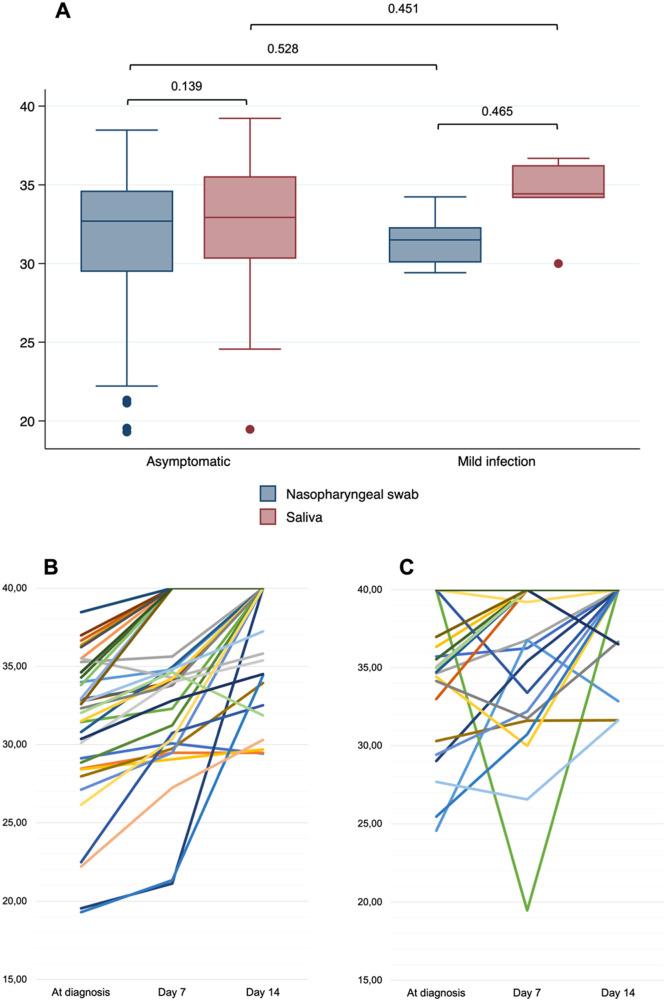
The overall percentage agreement (OPA) between saliva and nasopharyngeal swabs was 50.2%. The OPA was 52.8% at diagnosis, and this increased slightly to 54.2% at day 7, and subsequently decreased to 45.8% at day 14. Saliva specimens had sensitivity of 44.6%, specificity of 80.0%, positive predictive value of 94.2% and negative predictive value of 16.3% compared with nasopharyngeal swab specimens for the diagnosis of COVID-19.
CONCLUSIONS
The use of saliva as an alternative specimen for the diagnosis of COVID-19 in children should be considered carefully. Thorough sampling instructions should be given in order to minimize bias in the findings.
目的
随着学校重新开学,检测儿童新型冠状病毒肺炎(COVID-19)对于预防学校爆发疫情以及降低COVID-19后出现更严重并发症的风险非常重要。可使用多种标本检测严重急性呼吸综合征冠状病毒2(SARS-CoV-2)病毒,唾液已被视为成人的一种替代标本。然而,儿童方面的数据缺乏,尤其是女性群体。本研究比较了唾液标本与鼻咽拭子标本使用逆转录聚合酶链反应检测SARS-CoV-2的效果。
方法
本研究在三个时间点评估了寄宿学校女生唾液的诊断性能:诊断时、首次使用鼻咽拭子标本确诊后的第7天和第14天。比较了来自36名个体的84对样本。鼻咽采样由训练有素的卫生官员进行,而唾液采样由儿童独立完成。
结果
唾液与鼻咽拭子之间的总体一致性百分比(OPA)为50.2%。诊断时OPA为52.8%,第7天略有增加至54.2%,随后在第14天降至45.8%。与鼻咽拭子标本相比,唾液标本诊断COVID-19的敏感性为44.6%,特异性为80.0%,阳性预测值为94.2%,阴性预测值为16.3%。
结论
应谨慎考虑将唾液作为儿童COVID-19诊断的替代标本。应给出详细的采样说明,以尽量减少结果中的偏差。

 Zotero 插件