
与姑息性骨转移放射治疗和当代姑息性系统治疗后长期前列腺癌生存相关的因素:一项回顾性、基于人群的研究。
Factors Associated with Long-Term Prostate Cancer Survival after Palliative Radiotherapy to a Bone Metastasis and Contemporary Palliative Systemic Therapy: A Retrospective, Population-Based Study.
机构信息
Section of Radiation Oncology, Department of Radiology, Max Rady Faculty of Health Sciences, University of Manitoba, Winnipeg, MB R3E 0V9, Canada.
Department of Radiation Oncology, Kidwai Memorial Institute of Oncology, Bangalore 560029, India.
出版信息
Curr Oncol. 2023 Jun 9;30(6):5560-5573. doi: 10.3390/curroncol30060420.
BACKGROUND
Radiation therapy (RT) is an established palliative treatment for bone metastases; however, little is known about post-radiation survival and factors which impact it. The aim of this study was to assess a population-based sample of metastatic prostate cancer patients receiving palliative radiation therapy to bone metastases and contemporary palliative systemic therapy and identify factors that impact long-term survival.
MATERIALS/METHODS: This retrospective, population-based, cohort study assessed all prostate cancer patients receiving palliative RT for bone metastases at a Canadian provincial Cancer program during a contemporary time period. Baseline patient, disease, and treatment characteristics were extracted from the provincial medical physics databases and the electronic medical record. Post-RT Survival intervals were defined as the time interval from the first fraction of palliative RT to death from any cause or date of the last known follow-up. The median survival of the cohort was used to dichotomize the cohort into short- and long-term survivors following RT. Univariable and multivariable hazard regression analyses were performed to identify variables associated with post-RT survival.
RESULTS
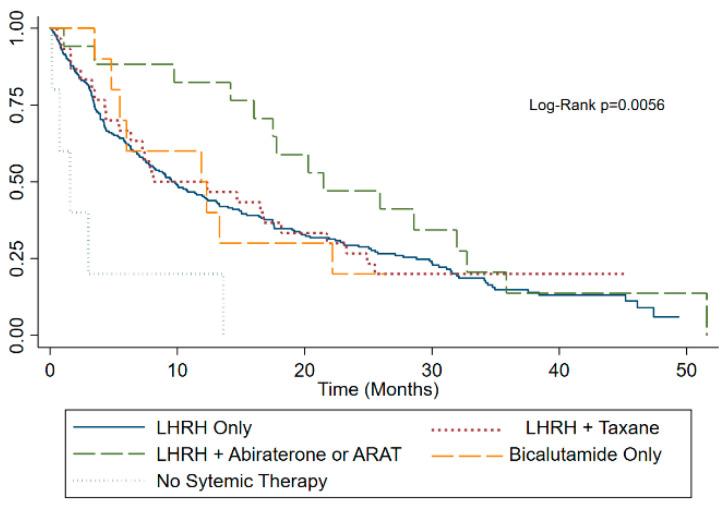
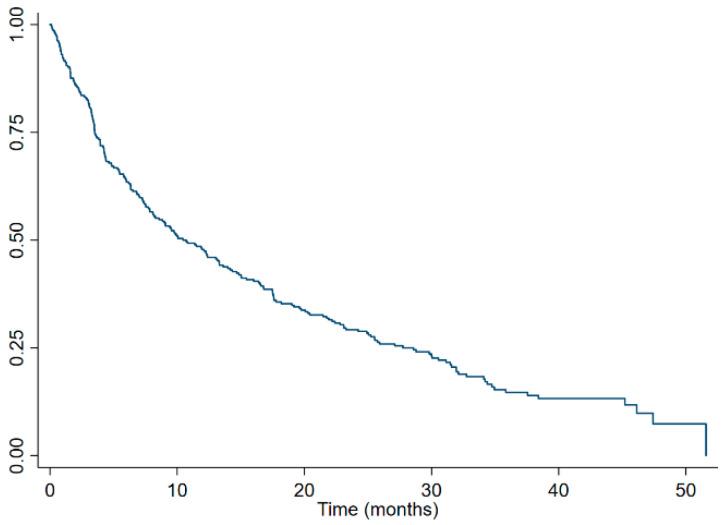
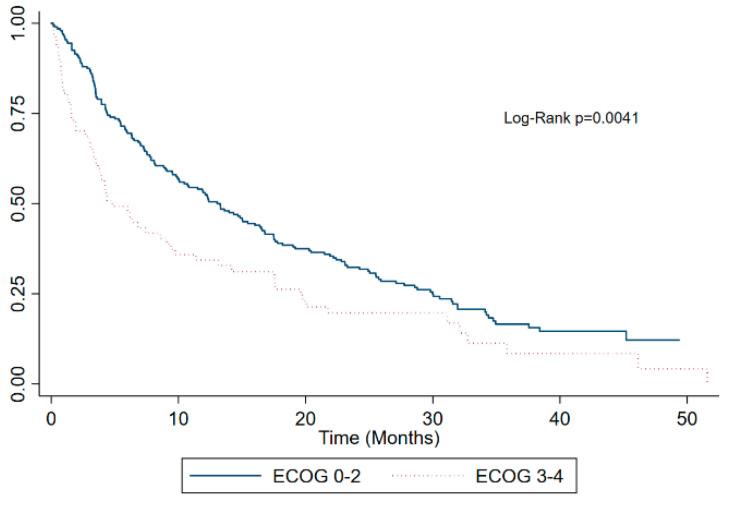
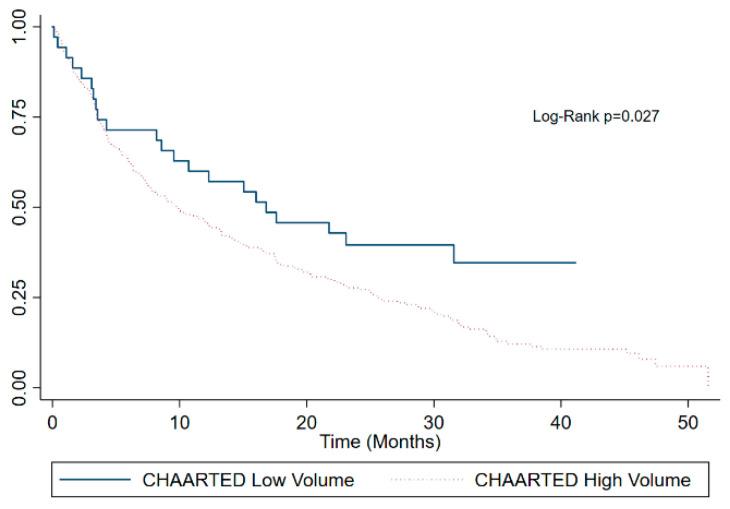
From 1 January 2018 until 31 December 2019, 545 palliative RT courses for bone metastases were delivered to = 274 metastatic prostate cancer patients with a median age of 76 yrs (Interquartile range (IQR) 39-83) and a median follow-up of 10.6 months (range 0.2 to 47.9). The median survival of the cohort was 10.6 months (IQR 3.5-25 months). The ECOG performance status of the whole cohort was ≤2 in = 200 (73%) and 3-4 in = 67 (24.5%). The most commonly treated sites of bone metastasis were the pelvis and lower extremities = 130 (47.4%), skull and spine = 114 (41.6%), and chest and upper extremities = 30 (10.9%). Most patients had CHAARTED high volume disease = 239 (87.2%). On multivariable hazard regression analysis, an ECOG performance status of 3-4 ( = 0.02), CHAARTED high volume disease burden ( = 0.023), and non-receipt of systemic therapy ( = 0.006) were significantly associated with worse post-RT survival.
CONCLUSION
Amongst metastatic prostate cancer patients treated with palliative radiotherapy to bone metastases and modern palliative systemic therapies, ECOG performance status, CHAARTED metastatic disease burden, and type of first-line palliative systemic therapy were significantly associated with post-RT survival durations.
背景
放射治疗(RT)是治疗骨转移的一种既定的姑息治疗方法;然而,对于放射治疗后的生存情况以及影响因素知之甚少。本研究的目的是评估在加拿大省级癌症项目中接受姑息性骨转移放射治疗和当代姑息性系统治疗的转移性前列腺癌患者的人群样本,并确定影响长期生存的因素。
材料/方法:本回顾性、基于人群的队列研究评估了在当代时期,在加拿大省级癌症项目中接受姑息性 RT 治疗骨转移的所有前列腺癌患者。从省级医学物理数据库和电子病历中提取基线患者、疾病和治疗特征。RT 后生存间隔定义为从姑息性 RT 的第一部分到任何原因死亡或最后一次已知随访日期的时间间隔。使用队列的中位生存时间将队列分为 RT 后短期和长期幸存者。进行单变量和多变量风险回归分析,以确定与 RT 后生存相关的变量。
结果
从 2018 年 1 月 1 日至 2019 年 12 月 31 日,545 次姑息性 RT 治疗骨转移,共 274 例转移性前列腺癌患者接受治疗,中位年龄为 76 岁(IQR 39-83),中位随访时间为 10.6 个月(范围 0.2-47.9)。该队列的中位生存时间为 10.6 个月(IQR 3.5-25 个月)。整个队列的 ECOG 表现状态为≤2 为 200 例(73%),3-4 为 67 例(24.5%)。最常治疗的骨转移部位为骨盆和下肢 130 例(47.4%)、颅骨和脊柱 114 例(41.6%)和胸部和上肢 30 例(10.9%)。大多数患者具有 CHAARTED 高容量疾病 239 例(87.2%)。多变量风险回归分析显示,ECOG 表现状态为 3-4(=0.02)、CHAARTED 高容量疾病负担(=0.023)和未接受系统治疗(=0.006)与 RT 后生存时间明显相关。
结论
在接受姑息性骨转移放射治疗和现代姑息性系统治疗的转移性前列腺癌患者中,ECOG 表现状态、CHAARTED 转移性疾病负担和一线姑息性系统治疗类型与 RT 后生存时间明显相关。
 Zotero 插件