
基于氧化还原聚合物的电化学葡萄糖生物传感器的研制,适用于集成在微流控 3D 细胞培养系统中。
Development of a Redox-Polymer-Based Electrochemical Glucose Biosensor Suitable for Integration in Microfluidic 3D Cell Culture Systems.
机构信息
Centro de Investigación y Desarrollo Tecnológico en Electroquímica, Pedro Escobedo 76703, Querétaro, Mexico.
Instituto de Química Física de los Materiales, Medio Ambiente y Energía, CONICET-Departamento de Química Inorgánica, Analítica y Química Física, Facultad de Ciencias Exactas y Naturales, Universidad de Buenos Aires, Buenos Aires C1428EGA, Argentina.
出版信息
Biosensors (Basel). 2023 May 27;13(6):582. doi: 10.3390/bios13060582.
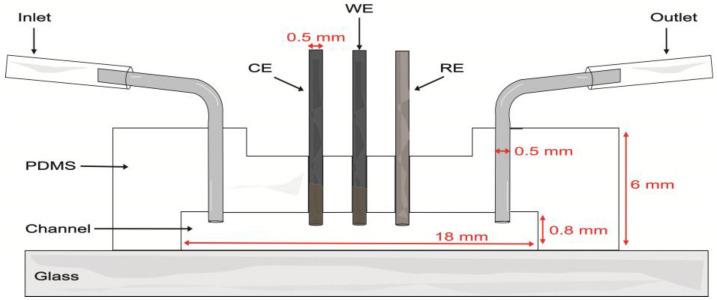
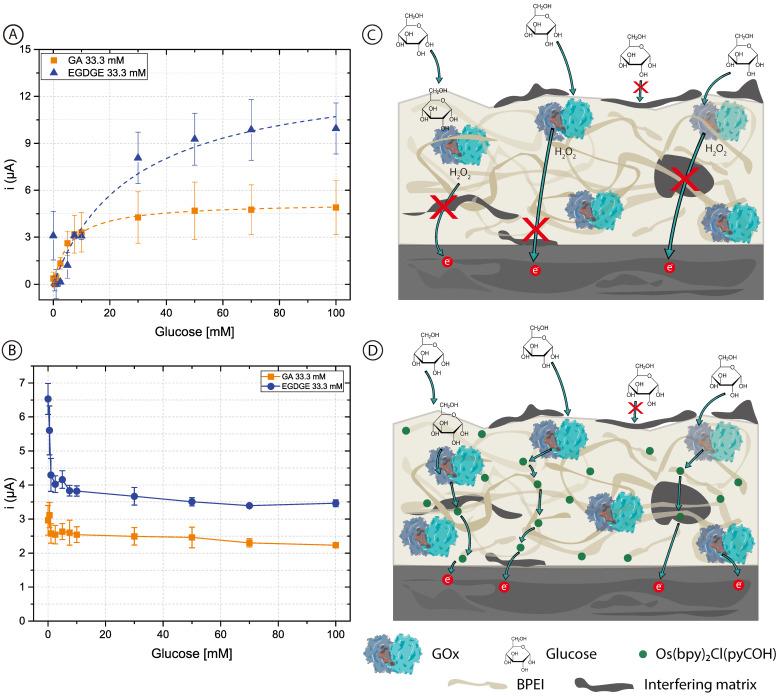
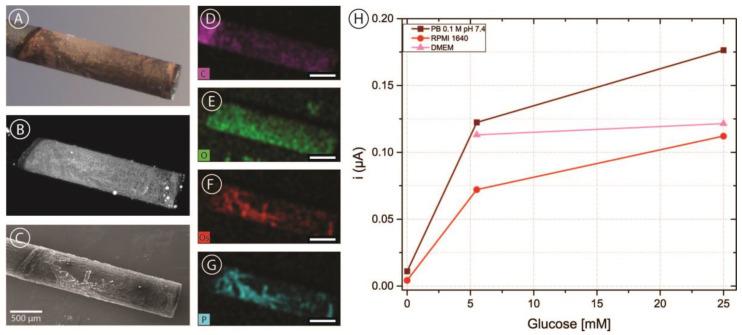
The inclusion of online, in situ biosensors in microfluidic cell cultures is important to monitor and characterize a physiologically mimicking environment. This work presents the performance of second-generation electrochemical enzymatic biosensors to detect glucose in cell culture media. Glutaraldehyde and ethylene glycol diglycidyl ether (EGDGE) were tested as cross-linkers to immobilize glucose oxidase and an osmium-modified redox polymer on the surface of carbon electrodes. Tests employing screen printed electrodes showed adequate performance in a Roswell Park Memorial Institute (RPMI-1640) media spiked with fetal bovine serum (FBS). Comparable first-generation sensors were shown to be heavily affected by complex biological media. This difference is explained in terms of the respective charge transfer mechanisms. Under the tested conditions, electron hopping between Os redox centers was less vulnerable than HO diffusion to biofouling by the substances present in the cell culture matrix. By employing pencil leads as electrodes, the incorporation of these electrodes in a polydimethylsiloxane (PDMS) microfluidic channel was achieved simply and at a low cost. Under flow conditions, electrodes fabricated using EGDGE presented the best performance with a limit of detection of 0.5 mM, a linear range up to 10 mM, and a sensitivity of 4.69 μA mM cm.
将在线、原位生物传感器纳入微流控细胞培养中对于监测和描述具有生理模拟环境的重要性。本工作展示了第二代电化学酶生物传感器在检测细胞培养基中葡萄糖方面的性能。戊二醛和乙二醇二缩水甘油醚(EGDGE)被测试作为交联剂,将葡萄糖氧化酶和锇修饰的氧化还原聚合物固定在碳电极表面。使用丝网印刷电极进行的测试表明,在添加胎牛血清(FBS)的罗格斯大学纪念医院(RPMI-1640)培养基中具有足够的性能。可比的第一代传感器被证明受到复杂生物介质的严重影响。这种差异可以根据各自的电荷转移机制来解释。在测试条件下,Os 氧化还原中心之间的电子跳跃比 HO 扩散对细胞培养基质中存在的物质引起的生物污垢更不易受影响。通过使用铅笔芯作为电极,简单且低成本地将这些电极纳入聚二甲基硅氧烷(PDMS)微流道中。在流动条件下,使用 EGDGE 制造的电极表现出最佳性能,检测限为 0.5 mM,线性范围高达 10 mM,灵敏度为 4.69 μA mM cm。



 Zotero 插件