
长链非编码RNA MALAT1与多梳抑制复合物2在MCF7乳腺癌细胞中对活性基因启动子区域的选择性共定位
Selective Concurrence of the Long Non-Coding RNA MALAT1 and the Polycomb Repressive Complex 2 to Promoter Regions of Active Genes in MCF7 Breast Cancer Cells.
作者信息
Arratia Felipe, Fierro Cristopher, Blanco Alejandro, Fuentes Sebastian, Nahuelquen Daniela, Montecino Martin, Rojas Adriana, Aguilar Rodrigo
机构信息
Institute of Biomedical Sciences (ICB), Faculty of Medicine and Faculty of Life Sciences, Universidad Andres Bello, Santiago 8370071, Chile.
Institute of Human Genetics, Faculty of Medicine, Pontificia Universidad Javeriana, Bogotá 110211, Colombia.
出版信息
Curr Issues Mol Biol. 2023 May 30;45(6):4735-4748. doi: 10.3390/cimb45060301.
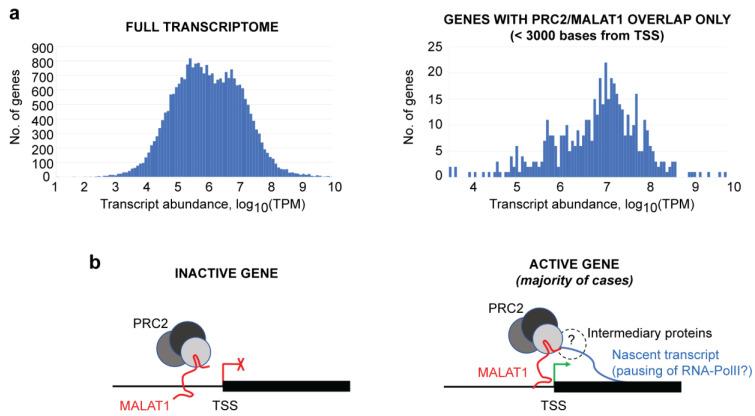
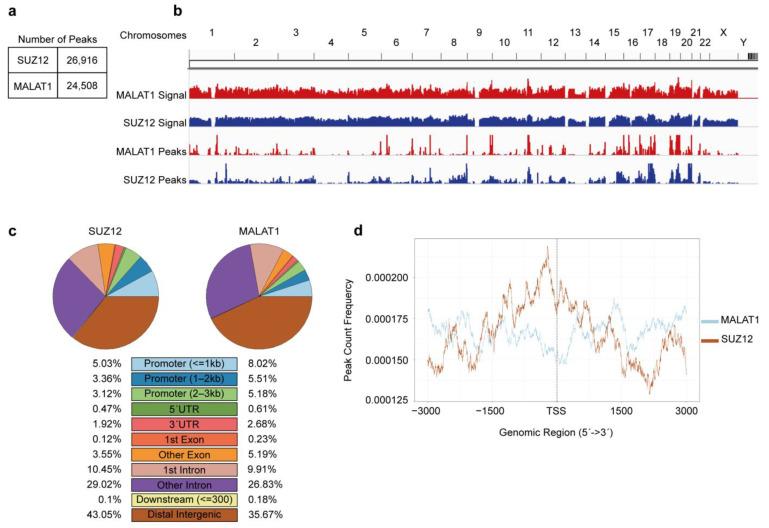
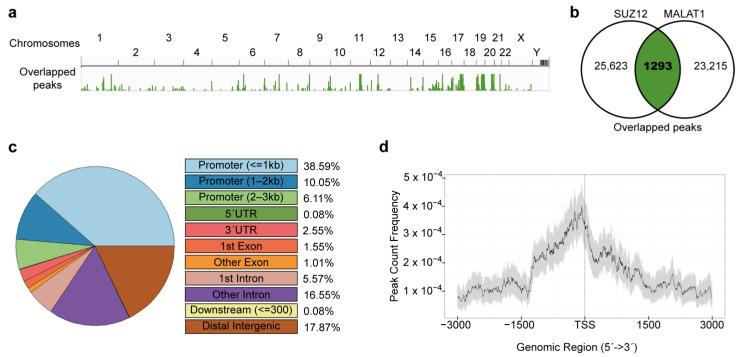
In cancer cells, the long non-coding RNA (lncRNA) MALAT1 has arisen as a key partner for the Polycomb Repressive Complex 2 (PRC2), an epigenetic modifier. However, it is unknown whether this partnership occurs genome-wide at the chromatin level, as most of the studies focus on single genes that are usually repressed. Due to the genomic binding properties of both macromolecules, we wondered whether there are binding sites shared by PRC2 and MALAT1. Using public genome-binding datasets for PRC2 and MALAT1 derived from independent ChIP- and CHART-seq experiments performed with the breast cancer cell line MCF7, we searched for regions containing PRC2 and MALAT1 overlapping peaks. Peak calls for each molecule were performed using MACS2 and then overlapping peaks were identified by bedtools intersect. Using this approach, we identified 1293 genomic sites where PRC2 and MALAT1 concur. Interestingly, 54.75% of those sites are within gene promoter regions (<3000 bases from the TSS). These analyses were also linked with the transcription profiles of MCF7 cells, obtained from public RNA-seq data. Hence, it is suggested that MALAT1 and PRC2 can concomitantly bind to promoters of actively-transcribed genes in MCF7 cells. Gene ontology analyses revealed an enrichment of genes related to categories including cancer malignancy and epigenetic regulation. Thus, by re-visiting occupancy and transcriptomic data, we identified a key gene subset controlled by the collaboration of MALAT1 and PRC2.
在癌细胞中,长链非编码RNA(lncRNA)MALAT1已成为表观遗传修饰因子多梳抑制复合体2(PRC2)的关键伙伴。然而,这种伙伴关系是否在全基因组的染色质水平上发生尚不清楚,因为大多数研究集中在通常被抑制的单个基因上。鉴于这两种大分子的基因组结合特性,我们想知道PRC2和MALAT1是否存在共享的结合位点。利用从乳腺癌细胞系MCF7进行的独立染色质免疫沉淀测序(ChIP-seq)和RNA结合分析的染色质分离测序(CHART-seq)实验中获得的PRC2和MALAT1的公共基因组结合数据集,我们搜索了包含PRC2和MALAT1重叠峰的区域。使用MACS2对每个分子进行峰检测,然后通过bedtools intersect识别重叠峰。通过这种方法,我们确定了1293个PRC2和MALAT1同时存在的基因组位点。有趣的是,这些位点中有54.75%位于基因启动子区域(距转录起始位点<3000个碱基)。这些分析还与从公共RNA测序数据中获得的MCF7细胞的转录谱相关联。因此,有人提出MALAT1和PRC2可以同时结合MCF7细胞中活跃转录基因的启动子。基因本体分析揭示了与癌症恶性和表观遗传调控等类别相关的基因富集。因此,通过重新审视占有率和转录组数据,我们确定了一个由MALAT1和PRC2协同控制的关键基因子集。

 Zotero 插件