
神经元中线粒体运输的高度专业化机制:从细胞内流动性到线粒体的细胞间转移。
Highly Specialized Mechanisms for Mitochondrial Transport in Neurons: From Intracellular Mobility to Intercellular Transfer of Mitochondria.
机构信息
Institute for Genetics, University of Cologne, 50931 Cologne, Germany.
Cologne Excellence Cluster on Cellular Stress Responses in Aging-Associated Diseases (CECAD), 50931 Cologne, Germany.
出版信息
Biomolecules. 2023 Jun 3;13(6):938. doi: 10.3390/biom13060938.
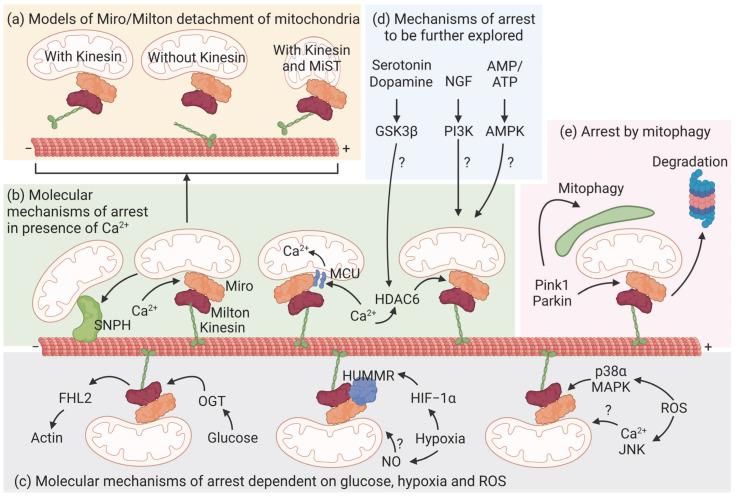
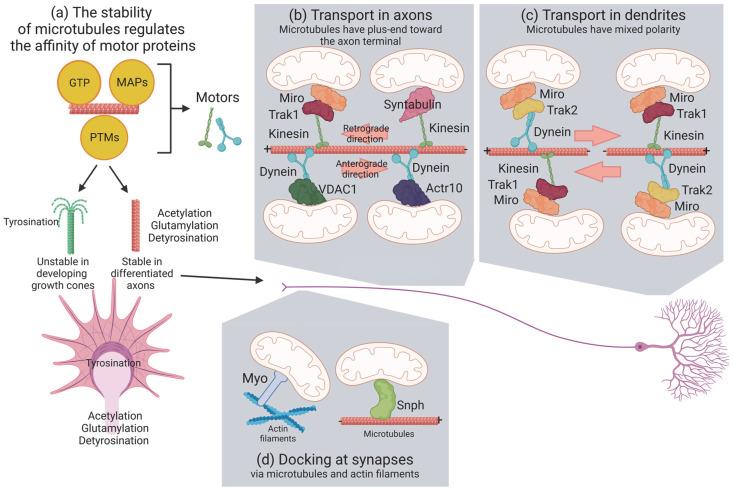
The highly specialized structure and function of neurons depend on a sophisticated organization of the cytoskeleton, which supports a similarly sophisticated system to traffic organelles and cargo vesicles. Mitochondria sustain crucial functions by providing energy and buffering calcium where it is needed. Accordingly, the distribution of mitochondria is not even in neurons and is regulated by a dynamic balance between active transport and stable docking events. This system is finely tuned to respond to changes in environmental conditions and neuronal activity. In this review, we summarize the mechanisms by which mitochondria are selectively transported in different compartments, taking into account the structure of the cytoskeleton, the molecular motors and the metabolism of neurons. Remarkably, the motor proteins driving the mitochondrial transport in axons have been shown to also mediate their transfer between cells. This so-named intercellular transport of mitochondria is opening new exciting perspectives in the treatment of multiple diseases.
神经元的高度专业化结构和功能依赖于细胞骨架的精细组织,细胞骨架支持着同样精细的细胞器和货物小泡运输系统。线粒体通过提供能量和缓冲需要的钙来维持关键功能。因此,线粒体在神经元中的分布不均匀,由活跃运输和稳定停靠事件之间的动态平衡来调节。这个系统能够精细地响应环境条件和神经元活动的变化。在这篇综述中,我们总结了线粒体在不同隔室中被选择性运输的机制,同时考虑了细胞骨架的结构、分子马达和神经元的代谢。值得注意的是,驱动轴突中线粒体运输的运动蛋白已被证明也介导了它们在细胞之间的转移。这种所谓的线粒体的细胞间运输为多种疾病的治疗开辟了新的令人兴奋的前景。
 Zotero 插件