
比目鱼肌的收缩功及腓肠肌的双关节机制增加了高步行速度下踝关节的净机械功。
Contractile Work of the Soleus and Biarticular Mechanisms of the Gastrocnemii Muscles Increase the Net Ankle Mechanical Work at High Walking Speeds.
作者信息
Kharazi Mohamadreza, Theodorakis Christos, Mersmann Falk, Bohm Sebastian, Arampatzis Adamantios
机构信息
Department of Training and Movement Sciences, Humboldt-Universität zu Berlin, 10115 Berlin, Germany.
Berlin School of Movement Science, 10115 Berlin, Germany.
出版信息
Biology (Basel). 2023 Jun 16;12(6):872. doi: 10.3390/biology12060872.
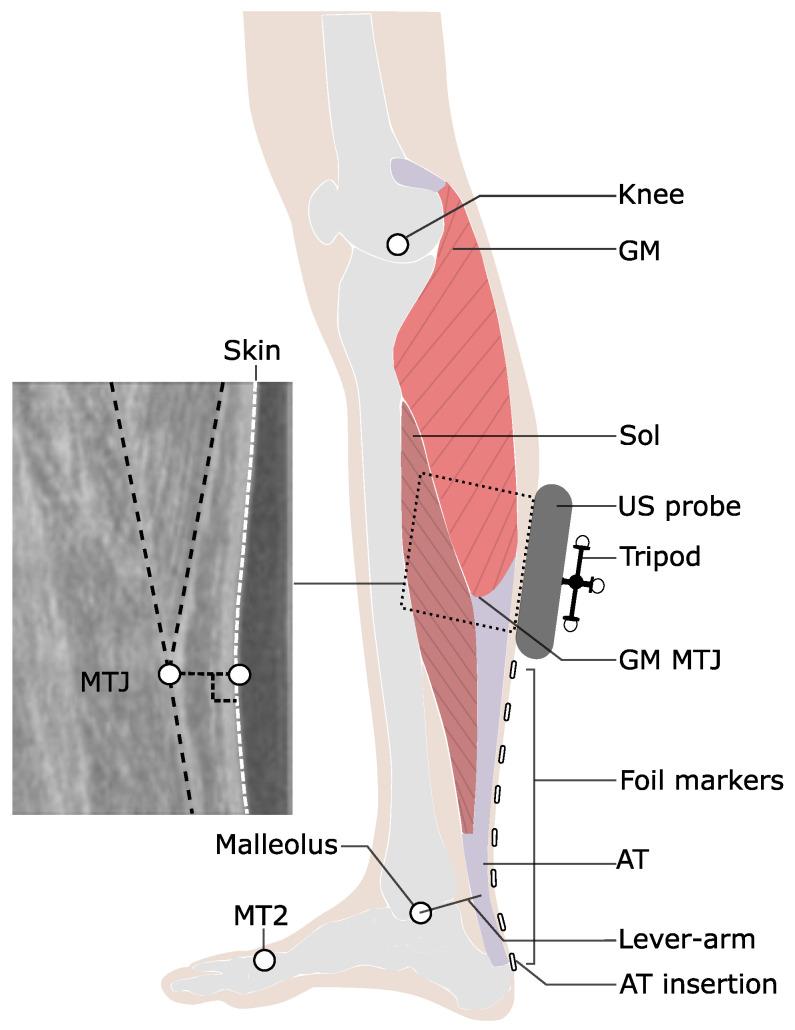
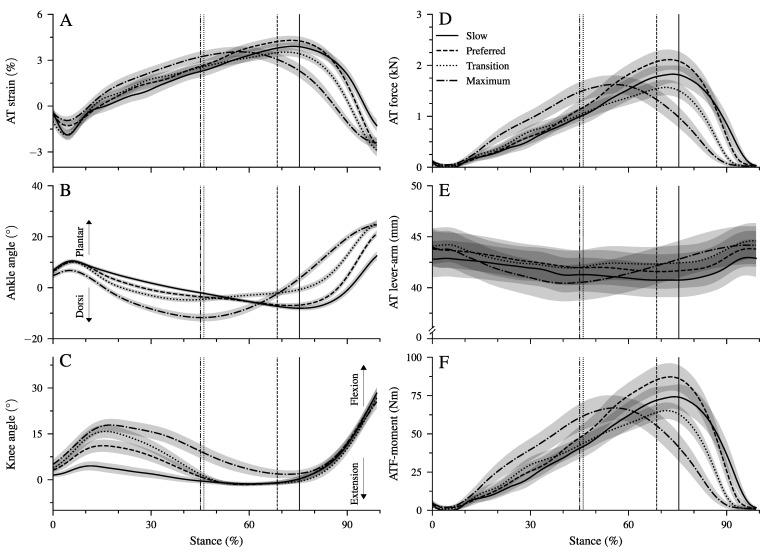
Increasing walking speed is accompanied by an increase of the mechanical power and work performed at the ankle joint despite the decrease of the intrinsic muscle force potential of the soleus (Sol) and gastrocnemius medialis (GM) muscles. In the present study, we measured Achilles tendon (AT) elongation and, based on an experimentally determined AT force-elongation relationship, quantified AT force at four walking speeds (slow 0.7 m.s-1, preferred 1.4 m.s-1, transition 2.0 m.s-1, and maximum 2.6 ± 0.3 m.s-1). Further, we investigated the mechanical power and work of the AT force at the ankle joint and, separately, the mechanical power and work of the monoarticular Sol at the ankle joint and the biarticular gastrocnemii at the ankle and knee joints. We found a 21% decrease in maximum AT force at the two higher speeds compared to the preferred; however, the net work of the AT force at the ankle joint (ATF work) increased as a function of walking speed. An earlier plantar flexion accompanied by an increased electromyographic activity of the Sol and GM muscles and a knee-to-ankle joint energy transfer via the biarticular gastrocnemii increased the net ATF mechanical work by 1.7 and 2.4-fold in the transition and maximum walking speed, respectively. Our findings provide first-time evidence for a different mechanistic participation of the monoarticular Sol muscle (i.e., increased contractile net work carried out) and the biarticular gastrocnemii (i.e., increased contribution of biarticular mechanisms) to the speed-related increase of net ATF work.
尽管比目鱼肌(Sol)和内侧腓肠肌(GM)的内在肌力潜力下降,但步行速度的增加伴随着踝关节处机械功率和所做功的增加。在本研究中,我们测量了跟腱(AT)的伸长,并基于实验确定的AT力-伸长关系,量化了四种步行速度(慢速0.7米/秒、偏好速度1.4米/秒、过渡速度2.0米/秒和最大速度2.6±0.3米/秒)下的AT力。此外,我们研究了踝关节处AT力的机械功率和功,以及分别研究了踝关节处单关节比目鱼肌和踝关节与膝关节处双关节腓肠肌的机械功率和功。我们发现,与偏好速度相比,在两种较高速度下最大AT力下降了21%;然而,踝关节处AT力的净功(ATF功)随步行速度的增加而增加。更早的跖屈伴随着Sol和GM肌肉肌电活动的增加,以及通过双关节腓肠肌从膝关节到踝关节的能量转移,使得在过渡速度和最大步行速度下,ATF机械净功分别增加了1.7倍和2.4倍。我们的研究结果首次证明了单关节比目鱼肌(即增加的收缩净功)和双关节腓肠肌(即双关节机制贡献的增加)对与速度相关的ATF净功增加有不同的机制参与。



 Zotero 插件