
慢性淋巴细胞白血病的治疗抵抗:新老分子生物标志物。
Treatment Refractoriness in Chronic Lymphocytic Leukemia: Old and New Molecular Biomarkers.
机构信息
Division of Hematology, Department of Translational Medicine, Università del Piemonte Orientale and Azienda Ospedaliero-Universitaria Maggiore della Carità, 28100 Novara, Italy.
Department of Hematology and Bone Marrow Transplant, Hematology and Bone Marrow Transplant Center, Baghdad 00964, Iraq.
出版信息
Int J Mol Sci. 2023 Jun 20;24(12):10374. doi: 10.3390/ijms241210374.
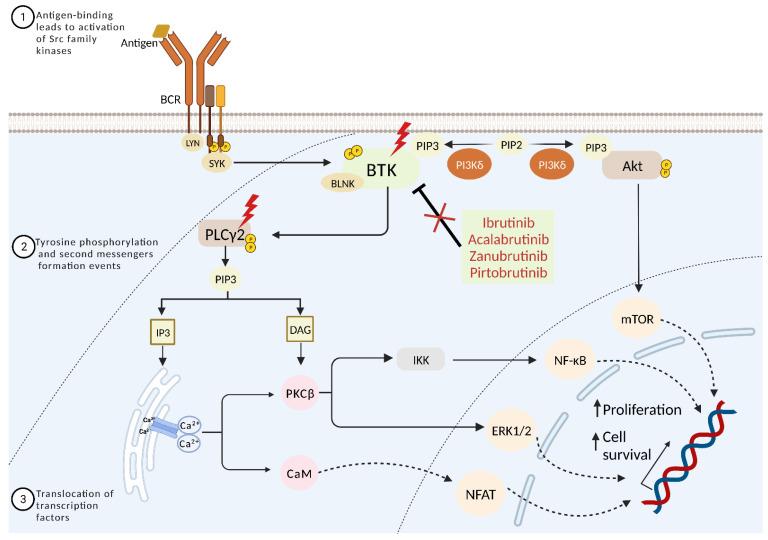
Chronic lymphocytic leukemia (CLL) is the most common leukemia in adults. Despite its indolent clinical course, therapy refractoriness and disease progression still represent an unmet clinical need. Before the advent of pathway inhibitors, chemoimmunotherapy (CIT) was the commonest option for CLL treatment and is still widely used in areas with limited access to pathway inhibitors. Several biomarkers of refractoriness to CIT have been highlighted, including the unmutated status of immunoglobulin heavy chain variable genes and genetic lesions of , and . In order to overcome resistance to CIT, targeted pathway inhibitors have become the standard of care for the treatment of CLL, with practice-changing results obtained through the inhibitors of Bruton tyrosine kinase (BTK) and BCL2. However, several acquired genetic lesions causing resistance to covalent and noncovalent BTK inhibitors have been reported, including point mutations of both (e.g., C481S and L528W) and (e.g., R665W). Multiple mechanisms are involved in resistance to the BCL2 inhibitor venetoclax, including point mutations that impair drug binding, the upregulation of BCL2-related anti-apoptotic family members, and microenvironmental alterations. Recently, immune checkpoint inhibitors and CAR-T cells have been tested for CLL treatment, obtaining conflicting results. Potential refractoriness biomarkers to immunotherapy were identified, including abnormal levels of circulating IL-10 and IL-6 and the reduced presence of CD27CD45RO CD8 T cells.
慢性淋巴细胞白血病(CLL)是成人中最常见的白血病。尽管其临床病程呈惰性,但治疗耐药和疾病进展仍然是未满足的临床需求。在通路抑制剂问世之前,化疗免疫治疗(CIT)是 CLL 治疗的最常见选择,并且在通路抑制剂获取有限的地区仍广泛使用。已经强调了对 CIT 耐药的几种生物标志物,包括免疫球蛋白重链可变基因的未突变状态以及 和 的遗传病变。为了克服对 CIT 的耐药性,靶向通路抑制剂已成为 CLL 治疗的标准护理方法,通过 Bruton 酪氨酸激酶(BTK)和 BCL2 的抑制剂取得了改变实践的结果。然而,已经报道了导致对共价和非共价 BTK 抑制剂耐药的几种获得性遗传病变,包括 (例如,C481S 和 L528W)和 (例如,R665W)的点突变。耐药性涉及多种机制BCL2 抑制剂 venetoclax,包括影响药物结合的点突变、BCL2 相关抗凋亡家族成员的上调以及微环境改变。最近,免疫检查点抑制剂和 CAR-T 细胞已被用于 CLL 治疗,获得了相互矛盾的结果。确定了对免疫治疗的潜在耐药性生物标志物,包括循环 IL-10 和 IL-6 水平异常以及 CD27CD45RO CD8 T 细胞减少。

 Zotero 插件