
≥65岁成年人强化流感疫苗成本效益分析中的真实世界证据:文献综述与专家意见
Real-World Evidence in Cost-Effectiveness Analysis of Enhanced Influenza Vaccines in Adults ≥ 65 Years of Age: Literature Review and Expert Opinion.
作者信息
Postma Maarten, Fisman David, Giglio Norberto, Márquez-Peláez Sergio, Nguyen Van Hung, Pugliese Andrea, Ruiz-Aragón Jesús, Urueña Analia, Mould-Quevedo Joaquin
机构信息
Department of Health Sciences, University Medical Center Groningen, University of Groningen, P.O. Box 72, 9700 AB Groningen, The Netherlands.
Department of Economics, Econometrics & Finance, Faculty of Economics & Business, University of Groningen, 9713 AB Groningen, The Netherlands.
出版信息
Vaccines (Basel). 2023 Jun 11;11(6):1089. doi: 10.3390/vaccines11061089.
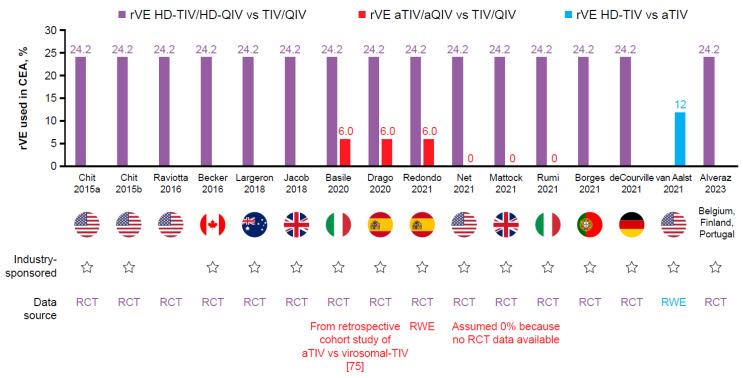
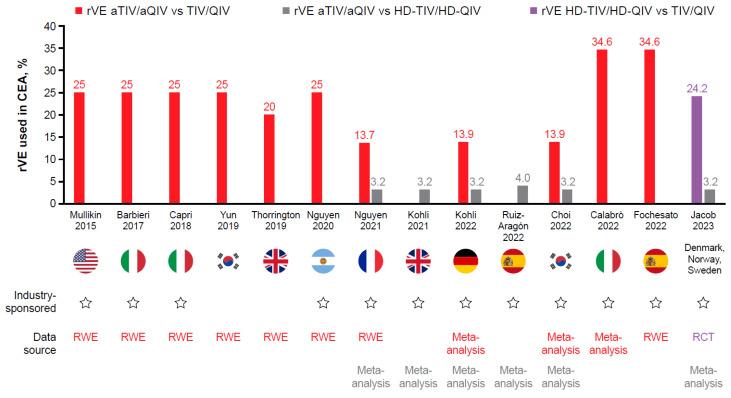
Influenza vaccination can benefit most populations, including adults ≥ 65 years of age, who are at greater risk of influenza-related complications. In many countries, enhanced vaccines, such as adjuvanted, high-dose, and recombinant trivalent/quadrivalent influenza vaccines (aTIV/aQIV, HD-TIV/HD-QIV, and QIVr, respectively), are recommended in older populations to provide higher immunogenicity and increased relative vaccine efficacy/effectiveness (rVE) than standard-dose vaccines. This review explores how efficacy and effectiveness data from randomized controlled trials and real-world evidence (RWE) are used in economic evaluations. Findings from published cost-effectiveness analyses (CEA) on enhanced influenza vaccines for older adults are summarized, and the assumptions and approaches used in these CEA are assessed alongside discussion of the importance of RWE in CEA. Results from many CEA showed that adjuvanted and high-dose enhanced vaccines were cost-effective compared with standard vaccines, and that differences in rVE estimates and acquisition price may drive differences in cost-effectiveness estimates between enhanced vaccines. Overall, RWE and CEA provide clinical and economic rationale for enhanced vaccine use in people ≥ 65 years of age, an at-risk population with substantial burden of disease. Countries that consider RWE when making vaccine recommendations have preferentially recommended aTIV/aQIV, as well as HD-TIV/HD-QIV and QIVr, to protect older individuals.
流感疫苗接种对大多数人群有益,包括65岁及以上的成年人,他们患流感相关并发症的风险更高。在许多国家,对于老年人群体,推荐使用增强型疫苗,如佐剂疫苗、高剂量疫苗和重组三价/四价流感疫苗(分别为aTIV/aQIV、HD-TIV/HD-QIV和QIVr),以提供比标准剂量疫苗更高的免疫原性,并提高相对疫苗效力/效果(rVE)。本综述探讨了随机对照试验的效力和效果数据以及真实世界证据(RWE)如何用于经济评估。总结了已发表的关于老年人增强型流感疫苗的成本效益分析(CEA)的结果,并评估了这些CEA中使用的假设和方法,同时讨论了RWE在CEA中的重要性。许多CEA的结果表明,与标准疫苗相比,佐剂和高剂量增强型疫苗具有成本效益,并且rVE估计值和采购价格的差异可能导致增强型疫苗之间成本效益估计值的差异。总体而言,RWE和CEA为在65岁及以上人群(这是一个疾病负担较重的高危人群)中使用增强型疫苗提供了临床和经济依据。在制定疫苗推荐时考虑RWE的国家已优先推荐aTIV/aQIV以及HD-TIV/HD-QIV和QIVr,以保护老年人。
 Zotero 插件