
自体 RNA 电穿孔 cMET 导向嵌合抗原受体 T 细胞静脉输注治疗黑色素瘤和乳腺癌患者的 I 期临床试验。
Phase I Trial of Autologous RNA-electroporated cMET-directed CAR T Cells Administered Intravenously in Patients with Melanoma and Breast Carcinoma.
机构信息
Perelman School of Medicine at the University of Pennsylvania, Philadelphia, Pennsylvania.
Abramson Cancer Center, University of Pennsylvania, Philadelphia, Pennsylvania.
出版信息
Cancer Res Commun. 2023 May 9;3(5):821-829. doi: 10.1158/2767-9764.CRC-22-0486. eCollection 2023 May.
PURPOSE
Treatments are limited for metastatic melanoma and metastatic triple-negative breast cancer (mTNBC). This pilot phase I trial (NCT03060356) examined the safety and feasibility of intravenous RNA-electroporated chimeric antigen receptor (CAR) T cells targeting the cell-surface antigen cMET.
EXPERIMENTAL DESIGN
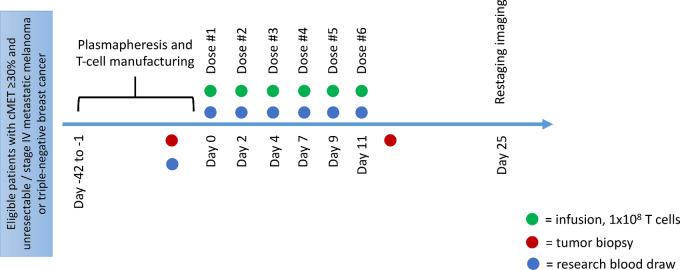
Metastatic melanoma or mTNBC subjects had at least 30% tumor expression of cMET, measurable disease and progression on prior therapy. Patients received up to six infusions (1 × 10e8 T cells/dose) of CAR T cells without lymphodepleting chemotherapy. Forty-eight percent of prescreened subjects met the cMET expression threshold. Seven (3 metastatic melanoma, 4 mTNBC) were treated.
RESULTS
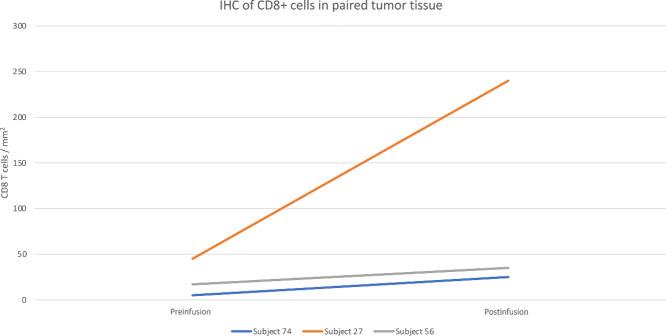
Mean age was 50 years (35-64); median Eastern Cooperative Oncology Group 0 (0-1); median prior lines of chemotherapy/immunotherapy were 4/0 for TNBC and 1/3 for melanoma subjects. Six patients experienced grade 1 or 2 toxicity. Toxicities in at least 1 patient included anemia, fatigue, and malaise. One subject had grade 1 cytokine release syndrome. No grade 3 or higher toxicity, neurotoxicity, or treatment discontinuation occurred. Best response was stable disease in 4 and disease progression in 3 subjects. mRNA signals corresponding to CAR T cells were detected by RT-PCR in all patients' blood including in 3 subjects on day +1 (no infusion administered on this day). Five subjects underwent postinfusion biopsy with no CAR T-cell signals seen in tumor. Three subjects had paired tumor tissue; IHC showed increases in CD8 and CD3 and decreases in pS6 and Ki67.
CONCLUSIONS
Intravenous administration of RNA-electroporated cMET-directed CAR T cells is safe and feasible.
SIGNIFICANCE
Data evaluating CAR T therapy in patients with solid tumors are limited. This pilot clinical trial demonstrates that intravenous cMET-directed CAR T-cell therapy is safe and feasible in patients with metastatic melanoma and metastatic breast cancer, supporting the continued evaluation of cellular therapy for patients with these malignancies.
目的
转移性黑色素瘤和转移性三阴性乳腺癌(mTNBC)的治疗方法有限。本试验(NCT03060356)采用静脉注射 RNA 电穿孔嵌合抗原受体(CAR)T 细胞靶向细胞表面抗原 cMET,旨在检验其安全性和可行性。
实验设计
转移性黑色素瘤或 mTNBC 患者肿瘤中 cMET 的表达至少为 30%,且既往治疗期间有疾病进展或可测量的疾病。患者接受多达六次输注(1×10e8 T 细胞/剂量)的 CAR T 细胞,不进行淋巴清除化疗。48%的预筛选患者达到 cMET 表达阈值。7 名患者(3 名转移性黑色素瘤患者,4 名 mTNBC 患者)接受了治疗。
结果
平均年龄为 50 岁(35-64 岁);东部肿瘤协作组 0 级(0-1 级)中位数;mTNBC 患者的中位数既往化疗/免疫治疗线数为 4/0,黑色素瘤患者为 1/3。6 名患者发生 1 级或 2 级毒性。至少 1 名患者出现贫血、乏力和不适等毒性。1 名患者发生 1 级细胞因子释放综合征。未发生 3 级或更高级别的毒性、神经毒性或治疗中止。4 名患者最佳反应为疾病稳定,3 名患者疾病进展。所有患者的血液中均通过 RT-PCR 检测到与 CAR T 细胞相对应的 mRNA 信号,包括在无输注的第 1 天(+1 天)的 3 名患者。5 名患者进行了输注后活检,肿瘤中未检测到 CAR T 细胞信号。3 名患者有配对肿瘤组织;免疫组化显示 CD8 和 CD3 增加,pS6 和 Ki67 减少。
结论
静脉注射 RNA 电穿孔 cMET 靶向 CAR T 细胞是安全可行的。
意义
评估 CAR T 疗法治疗实体瘤患者的数据有限。本试验初步临床研究表明,静脉注射 cMET 靶向 CAR T 细胞治疗转移性黑色素瘤和转移性乳腺癌患者是安全可行的,支持对这些恶性肿瘤患者进行细胞治疗的进一步评估。
 Zotero 插件