
分析 中的 HD-Zip I 转录因子家族和 在丹参酮合成中的功能研究。
Analysis of the HD-Zip I transcription factor family in and functional research of in tanshinone synthesis.
机构信息
College of Pharmacy, Shandong University of Traditional Chinese Medicine, Jinan, Shandong, China.
LiShizhen College of Traditional Chinese Medicine, Huanggang Normal University, Huanggang, Hubei, China.
出版信息
PeerJ. 2023 Jun 27;11:e15510. doi: 10.7717/peerj.15510. eCollection 2023.
BACKGROUND
The homeodomain-leucine zipper I (HD-Zip I) transcription factor is a plant-specific protein that plays an essential role in the abiotic stress response of plants. Research on the HD-Zip I family in is still lacking.
METHODS AND RESULTS
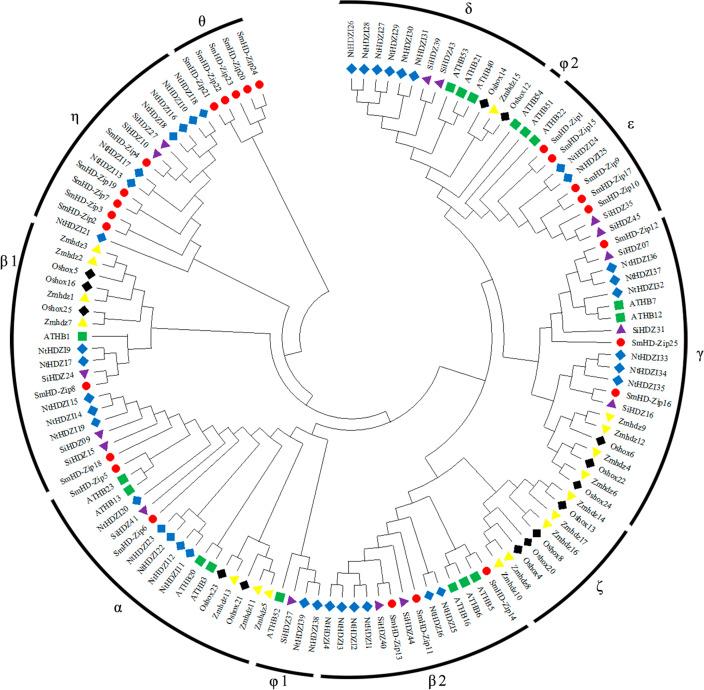
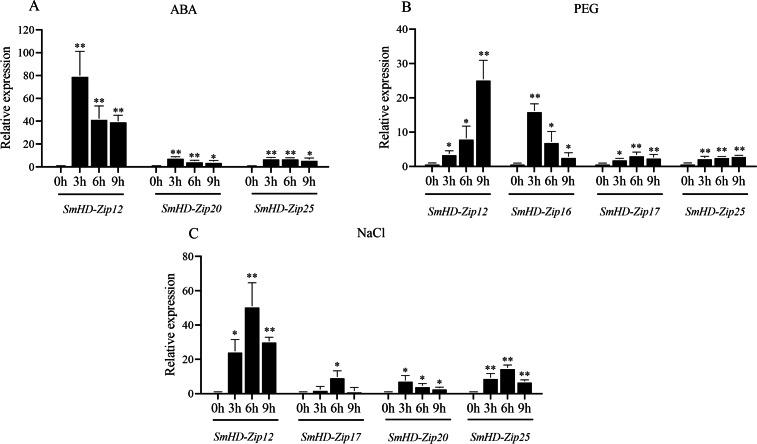
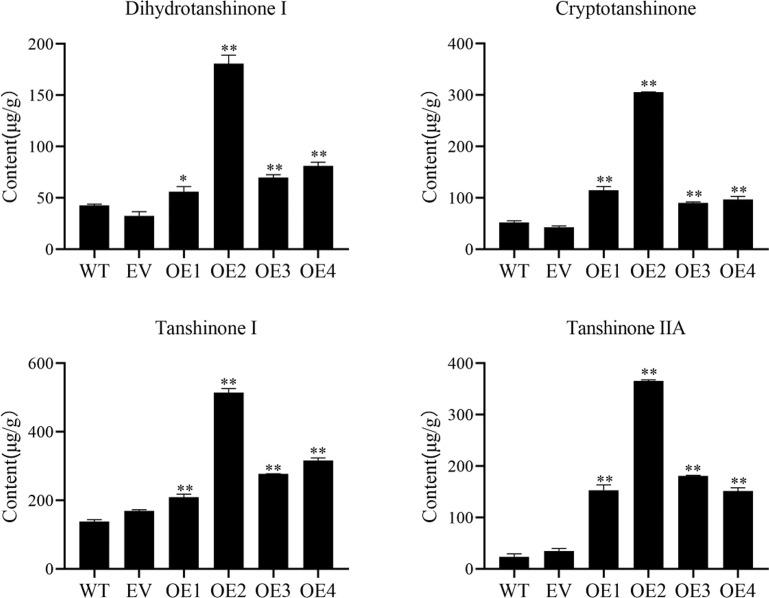
In this study, a total of 25 SmHD-Zip I proteins were identified. Their characterizations, phylogenetic relationships, conserved motifs, gene structures, and cis-elements were analyzed comprehensively using bioinformatics methods. Expression profiling revealed that genes exhibited distinctive tissue-specific patterns and divergent responses to ABA, PEG, and NaCl stresses. responded the most strongly to ABA, PEG, and NaCl, so it was used for transgenic experiments. The overexpression of significantly increased the content of cryptotanshinone, dihydrotanshinone I, tanshinone I, and tanshinone IIA by 2.89-fold, 1.85-fold, 2.14-fold, and 8.91-fold compared to the wild type, respectively. Moreover, in the tanshinone biosynthetic pathways, the overexpression of up-regulated the expression levels of , , , , , , , , and compared with the wild type.
CONCLUSIONS
This study provides information the possible functions of the HD-Zip I family and lays a theoretical foundation for clarifying the functional mechanism of the gene in regulating the synthesis of tanshinone in .
背景
同源域亮氨酸拉链 I(HD-Zip I)转录因子是一种植物特异性蛋白,在植物的非生物胁迫响应中发挥着重要作用。目前对 中的 HD-Zip I 家族的研究还很少。
方法和结果
本研究共鉴定了 25 个 SmHD-Zip I 蛋白。利用生物信息学方法对它们的特征、系统发育关系、保守基序、基因结构和顺式元件进行了全面分析。表达谱分析表明,SmHD-Zip I 基因具有独特的组织特异性模式和对 ABA、PEG 和 NaCl 胁迫的不同响应。SmHD-Zip I 基因对 ABA、PEG 和 NaCl 的响应最为强烈,因此被用于转基因实验。与野生型相比,SmHD-Zip I 基因的过表达使隐丹参酮、二氢丹参酮 I、丹参酮 I 和丹参酮 IIA 的含量分别增加了 2.89 倍、1.85 倍、2.14 倍和 8.91 倍。此外,在丹参酮生物合成途径中,SmHD-Zip I 基因的过表达使 、 、 、 、 、 、 和 的表达水平与野生型相比分别上调了 2.89 倍、1.85 倍、2.14 倍和 8.91 倍。
结论
本研究为 HD-Zip I 家族的可能功能提供了信息,为阐明 基因在调控丹参酮合成中的功能机制奠定了理论基础。




 Zotero 插件