
健康与退休研究中中老年人群食物不安全与记忆功能的相关性。
Associations of Food Insecurity and Memory Function Among Middle to Older-Aged Adults in the Health and Retirement Study.
机构信息
Department of Epidemiology, Mailman School of Public Health, Columbia University, New York, New York.
Department of Health Sciences, University of New Mexico, Albuquerque.
出版信息
JAMA Netw Open. 2023 Jul 3;6(7):e2321474. doi: 10.1001/jamanetworkopen.2023.21474.
IMPORTANCE
Food insecurity is a leading public health issue in the US. Research on food insecurity and cognitive aging is scarce, and is mostly cross-sectional. Food insecurity status and cognition both can change over the life course, but their longitudinal relationship remains unexplored.
OBJECTIVE
To examine the longitudinal association between food insecurity and changes in memory function during a period of 18 years among middle to older-aged adults in the US.
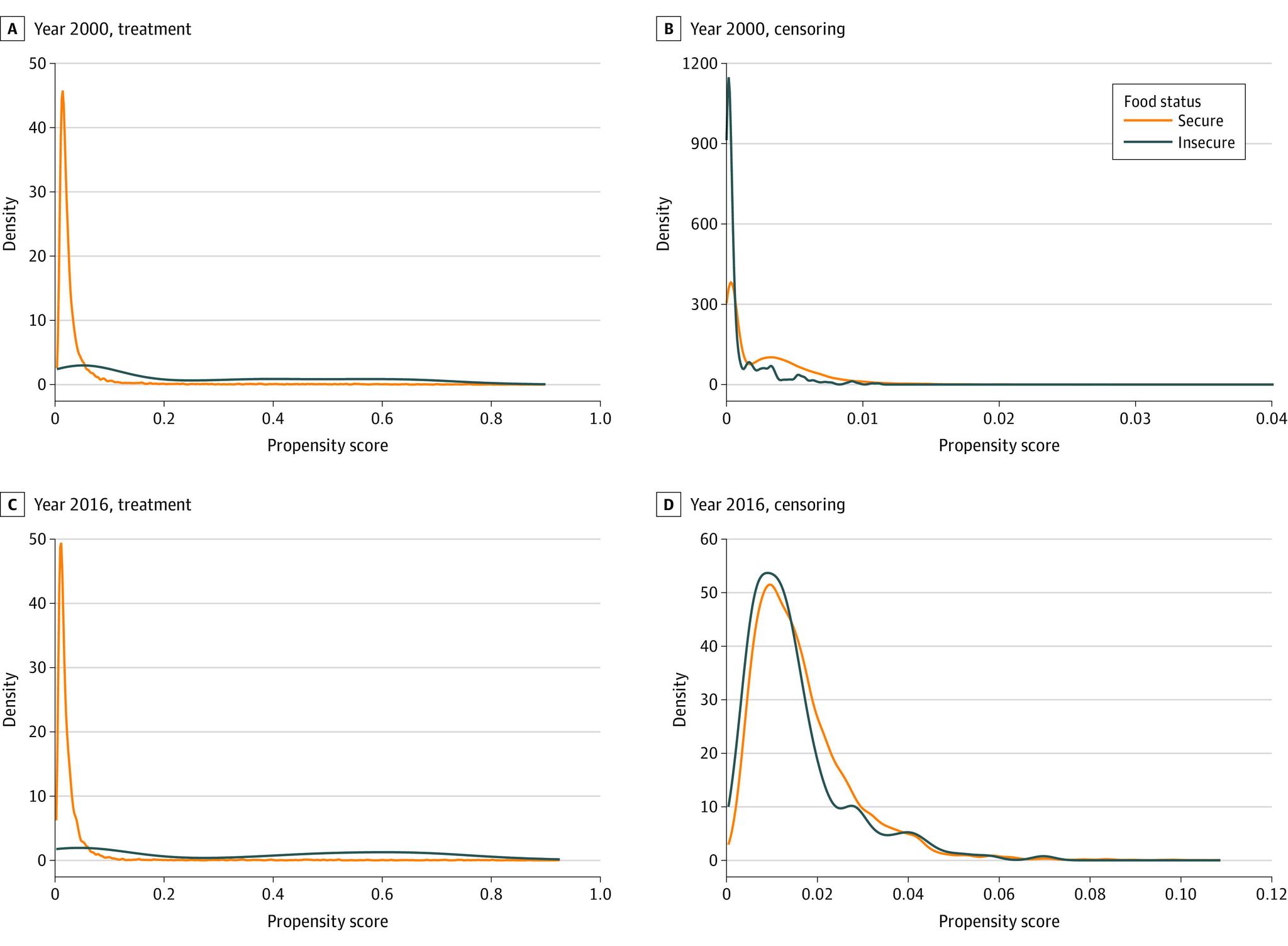
DESIGN, SETTING, AND PARTICIPANTS: The Health and Retirement Study is an ongoing population-based cohort study of individuals aged 50 years or older. Participants with nonmissing information on their food insecurity in 1998 who contributed information on memory function at least once over the study period (1998-2016) were included. To account for time-varying confounding and censoring, marginal structural models were created, using inverse probability weighting. Data analyses were conducted between May 9 and November 30, 2022.
MAIN OUTCOMES AND MEASURES
In each biennial interview, food insecurity status (yes/no) was assessed by asking respondents whether they had enough money to buy food or ate less than they felt they should. Memory function was a composite score based on self-completed immediate and delayed word recall task of a 10-word list and proxy-assessed validated instruments.
RESULTS
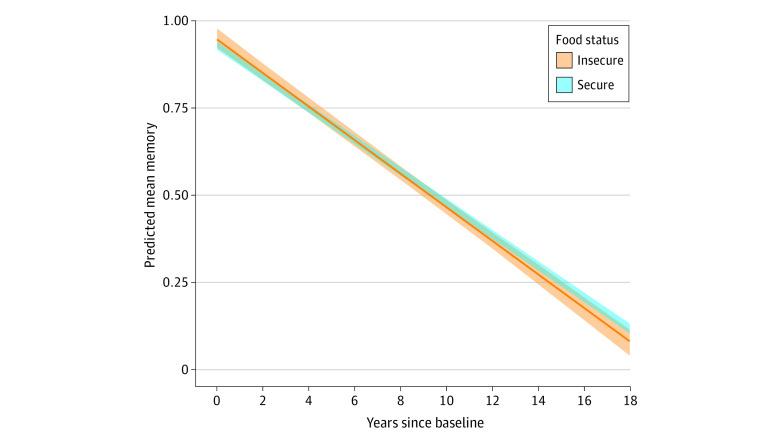
The analytic sample included 12 609 respondents (mean [SD] age, 67.7 [11.0] years, 8146 [64.60%] women, 10 277 [81.51%] non-Hispanic White), including 11 951 food-secure and 658 food-insecure individuals in 1998. Over time, the memory function of the food-secure respondents decreased by 0.045 SD units annually (β for time, -0.045; 95% CI, -0.046 to -0.045 SD units). The memory decline rate was faster among food-insecure respondents than food-secure respondents, although the magnitude of the coefficient was small (β for food insecurity × time, -0.0030; 95% CI, -0.0062 to -0.00018 SD units), which translates to an estimated 0.67 additional (ie, excess) years of memory aging over a 10-year period for food-insecure respondents compared with food-secure respondents.
CONCLUSIONS AND RELEVANCE
In this cohort study of middle to older-aged individuals, food insecurity was associated with slightly faster memory decline, suggesting possible long-term negative cognitive function outcomes associated with exposure to food insecurity in older age.
重要性
在美国,粮食不安全是一个主要的公共卫生问题。关于粮食不安全和认知老化的研究很少,而且大多是横断面研究。粮食不安全状况和认知能力都可以在整个生命周期中发生变化,但它们的纵向关系仍未得到探索。
目的
在美国,研究 18 年期间粮食不安全状况与中老年人记忆功能变化之间的纵向关联。
设计、地点和参与者:健康与退休研究是一项正在进行的基于人群的队列研究,参与者年龄在 50 岁或以上。在 1998 年有非缺失的粮食不安全信息且在研究期间至少有一次提供记忆功能信息的参与者(1998-2016 年)被纳入研究。为了考虑时间变化的混杂因素和删失,使用逆概率加权创建了边缘结构模型。数据分析于 2022 年 5 月 9 日至 11 月 30 日进行。
主要结果和措施
在每两年一次的访谈中,通过询问受访者是否有足够的钱购买食物或是否吃得比他们认为应该吃的少来评估粮食不安全状况(是/否)。记忆功能是基于自我完成的即时和延迟单词回忆任务的一个 10 个单词列表的综合得分,以及代理评估的经过验证的工具。
结果
分析样本包括 12609 名受访者(平均[SD]年龄 67.7[11.0]岁,8146[64.60%]名女性,10277[81.51%]名非西班牙裔白人),其中 1998 年有 11951 名粮食安全和 658 名粮食不安全的个体。随着时间的推移,粮食安全的受访者的记忆功能每年下降 0.045 个 SD 单位(时间的β,-0.045;95%CI,-0.046 至 -0.045 SD 单位)。与粮食安全的受访者相比,粮食不安全的受访者的记忆下降速度更快,尽管系数的幅度较小(粮食不安全×时间,-0.0030;95%CI,-0.0062 至 -0.00018 SD 单位),这意味着在 10 年内,与粮食安全的受访者相比,粮食不安全的受访者的记忆老化速度可能会快 0.67 年。
结论和相关性
在这项针对中老年人的队列研究中,粮食不安全与记忆衰退速度略有加快有关,这表明在老年时期接触粮食不安全可能与长期负面认知功能结果有关。

 Zotero 插件