
死亡的不同方式:细胞死亡途径及其与脊髓损伤的关联
Different Ways to Die: Cell Death Pathways and Their Association With Spinal Cord Injury.
作者信息
Guha Lahanya, Singh Nidhi, Kumar Hemant
机构信息
Department of Pharmacology and Toxicology, National Institute of Pharmaceutical Education and Research (NIPER)-Ahmedabad, Gandhinagar, Gujarat, India.
Department of Biotechnology, National Institute of Pharmaceutical Education and Research (NIPER)- Ahmedabad, Gandhinagar, Gujarat, India.
出版信息
Neurospine. 2023 Jun;20(2):430-448. doi: 10.14245/ns.2244976.488. Epub 2023 Mar 2.
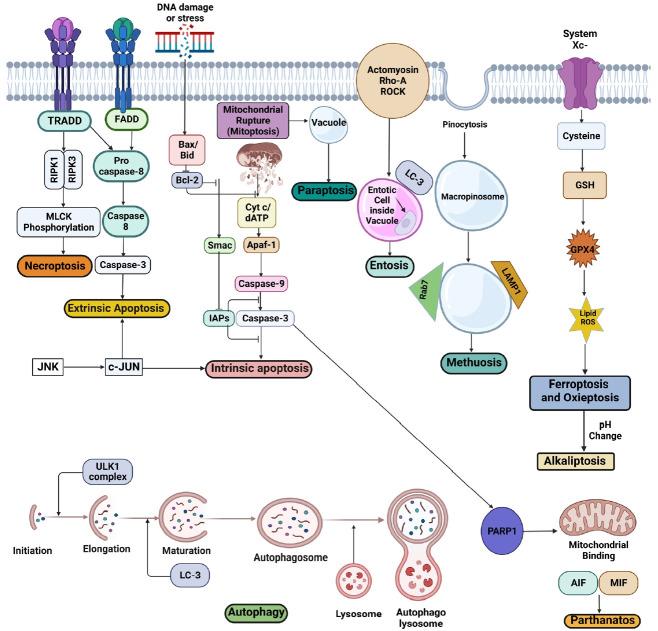
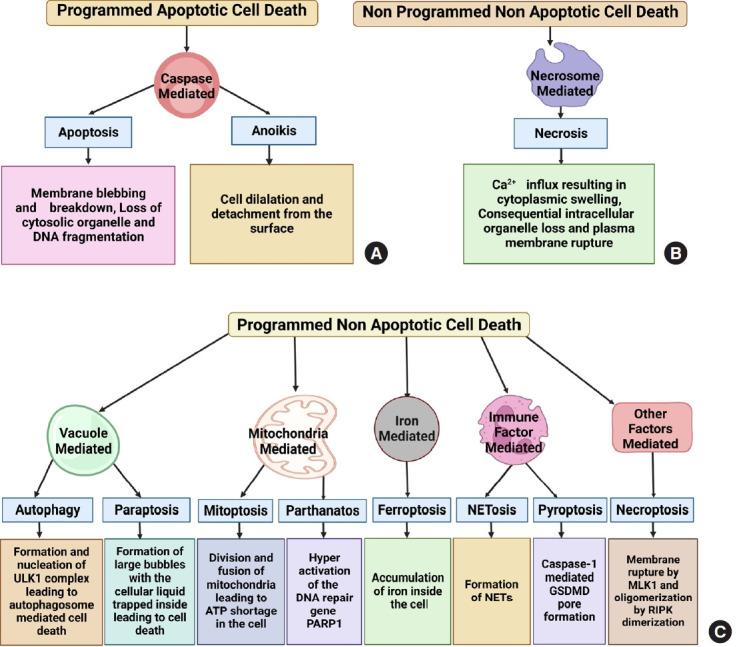
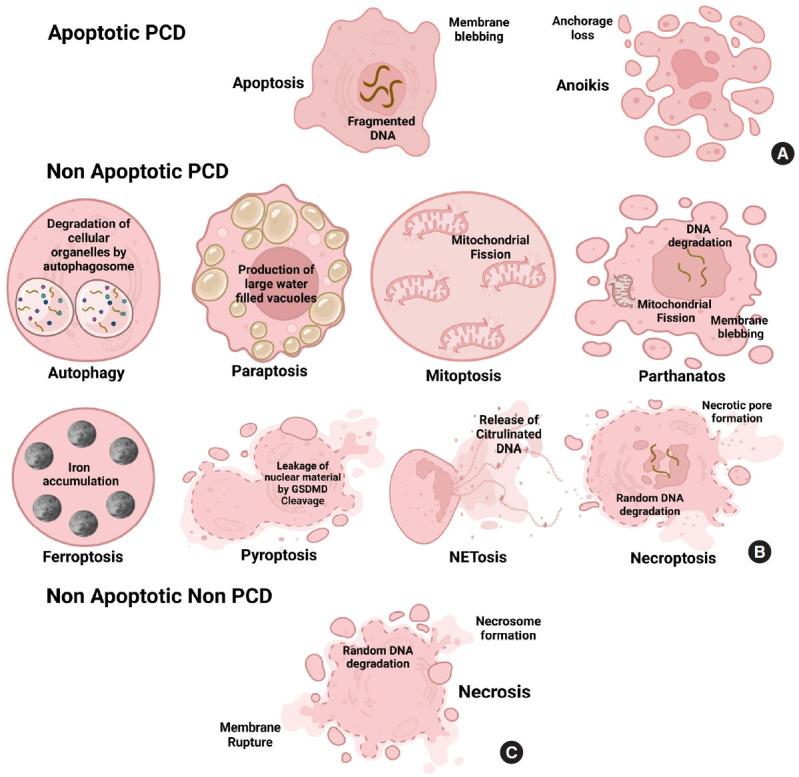
Cell death is a systematic/nonsystematic process of cessation of normal morphology and functional properties of the cell to replace and recycle old cells with new also promoting inflammation in some cases. It is a complicated process comprising multiple pathways. Some are well-explored, and others have just begun to be. The research on appropriate control of cell death pathways after acute and chronic damage of neuronal cells is being widely researched today due to the lack of regeneration and recovering potential of a neuronal cell after sustaining damage and the inability to control the direction of neuronal growth. In the progression and onset of various neurological diseases, impairments in programmed cell death signaling processes, like necroptosis, apoptosis, ferroptosis, pyroptosis, and pathways directly or indirectly linked, like autophagy as in nonprogrammed necrosis, are observed. Spinal cord injury (SCI) involves the temporary or permanent disruption of motor activities due to the death of a neuronal and glial cell in the spinal cord accompanied by axonal degeneration. Recent years have seen a significant increase in research on the intricate biochemical interactions that occur after a SCI. Different cell death pathways may significantly impact the subsequent damage processes that lead to the eventual neurological deficiency after an injury to the spinal cord. A better knowledge of the molecular basis of the involved cell death pathways might help enhance neuronal and glial survival and neurological deficits, promoting a curative path for SCI.
细胞死亡是细胞正常形态和功能特性停止的系统性/非系统性过程,用于替换和循环旧细胞,新细胞在某些情况下也会引发炎症。这是一个包含多种途径的复杂过程。有些途径已得到充分研究,而其他途径才刚刚开始被研究。由于神经元细胞在遭受损伤后缺乏再生和恢复潜力,且无法控制神经元生长方向,目前针对神经元细胞急性和慢性损伤后细胞死亡途径的适当控制的研究正在广泛开展。在各种神经系统疾病的进展和发病过程中,可观察到程序性细胞死亡信号传导过程的损伤,如坏死性凋亡、细胞凋亡、铁死亡、焦亡,以及与非程序性坏死中的自噬等直接或间接相关的途径。脊髓损伤(SCI)是指由于脊髓中神经元和神经胶质细胞死亡并伴有轴突变性,导致运动活动暂时或永久性中断。近年来,对脊髓损伤后发生的复杂生化相互作用的研究显著增加。不同的细胞死亡途径可能会对随后导致脊髓损伤后最终神经功能缺损的损伤过程产生重大影响。更好地了解所涉及的细胞死亡途径的分子基础可能有助于提高神经元和神经胶质细胞的存活率,并改善神经功能缺损,为脊髓损伤开辟一条治疗途径。
 Zotero 插件