
COVID-19 对伊朗德黑兰国家结直肠癌筛查计划的影响:一项多中心研究。
The impact of COVID-19 on national program of colorectal cancer screening in Tehran, Iran: a multicenter study.
机构信息
Research Institute for Gastroenterology and Liver Diseases (RIGLD), Shahid Beheshti University of Medical Sciences (SBMU), Taleghani Hospital, Tehran, Iran.
Community Medicine Department, School of Medicine, Shahid Beheshti Medical University, Tehran, Iran.
出版信息
BMC Cancer. 2023 Jul 5;23(1):627. doi: 10.1186/s12885-023-11111-x.
BACKGROUND
The COVID-19 pandemic has affected all aspects of the healthcare system, including prevention, treatment, rehabilitation of diseases and health education; access to essential therapies; allocation of finance & facilities to health issues, and governance of diseases, including COVID-19 and other diseases. Consequently, the burden of COVID-19 was not only attributable to the multiorgan involvement and detailed presentation of the disease but also to the inadequate management of other diseases resulting from the exclusive allocation of resources and medical personnel to the pandemic crisis. Over the mentioned period, one observed deficiency was the lack of public and official favor for conventional screening protocols. To this end, this study aims to evaluate the impact of the COVID-19 pandemic on colorectal cancer (CRC) screening protocols at Shahid Beheshti University of Medical Sciences in Tehran, Iran, in an effort to identify individuals at risk for CRC and provide them with intensive screening and therapy.
METHODS
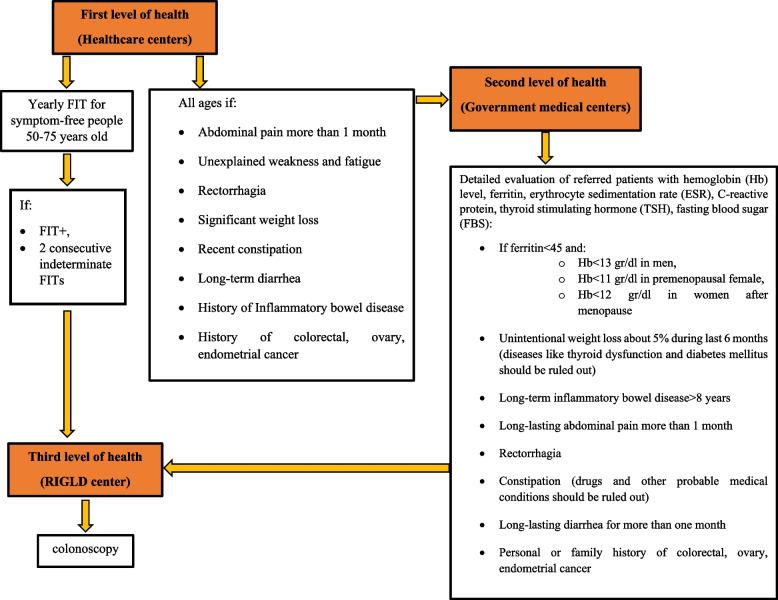
This is an observational study comparing the number of candidates for CRC screening referred to primary, secondary, and tertiary health-care centers under supervision of Shahid Beheshti University of Medical Sciences (SBMU), Tehran, Iran in a 2-year interval before and after COVID-19 pandemics. Patients with intermediate- and high-risk criteria for colorectal cancer were included in the study and were screened by fecal immunochemical test. Patients with positive or indeterminate fecal test results were further evaluated with colonoscopy in research institute for gastroenterology and liver diseases where is a tertiary referral center for CRC screening. Finally, the decrease percentage of screening tests and endoscopic findings during the pandemic period compared to pre-pandemic period was calculated and interpreted.
RESULTS
A significant decrease in the number of performed fecal immunochemical tests (FITs), referred positive FITs, and referred patients with positive alarm signs to the Research Institute of Gastroenterology and Liver Diseases (RIGLD) center inevitably led to a considerable decrease in the number of endoscopic findings, including high-risk adenomas, sessile serrated polyps, and even early-stage colorectal cancers (CRCs).
CONCLUSION
The disruption of screening protocols caused by the COVID-19 pandemic appears to increase the number of patients with high-grade and end-stage CRCs referred in the near future.
背景
COVID-19 大流行影响了医疗保健系统的各个方面,包括预防、治疗、疾病康复和健康教育;基本治疗方法的获取;对卫生问题的财政和设施分配;以及疾病的治理,包括 COVID-19 和其他疾病。因此,COVID-19 的负担不仅归因于该疾病的多器官受累和详细表现,还归因于由于资源和医务人员专用于大流行危机,对其他疾病的管理不足。在此期间,人们观察到的一个不足之处是缺乏公众和官方对常规筛查方案的支持。为此,本研究旨在评估 COVID-19 大流行对伊朗德黑兰谢哈迪比什提医科大学结直肠癌(CRC)筛查方案的影响,努力识别 CRC 高危个体,并为他们提供强化筛查和治疗。
方法
这是一项观察性研究,比较了在 COVID-19 大流行前后 2 年期间,在谢哈迪比什提医科大学(SBMU)监督下,向初级、二级和三级保健中心转诊的 CRC 筛查候选人数量。将具有结直肠癌中高危标准的患者纳入研究,并通过粪便免疫化学试验进行筛查。粪便试验结果阳性或不确定的患者在胃肠病学和肝病研究所进行进一步评估,该研究所是 CRC 筛查的三级转诊中心。最后,计算并解释了大流行期间与大流行前相比筛查试验和内镜检查结果减少的百分比。
结果
粪便免疫化学试验(FIT)的数量、转诊阳性 FIT 的数量以及转诊有阳性报警症状的患者到胃肠病学和肝病研究所(RIGLD)中心的数量显著减少,这不可避免地导致内镜检查结果数量减少,包括高危腺瘤、无蒂锯齿状息肉,甚至早期结直肠癌(CRC)。
结论
COVID-19 大流行导致筛查方案中断,似乎增加了未来不久将转诊的高分级和晚期 CRC 患者数量。


 Zotero 插件