
刺猬信号通路协调组蛋白修饰之间的相互作用,并定制乳腺癌的联合表观遗传疗法。
Hedgehog pathway orchestrates the interplay of histone modifications and tailors combination epigenetic therapies in breast cancer.
作者信息
Wang Xiaomin, Xu Jun, Sun Yiming, Cao Siyuwei, Zeng Hanlin, Jin Nan, Shou Matthew, Tang Shuai, Chen Yi, Huang Min
机构信息
Cancer Research Center, State Key Laboratory of Drug Research, Shanghai Institute of Materia Medica, Chinese Academy of Sciences, Shanghai 201203, China.
University of Chinese Academy of Sciences, Beijing 100049, China.
出版信息
Acta Pharm Sin B. 2023 Jun;13(6):2601-2612. doi: 10.1016/j.apsb.2023.03.009. Epub 2023 Mar 11.
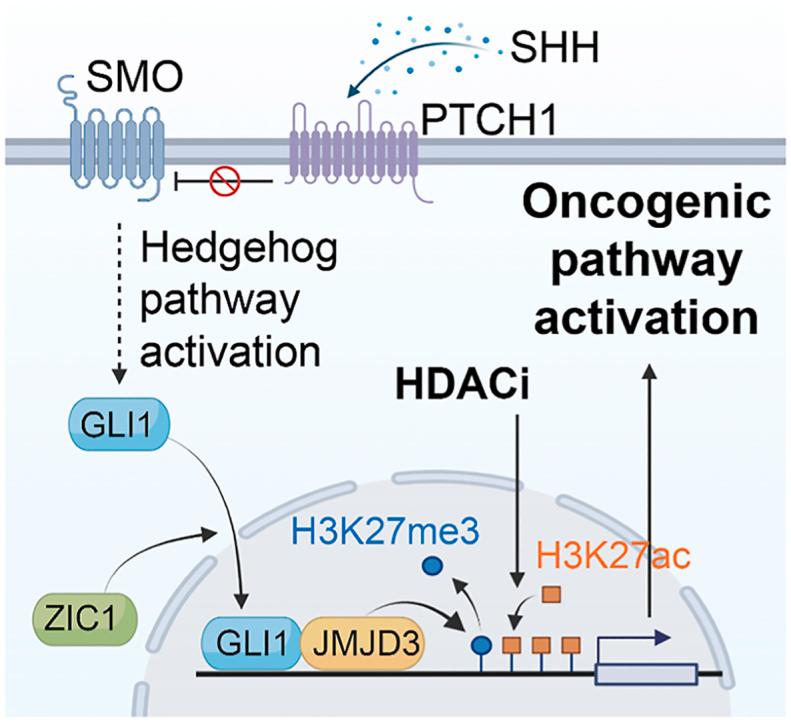
Epigenetic therapies that cause genome-wide epigenetic alterations, could trigger local interplay between different histone marks, leading to a switch of transcriptional outcome and therapeutic responses of epigenetic treatment. However, in human cancers with diverse oncogenic activation, how oncogenic pathways cooperate with epigenetic modifiers to regulate the histone mark interplay is poorly understood. We herein discover that the hedgehog (Hh) pathway reprograms the histone methylation landscape in breast cancer, especially in triple-negative breast cancer (TNBC). This facilitates the histone acetylation caused by histone deacetylase (HDAC) inhibitors and gives rise to new therapeutic vulnerability of combination therapies. Specifically, overexpression of zinc finger protein of the cerebellum 1 (ZIC1) in breast cancer promotes Hh activation, facilitating the switch of H3K27 methylation (H3K27me) to acetylation (H3K27ac). The mutually exclusive relationship of H3K27me and H3K27ac allows their functional interplay at oncogenic gene locus and switches therapeutic outcomes. Using multiple breast cancer models including patient-derived TNBC xenograft, we show that Hh signaling-orchestrated H3K27me and H3K27ac interplay tailors combination epigenetic drugs in treating breast cancer. Together, this study reveals the new role of Hh signaling-regulated histone modifications interplay in responding to HDAC inhibitors and suggests new epigenetically-targeted therapeutic solutions for treating TNBC.
导致全基因组表观遗传改变的表观遗传疗法,可能会引发不同组蛋白标记之间的局部相互作用,从而导致转录结果的转变以及表观遗传治疗的反应。然而,在具有多种致癌激活的人类癌症中,致癌途径如何与表观遗传修饰因子协同作用以调节组蛋白标记的相互作用,目前尚不清楚。我们在此发现,刺猬(Hh)信号通路可重新编程乳腺癌中的组蛋白甲基化格局,尤其是在三阴性乳腺癌(TNBC)中。这促进了组蛋白去乙酰化酶(HDAC)抑制剂引起的组蛋白乙酰化,并产生了联合疗法的新治疗脆弱性。具体而言,乳腺癌中小脑锌指蛋白1(ZIC1)的过表达促进Hh激活,促使H3K27甲基化(H3K27me)向乙酰化(H3K27ac)转变。H3K27me和H3K27ac的相互排斥关系使其在致癌基因位点发挥功能相互作用,并改变治疗结果。使用包括患者来源的TNBC异种移植在内的多种乳腺癌模型,我们表明Hh信号通路协调的H3K27me和H3K27ac相互作用可定制联合表观遗传药物来治疗乳腺癌。总之,这项研究揭示了Hh信号通路调节的组蛋白修饰相互作用在对HDAC抑制剂反应中的新作用,并为治疗TNBC提出了新的表观遗传靶向治疗方案。



 Zotero 插件