
全球范围内肾脏病学中电子患者报告结局系统的使用:一项混合方法研究。
Global use of electronic patient-reported outcome systems in nephrology: a mixed methods study.
机构信息
Institute of Applied Heath Research, Centre for Patient Reported Outcomes Research, University of Birmingham, Birmingham, UK
Research, Development and Innovation, University Hospitals Birmingham NHS Foundation Trust, Birmingham, UK.
出版信息
BMJ Open. 2023 Jul 12;13(7):e070927. doi: 10.1136/bmjopen-2022-070927.
OBJECTIVES
The use of electronic patient-reported outcome (ePRO) systems to support the management of patients with chronic kidney disease is increasing. This mixed-methods study aimed to comprehensively identify existing and developing ePRO systems, used in nephrology settings globally, ascertaining key characteristics and factors for successful implementation.
STUDY DESIGN
ePRO systems and developers were identified through a scoping review of the literature and contact with field experts. Developers were invited to participate in a structured survey, to summarise key system characteristics including: (1) system objectives, (2) population, (3) PRO measures used, (4) level of automation, (5) reporting, (6) integration into workflow and (7) links to electronic health records/national registries. Subsequent semistructured interviews were conducted to explore responses.
SETTING AND PARTICIPANTS
Eligible systems included those being developed or used in nephrology settings to assess ePROs and summarise results to care providers. System developers included those with a key responsibility for aspects of the design, development or implementation of an eligible system.
ANALYTICAL APPROACH
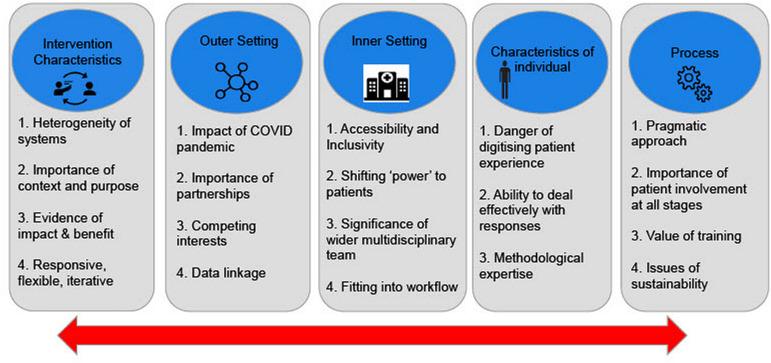
Structured survey data were summarised using descriptive statistics. Interview transcripts were analysed using Codebook Thematic Analysis using domains from the Consolidated Framework for Implementation Research.
RESULTS
Fifteen unique ePRO systems were identified across seven countries; 10 system developers completed the structured survey and 7 participated in semistructured interviews. Despite system heterogeneity, reported features required for effective implementation included early and sustained patient involvement, clinician champions and expanding existing electronic platforms to integrate ePROs. Systems demonstrated several common features, with the majority being implemented within research settings, thereby affecting system implementation readiness for real-world application.
CONCLUSIONS
There has been considerable research investment in ePRO systems. The findings of this study outline key system features and factors to support the successful implementation of ePROs in routine kidney care.Cite Now.
目的
使用电子患者报告结局(ePRO)系统来支持慢性肾脏病患者的管理正在增加。本混合方法研究旨在全面识别当前和正在开发的全球肾脏病领域使用的 ePRO 系统,确定成功实施的关键特征和因素。
研究设计
通过对文献进行范围审查并与领域专家联系,确定了 ePRO 系统及其开发者。邀请开发者参与一项结构化调查,总结关键系统特征,包括:(1)系统目标;(2)人群;(3)使用的患者报告结局测量工具;(4)自动化程度;(5)报告;(6)与工作流程的整合;(7)与电子健康记录/国家登记册的链接。随后进行了半结构化访谈以探讨回应。
设置和参与者
符合条件的系统包括那些正在开发或用于肾脏病领域评估 ePRO 并向护理提供者总结结果的系统。系统开发者包括对符合条件系统的设计、开发或实施的某些方面负有主要责任的人员。
分析方法
使用描述性统计对结构化调查数据进行总结。使用整合实施研究综合框架的领域对访谈记录进行了基于代码簿的主题分析。
结果
在七个国家中确定了 15 个独特的 ePRO 系统;10 个系统开发者完成了结构化调查,7 个参与了半结构化访谈。尽管系统存在异质性,但报告的有效实施所需特征包括早期和持续的患者参与、临床医生拥护者以及扩大现有电子平台以整合 ePRO。系统展示了一些共同的特征,其中大多数在研究环境中实施,从而影响了 ePRO 在实际应用中的实施准备情况。
结论
在 ePRO 系统方面已经进行了相当大的研究投资。本研究结果概述了关键的系统特征和因素,以支持在常规肾脏护理中成功实施 ePRO。
 Zotero 插件