
基线时患有或不患有 2 型糖尿病的瑞典肥胖受试者接受减重手术或常规治疗后的预期寿命。
Life expectancy after bariatric surgery or usual care in patients with or without baseline type 2 diabetes in Swedish Obese Subjects.
机构信息
Institute of Medicine, Sahlgrenska Academy, University of Gothenburg, Gothenburg, Sweden.
Research and Early Development, Cardiovascular, Renal and Metabolism (CVRM), BioPharmaceuticals R&D, AstraZeneca, Gothenburg, Sweden.
出版信息
Int J Obes (Lond). 2023 Oct;47(10):931-938. doi: 10.1038/s41366-023-01332-2. Epub 2023 Jul 12.
OBJECTIVES
To determine life expectancy and causes of death after bariatric surgery in relation to baseline type 2 diabetes (T2D) in the prospective, Swedish Obese Subjects study.
METHODS
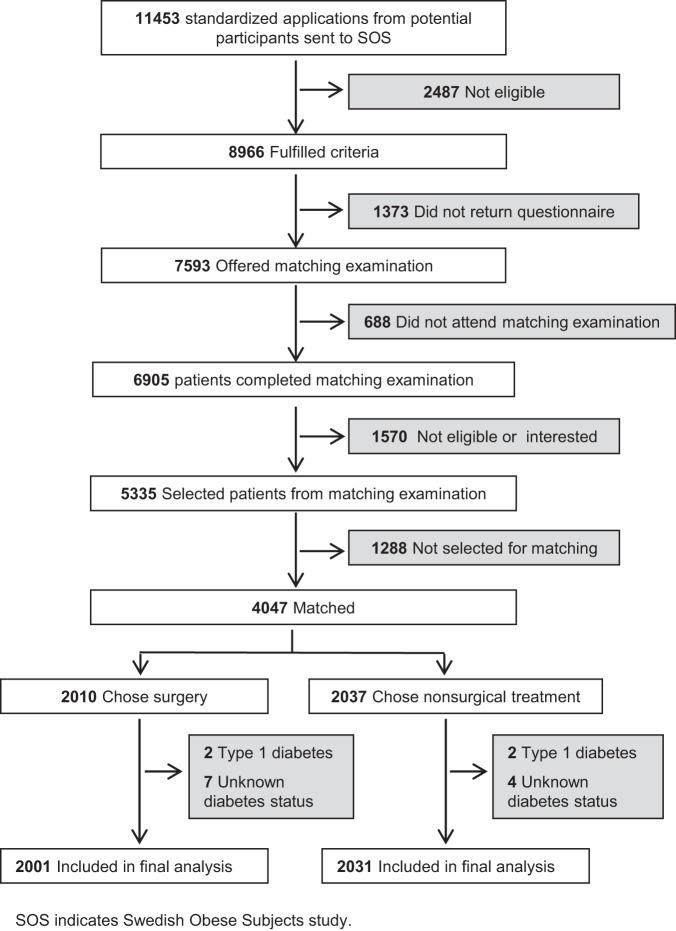
The study included 2010 patients with obesity who underwent bariatric surgery and 2037 matched controls, eligible for surgery. The surgery group underwent gastric bypass (n = 265), banding (n = 376), or vertical banded gastroplasty (n = 1369). The control group (n = 2037) received usual obesity care. Causes of death were obtained from the Swedish Cause of Death Register, case sheets and autopsy reports, in patients with baseline T2D (n = 392 surgery patients/n = 305 controls) or non-T2D (n = 1609 surgery patients/n = 1726 controls) during a median follow-up 26 years.
RESULTS
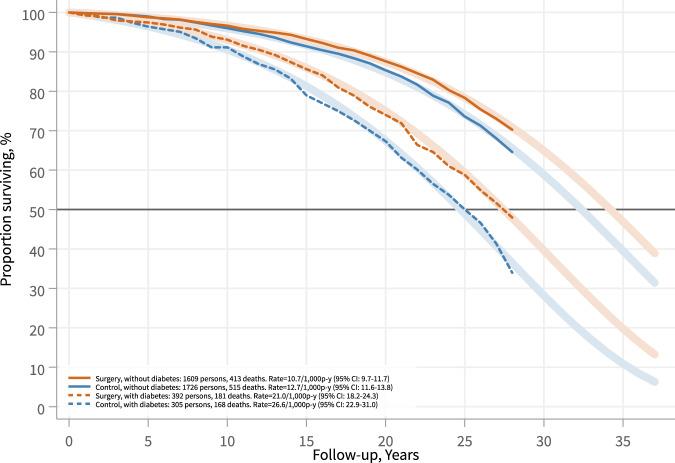
In T2D and non-T2D subgroups, bariatric surgery was associated with increased life expectancy (2.1, 95% confidence interval (95% CI) 0.2-4.0; and 1.6, 0.5-2.7 years, respectively) and reduced overall mortality (adjusted hazard ratio (adjHR) = 0.77, 95% CI: 0.61-0.97; and 0.82, 0.72-0.94, respectively), and the treatment benefit was similar (interaction p = 0.615). Bariatric surgery was associated with reduced cardiovascular mortality in both subgroups (adjHR = 0.65, 95% CI: 0.46-0.91; and 0.70, 0.55-0.88, respectively (interaction p = 0.516)).
CONCLUSIONS
Bariatric surgery is associated with similar reduction of overall and cardiovascular mortality and increased life expectancy regardless of baseline diabetes status.
目的
在瑞典肥胖患者研究中,根据基线 2 型糖尿病(T2D)情况,确定减肥手术后的预期寿命和死亡原因。
方法
该研究纳入了 2010 名接受减肥手术的肥胖患者和 2037 名符合手术条件的匹配对照者。手术组接受胃旁路术(n=265)、带术(n=376)或垂直束带胃成形术(n=1369)。对照组(n=2037)接受常规肥胖治疗。在基线 T2D(手术患者 n=392/对照者 n=305)或非 T2D(手术患者 n=1609/对照者 n=1726)患者中,通过瑞典死因登记处、病例记录和尸检报告获得死亡原因。中位随访 26 年后进行分析。
结果
在 T2D 和非 T2D 亚组中,减肥手术与预期寿命延长相关(分别为 2.1 年,95%置信区间 95%CI:0.2-4.0;和 1.6 年,95%CI:0.5-2.7),总死亡率降低(校正后的危险比 adjHR:0.77,95%CI:0.61-0.97;和 0.82,95%CI:0.72-0.94),治疗获益相似(交互作用 p=0.615)。两组亚组的心血管死亡率均降低(adjHR:0.65,95%CI:0.46-0.91;和 0.70,95%CI:0.55-0.88)(交互作用 p=0.516)。
结论
无论基线糖尿病状况如何,减肥手术都可降低总死亡率和心血管死亡率,延长预期寿命,效果相似。

 Zotero 插件