
乳腺癌患者诊断为第二原发性恶性肿瘤后的生存分析,重点关注第二原发性血液系统恶性肿瘤。
Survival analysis of breast cancer patients after diagnosis of second primary malignancies, focusing on the second primary hematologic malignancy.
作者信息
Kim Hyung Jin, Lee Juhyeon, Park In-Chul, Han Yireh, Seong Min-Ki, Noh Woo Chul, Kang Hye Jin, Kim Hyun-Ah, Park Chan Sub
机构信息
Department of Surgery, Korea Cancer Center Hospital, Korea Institute of Radiological and Medical Sciences, Seoul, Korea.
Division of Fusion Radiology Research, Korea Institute of Radiological & Medical Sciences, Seoul, Korea.
出版信息
Ann Surg Treat Res. 2023 Jul;105(1):1-9. doi: 10.4174/astr.2023.105.1.1. Epub 2023 Jul 4.
PURPOSE
Although the overall survival (OS) of breast cancer patients is increasing with improved detection and therapies, so is the risk of breast cancer patients developing subsequent malignancies. We investigated the OS of breast cancer survivors according to sites of second primary malignancies (SPM). The OS of the second primary hematologic malignancy (SPHM) was then compared with that of metastatic breast cancer (MBC).
METHODS
We retrospectively analyzed patients diagnosed with primary breast cancer between 1998 and 2019. Only those with SPM were eligible for analysis. First, the OS of patients with SPM diagnosed as the first event after the diagnosis of breast cancer was analyzed. Next, the OS of patients with SPHM, with or without breast cancer relapse, was compared with that of patients with MBC, matched using the propensity score.
RESULTS
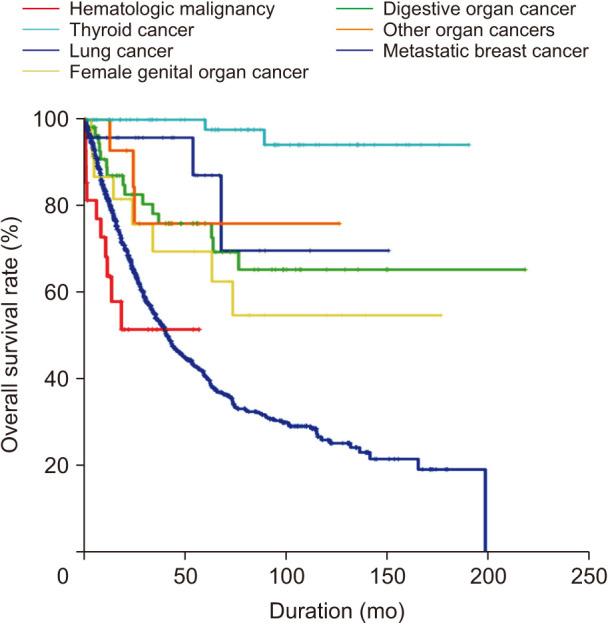
Patients diagnosed with SPM without breast cancer relapse as the first event had a significantly better OS than did patients with MBC, but the OS of those with SPHM as the first event did not differ significantly from that of patients with MBC (hazard ratio [HR], 1.558; 95% confidence interval [CI], 0.856-2.839; P = 0.147). The OS of patients with SPHM with or without breast cancer relapse was worse than that of the MBC group after propensity score matching (HR, 1.954; 95% CI, 1.045-3.654; P = 0.036).
CONCLUSION
Prognosis of SPM diagnosed as the first event was statistically better than that of MBC, except in case of SPHM. Patients with SPHM, with or without MBC, showed poor OS before and after propensity score matching.
目的
尽管随着检测和治疗方法的改进,乳腺癌患者的总生存期(OS)在增加,但乳腺癌患者发生后续恶性肿瘤的风险也在增加。我们根据第二原发性恶性肿瘤(SPM)的部位研究了乳腺癌幸存者的总生存期。然后将第二原发性血液系统恶性肿瘤(SPHM)的总生存期与转移性乳腺癌(MBC)的总生存期进行比较。
方法
我们回顾性分析了1998年至2019年间被诊断为原发性乳腺癌的患者。只有那些患有SPM的患者才有资格进行分析。首先,分析了在乳腺癌诊断后被诊断为第一事件的SPM患者的总生存期。接下来,将有或无乳腺癌复发的SPHM患者的总生存期与使用倾向评分匹配的MBC患者的总生存期进行比较。
结果
以无乳腺癌复发作为第一事件被诊断为SPM的患者的总生存期明显优于MBC患者,但以SPHM作为第一事件的患者的总生存期与MBC患者的总生存期无显著差异(风险比[HR],1.558;95%置信区间[CI],0.856 - 2.839;P = 0.147)。在倾向评分匹配后,有或无乳腺癌复发的SPHM患者的总生存期比MBC组更差(HR,1.954;95%CI,1.045 - 3.654;P = 0.036)。
结论
除SPHM外,被诊断为第一事件的SPM的预后在统计学上优于MBC。有或无MBC的SPHM患者在倾向评分匹配前后的总生存期均较差。


 Zotero 插件