
社会福祉对人群饮食营养价值及抗自由基状态的影响
The Impact of Social Well-Being on Population Diet Nutritional Value and Antiradical Status.
作者信息
Gorbachev Victor, Nikitin Igor, Velina Daria, Zhuchenko Natalia, Kosenkov Alexander N, Sokolov Andrey, Zavalishin Igor, Stolyarova Alla, Nikulchev Evgeny
机构信息
Research Laboratory of Nutritional Systems Biotechnology, The Plekhanov Russian University of Economics, 36 Stremyanny Per., 117997 Moscow, Russia.
Department of Biotechnology of Food Products from Plant and Animal Raw Materials, K.G. Razumovsky Moscow State University of Technologies and Management (the First Cossack University), 73 Zemlyanoy Val, 109004 Moscow, Russia.
出版信息
Foods. 2023 Jul 6;12(13):2619. doi: 10.3390/foods12132619.
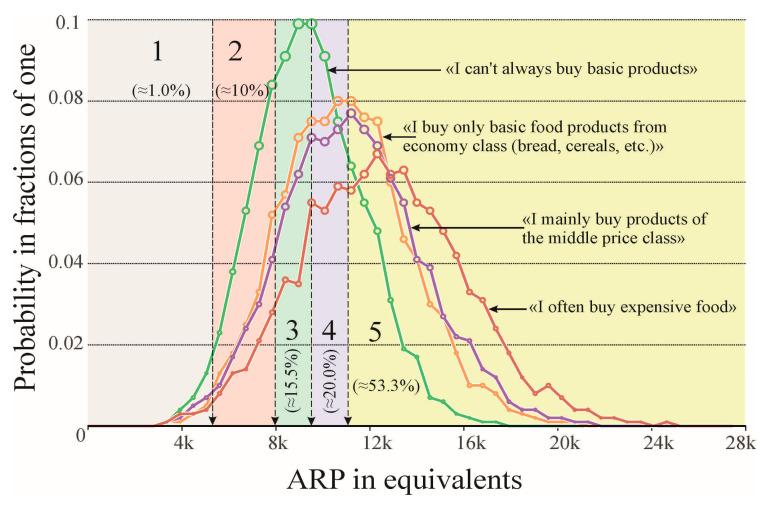
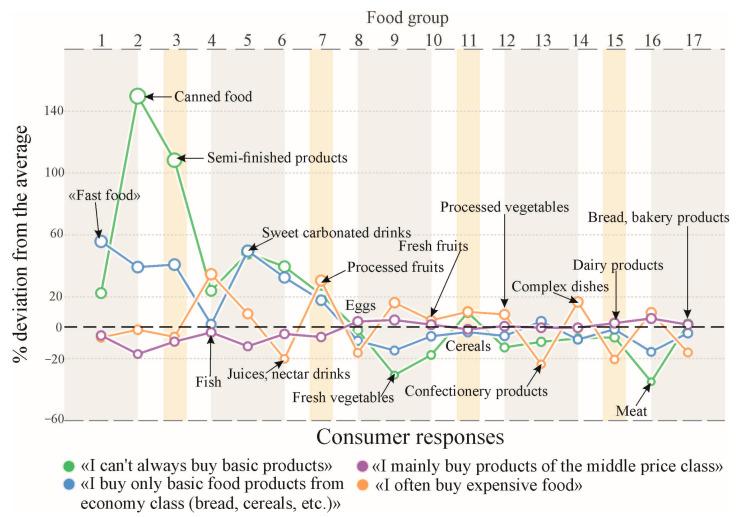
The paper presents the result of assessing the antiradical status of consumers (in the context of Russia) in connection with their well-being. This approach is based on a multistage study, in which the results of sociological surveys were applied, as well as estimates of the antiradical potential (ARP) of diets obtained using neural networks, bootstrapping the chemical composition of diets, and calculating reference values using mathematical models. The paper presents data collected from residents living in the territories of at least 21 regions and cities of Russia: Magadan, Saint Petersburg, Moscow, Krasnodar, Lipetsk, Vladivostok, Novosibirsk, Omsk, Voronezh, etc. A total of 1001 people were interviewed, which, according to our calculations, gives a margin of error in value of approximately 3.1%. To calculate the lack of vitamins in the diets of residents of the Russian Federation, data on the chemical composition of food products from the FNDDS database were used. The assessment of dietary habits showed a lack of vitamins below the recommended level in 73% of Russians for vitamin D, 59% for retinol, 38% for β-carotenes, 13% for vitamin E, and 6% for ascorbic acid. The study showed that at least 36% of the Russian population has a low antiradical status, while it was found that "poor" consumers are more likely to consume economically more expensive foods (in terms of their nutritional value). The "poor" segments of the population consume 180-305% more canned food and 38-68% more sweet carbonated drinks than other social groups, but their consumption of vegetables is 23-48% lower. On the contrary, "wealthy" consumers consume 17-25% more complex (varied) dishes, 10-68% more fresh vegetables, and 8-39% more fish. From the obtained values it follows that consumers with low levels of ARP in their diets are in a group with an increased probability of a number of "excess" diseases (diseases of the cardiovascular system, obesity, etc.). In general, the ARP values of food consumed for low-income segments of the population were 2.3 times lower (the ratio was calculated as the percentage of consumers below the level of 11,067 equivalents necessary for the disposal of free radicals generated in the human body per day) than for those who can afford expensive food (consumers with high income). A simple increase in consumption of unbalanced foods, in our opinion, will only contribute to the entry of these consumers into the "average diet trap". All this makes it imperative to develop comprehensive measures to create a new concept of public catering; otherwise, we can expect a reduction in both the health of the population and the performance of the economy of the whole country.
本文介绍了一项关于消费者抗自由基状态(以俄罗斯为例)及其健康状况的评估结果。该方法基于一项多阶段研究,其中应用了社会学调查结果,以及使用神经网络对饮食的抗自由基潜力(ARP)进行的评估、对饮食化学成分的自展法分析,并用数学模型计算参考值。本文展示了从俄罗斯至少21个地区和城市的居民那里收集的数据:马加丹、圣彼得堡、莫斯科、克拉斯诺达尔、利佩茨克、符拉迪沃斯托克、新西伯利亚、鄂木斯克、沃罗涅日等。总共采访了1001人,根据我们的计算,其数值误差幅度约为3.1%。为了计算俄罗斯联邦居民饮食中维生素的缺乏情况,使用了FNDDS数据库中食品化学成分的数据。饮食习惯评估显示,73%的俄罗斯人饮食中维生素D低于推荐水平,59%的人视黄醇缺乏,38%的人β-胡萝卜素缺乏,13%的人维生素E缺乏,6%的人抗坏血酸缺乏。研究表明,至少36%的俄罗斯人口抗自由基状态较低,同时发现“贫困”消费者更倾向于消费营养价值上经济成本更高的食物。与其他社会群体相比,人口中的“贫困”阶层食用的罐头食品多180 - 305%,甜味碳酸饮料多38 - 68%,但蔬菜消费量低23 - 48%。相反,“富裕”消费者食用的复杂(多样)菜肴多17 - 25%,新鲜蔬菜多10 - 68%,鱼类多8 - 39%。从所得数据可以看出,饮食中ARP水平低的消费者患一系列“过剩”疾病(心血管系统疾病、肥胖症等)的概率较高。总体而言,低收入人群所消费食物的ARP值比那些能买得起昂贵食物(高收入消费者)的人群低2.3倍(该比率是通过低于人体每天清除自由基所需的11,067当量水平的消费者百分比计算得出)。我们认为,单纯增加不均衡食物的消费量只会促使这些消费者陷入“平均饮食陷阱”。所有这些都使得制定全面措施以创建公共饮食新概念成为当务之急;否则,我们可能会看到人口健康状况下降以及整个国家经济表现下滑。


 Zotero 插件