
IRI 可视化在羟基苯甲酸异构体太赫兹振动光谱中的应用。
Application of IRI Visualization to Terahertz Vibrational Spectroscopy of Hydroxybenzoic Acid Isomers.
机构信息
School of Electronic Engineering and Automation, Guilin University of Electronic Technology, Guilin 541004, China.
Guangxi Key Laboratory of Nuclear Physics and Technology, Guangxi Normal University, Guilin 541004, China.
出版信息
Int J Mol Sci. 2023 Jun 21;24(13):10417. doi: 10.3390/ijms241310417.
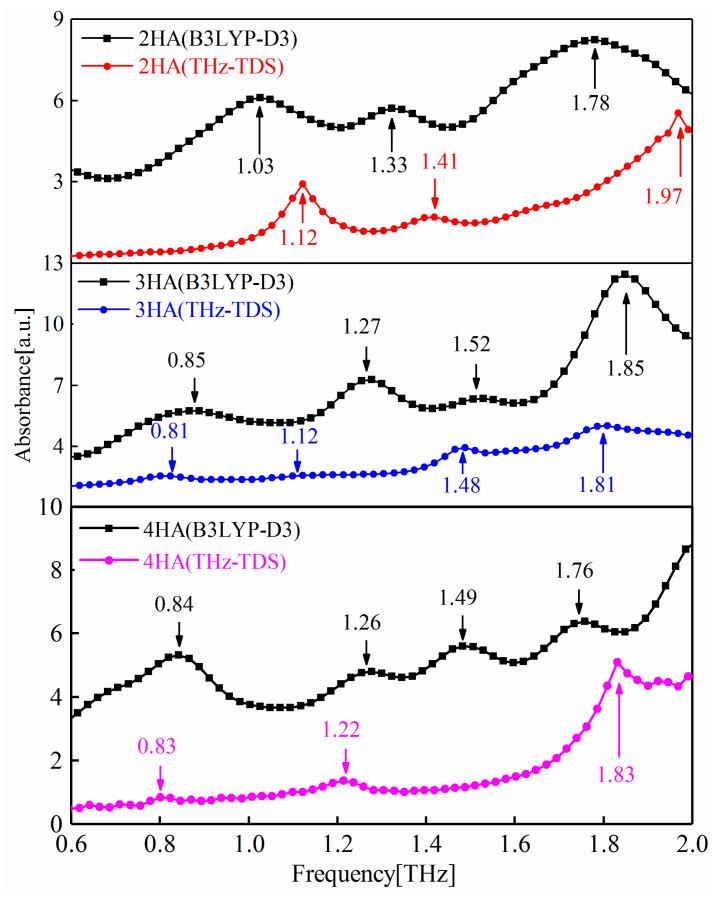
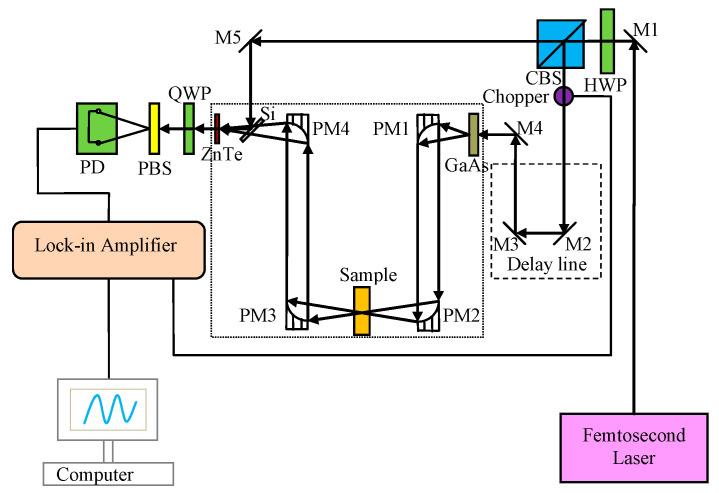
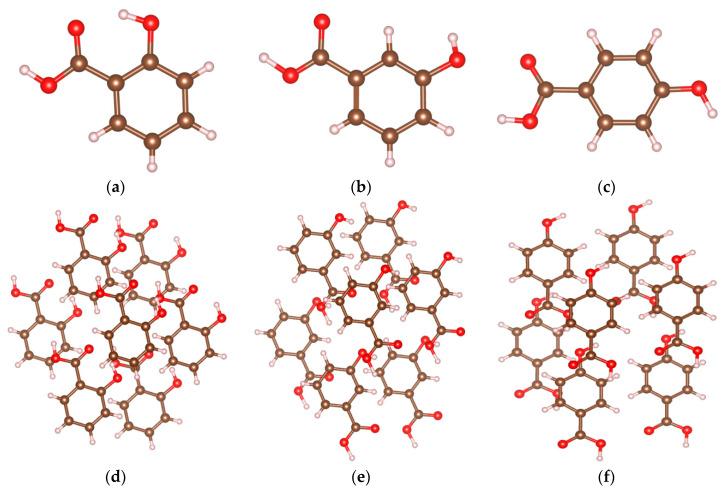
The characteristic absorption spectra of three positional isomers of hydroxybenzoic acid are measured using a terahertz time-domain spectroscopy system (THz-TDS) in the 0.6-2.0 THz region at room temperature. Significant differences in their terahertz spectra are discovered, which indicates that THz-TDS is an effective means to identify positional isomers. In order to simulate their spectra, the seven molecular clusters of 2-, 3-, and 4-hydroxybenzoic acid (2-, 3-, and 4-HA) are calculated using the DFT-D3 method. Additionally, the potential energy distribution (PED) method is used to analyze their vibration modes. The analysis indicates that the vibration modes of 2-HA are mainly out-of-plane angle bending and bond angle bend in plane. The vibration modes of 3-HA are mainly bond length stretch and dihedral angle torsion. The vibration modes of 4-HA are mainly bond angle bend in plane and dihedral angle torsion. Interaction region indicator (IRI) analysis is used to visualize the location and type of intermolecular interactions in 2-, 3-, and 4-HA crystals. The results show that the weak interaction type of 2-, 3-, and 4-HA is dominated by van der Waals (vdW) interaction. Therefore, we can confirm that terahertz spectroscopy detection technology can be used as an effective means to identify structural isomers and detect the intermolecular interactions in these crystals. In addition, it can explain the absorption mechanism of terahertz waves interacting with matter.
室温下,利用太赫兹时域光谱系统(THz-TDS)在 0.6-2.0THz 区域测量了三种羟基苯甲酸位置异构体的特征吸收光谱。发现它们的太赫兹光谱存在显著差异,表明 THz-TDS 是识别位置异构体的有效手段。为了模拟它们的光谱,使用 DFT-D3 方法计算了 2-、3-和 4-羟基苯甲酸(2-、3-和 4-HA)的七个分子簇。此外,还使用势能分布(PED)方法分析了它们的振动模式。分析表明,2-HA 的振动模式主要是面外角度弯曲和键角弯曲。3-HA 的振动模式主要是键长拉伸和二面角扭转。4-HA 的振动模式主要是平面内键角弯曲和二面角扭转。交互区域指标(IRI)分析用于可视化 2-、3-和 4-HA 晶体中分子间相互作用的位置和类型。结果表明,2-、3-和 4-HA 的弱相互作用类型主要由范德华(vdW)相互作用主导。因此,我们可以确认太赫兹光谱检测技术可作为识别结构异构体和检测这些晶体中分子间相互作用的有效手段。此外,它可以解释太赫兹波与物质相互作用的吸收机制。



 Zotero 插件