
干细胞及基于干细胞衍生细胞外囊泡的疗法在阿尔茨海默病治疗中的最新进展。
An update on stem cell and stem cell-derived extracellular vesicle-based therapy in the management of Alzheimer's disease.
作者信息
Jeyaraman Madhan, Rajendran Ramya Lakshmi, Muthu Sathish, Jeyaraman Naveen, Sharma Shilpa, Jha Saurabh Kumar, Muthukanagaraj Purushothaman, Hong Chae Moon, Furtado da Fonseca Lucas, Santos Duarte Lana José Fábio, Ahn Byeong-Cheol, Gangadaran Prakash
机构信息
Department of Orthopaedics, ACS Medical College and Hospital, Dr MGR Educational and Research Institute, Chennai, Tamil Nadu, 600056, India.
Department of Biotechnology, School of Engineering and Technology, Sharda University, Greater Noida, Uttar Pradesh, 201310, India.
出版信息
Heliyon. 2023 Jun 29;9(7):e17808. doi: 10.1016/j.heliyon.2023.e17808. eCollection 2023 Jul.
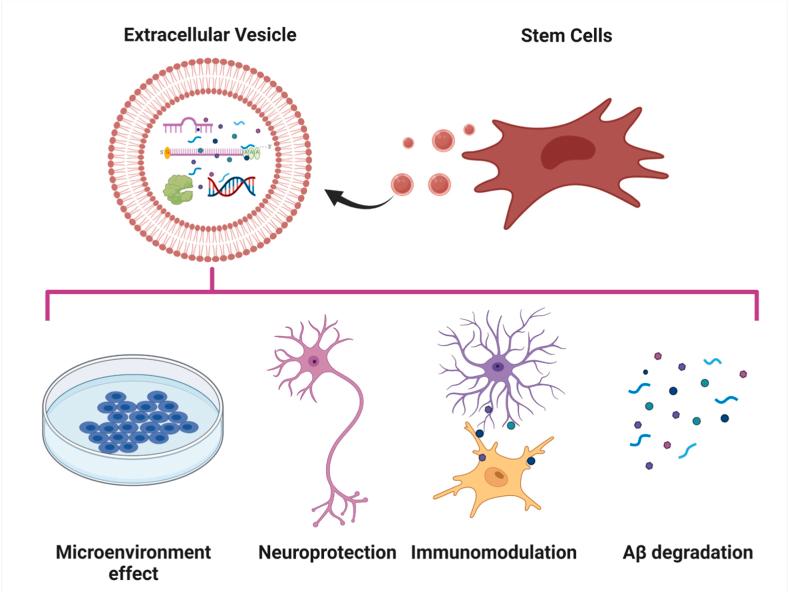
Globally, neurological diseases pose a major burden to healthcare professionals in terms of the management and prevention of the disorder. Among neurological diseases, Alzheimer's disease (AD) accounts for 50%-70% of dementia and is the fifth leading cause of mortality worldwide. AD is a progressive, degenerative neurological disease, with the loss of neurons and synapses in the cerebral cortex and subcortical regions. The management of AD remains a debate among physicians as no standard and specific "disease-modifying" modality is available. The concept of 'Regenerative Medicine' is aimed at regenerating the degenerated neural tissues to reverse the pathology in AD. Genetically modified engineered stem cells modify the course of AD after transplantation into the brain. Extracellular vesicles (EVs) are an emerging new approach in cell communication that involves the transfer of cellular materials from parental cells to recipient cells, resulting in changes at the molecular and signaling levels in the recipient cells. EVs are a type of vesicle that can be transported between cells. Many have proposed that EVs produced from mesenchymal stem cells (MSCs) may have therapeutic promise in the treatment of AD. The biology of AD, as well as the potential applications of stem cells and their derived EVs-based therapy, were explored in this paper.
在全球范围内,神经系统疾病在疾病管理和预防方面给医疗保健专业人员带来了重大负担。在神经系统疾病中,阿尔茨海默病(AD)占痴呆症的50%-70%,是全球第五大死因。AD是一种进行性、退行性神经系统疾病,大脑皮层和皮层下区域的神经元和突触会丧失。由于没有标准且特定的“疾病修正”方法,AD的治疗在医生中仍然存在争议。“再生医学”的概念旨在使退化的神经组织再生,以逆转AD的病理过程。基因改造的工程干细胞在移植到大脑后可改变AD的病程。细胞外囊泡(EVs)是细胞通讯中一种新兴的新方法,涉及细胞物质从亲代细胞转移到受体细胞,导致受体细胞在分子和信号水平上发生变化。EVs是一种可在细胞间运输的囊泡。许多人提出,间充质干细胞(MSCs)产生的EVs在AD治疗中可能具有治疗前景。本文探讨了AD的生物学特性以及基于干细胞及其衍生EVs的治疗的潜在应用。
 Zotero 插件