
莫博替尼治疗非小细胞肺癌的临床效用——患者选择与报告结果
Clinical Utility of Mobocertinib in the Treatment of NSCLC - Patient Selection and Reported Outcomes.
作者信息
Arnold Abram, Ganti Apar Kishor
机构信息
Department of Medicine, Veterans Affairs Nebraska-Western Iowa Health Care System, Omaha, NE, USA.
Division of Oncology/Hematology, Department of Internal Medicine, Veterans Affairs Nebraska-Western Iowa Health Care System and University of Nebraska Medical Center, Omaha, NE, USA.
出版信息
Onco Targets Ther. 2023 Jul 11;16:559-569. doi: 10.2147/OTT.S374489. eCollection 2023.
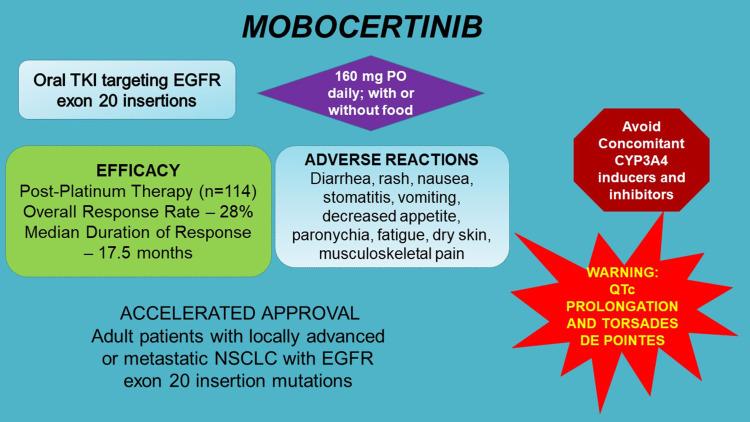
Mobocertinib is an oral tyrosine kinase inhibitor (TKI) that selectively targets epidermal growth factor receptor exon 20 insertion (EGFRex20ins) mutations. It is a structural analog of the third-generation TKI osimertinib, which targets EGFR T790M mutant non-small cell lung cancer (NSCLC); however, mobocertinib gains selectivity for EGFRex20ins mutants over wild type (WT) by interacting with the C790 gatekeeper residue of EGFR. This is accomplished via a carboxylated isopropyl ester moiety at the C5-position of mobocertinib's central pyrimidine core. In Phase 1/2 dose-escalation and dose-expansion studies, mobocertinib was found to have an investigator-confirmed overall response rate (ORR) of 56% (9/16; 95% CI: 30-80%) and 25% (3/12; 95% CI: 5-57%) in patients without and with baseline brain metastasis, respectively. Median investigator-assessed progression-free survival (mPFS) was 10.2 months (95% CI: 5.6 - not reached) and 3.7 months (95% CI: 1.8-15.9) in patients without and with baseline brain metastasis, respectively. A third phase evaluated patients who had received pre-treatment with platinum-based chemotherapy (PPP) and included an extension cohort (EXCLAIM cohort) which evaluated patients treated previously with 1 or 2 lines of therapy. An Independent Review Committee (IRC) found both cohorts to have similar outcomes in terms of ORR, median time to response, mPFS, and disease progression or death. The treatment-emergent adverse events (TEAE) related to mobocertinib are similar to other EGFR inhibitors and are predominately gastrointestinal (eg diarrhea, nausea, vomiting) and cutaneous (eg rash). In September 2021, the FDA granted accelerated approval for mobocertinib in the treatment of patients with locally advanced or metastatic NSCLC with EGFRex20ins mutation whose disease progressed while on platinum-based chemotherapy. The present review describes data that led to the approval of mobocertinib.
莫博替尼是一种口服酪氨酸激酶抑制剂(TKI),可选择性靶向表皮生长因子受体外显子20插入(EGFRex20ins)突变。它是第三代TKI奥希替尼的结构类似物,后者靶向EGFR T790M突变的非小细胞肺癌(NSCLC);然而,莫博替尼通过与EGFR的C790守门残基相互作用,对EGFRex20ins突变体的选择性高于野生型(WT)。这是通过莫博替尼中心嘧啶核心C5位的羧化异丙酯部分实现的。在1/2期剂量递增和剂量扩展研究中,在无基线脑转移和有基线脑转移的患者中,莫博替尼经研究者确认的总缓解率(ORR)分别为56%(9/16;95%CI:30-80%)和25%(3/12;95%CI:5-57%)。研究者评估的无进展生存期(mPFS)中位数在无基线脑转移和有基线脑转移的患者中分别为10.2个月(95%CI:5.6-未达到)和3.7个月(95%CI:1.8-15.9)。第三阶段评估了接受过铂类化疗(PPP)预处理的患者,并包括一个扩展队列(EXCLAIM队列),该队列评估了先前接受过1或2线治疗的患者。一个独立审查委员会(IRC)发现,两个队列在ORR、中位缓解时间、mPFS以及疾病进展或死亡方面的结果相似。与莫博替尼相关的治疗中出现的不良事件(TEAE)与其他EGFR抑制剂相似,主要是胃肠道(如腹泻、恶心、呕吐)和皮肤方面的(如皮疹)。2021年9月,美国食品药品监督管理局(FDA)加速批准莫博替尼用于治疗患有局部晚期或转移性NSCLC且伴有EGFRex20ins突变、在铂类化疗期间疾病进展的患者。本综述描述了导致莫博替尼获批的数据。
 Zotero 插件