
苏丹不明原因女性不孕症的特征及危险因素:一项病例对照研究。
Characterization and risk factors for unexplained female infertility in Sudan: A case-control study.
作者信息
Abdullah Abdullah Abdulslam, Ahmed Musa, Oladokun Adesina
机构信息
Reproductive Health Sciences Program, Pan African University Life and Earth Sciences Institute, University of Ibadan, Ibadan 119, Oyo state, Nigeria.
Department of Obstetrics and Gynecology, College of Medicine, University of Ibadan, Ibadan 119, Oyo state, Nigeria.
出版信息
World J Methodol. 2023 Jun 20;13(3):98-117. doi: 10.5662/wjm.v13.i3.98.
BACKGROUND
Female infertility with unknown causes (unexplained) remains one of the mysteries in the reproductive health field, where the diagnostic evidence is still weak and the proposed treatments still work with unknown methods. However, several studies have proposed some possible causes and risk factors for unexplained female infertility.
AIM
To characterize and identify factors associated with unexplained infertility in Sudanese women.
METHODS
A matched (age and body mass index) case-control study was conducted from March 2021 to February 2022. The study samples were 210 women with unexplained infertility (UI) and 190 fertile women of reproductive age who were attending the maternity hospitals and fertility clinics in Khartoum, Sudan. The risk factors of unexplained infertility were identified using a structured, pre-tested questionnaire containing information on socio-demographic variables, anthropometrics, clinical diagnosis of infertility, behavioral factors, physical activity assessment, diversity, and consumption of different food groups by the study participants.
RESULTS
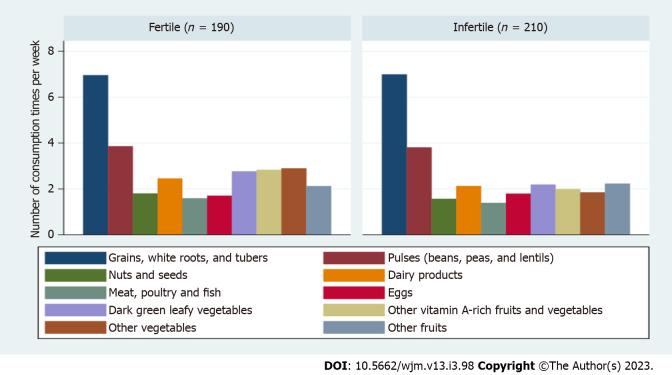
The results showed a higher proportion of women diagnosed with UI were residents of rural areas than controls (21.4% 11.1%, < 0.05), and previous miscarriages and/or abortions were more common in fertile women compared with infertile women (13.16% 5.71%, < 0.05). Additionally, infertile women had a significantly ( < 0.05) higher proportion of family history of infertility (explained and unexplained) compared with controls. Finally, after controlling for the effects of potentially confounding variables using multivariable logistic regression analysis, only marital status, family history of infertility, use of modern contraceptives, smoking, caffeine consumption, physical activity level, meals consumed, other vitamin-A-rich fruits and vegetables, and other vegetables were found to be significant ( < 0.05) factors associated with unexplained infertility among Sudanese women.
CONCLUSION
Married women with a family history of infertility who smoke and consume a high amount of caffeine, who live a sedentary lifestyle, and who consume more than two meals free of vitamin-A-rich fruits and/or vegetables and/or other vegetables per day are at the highest risk of developing unexplained infertility.
背景
不明原因的女性不孕症仍是生殖健康领域的谜团之一,其诊断证据仍然薄弱,所提出的治疗方法的作用机制也尚不清楚。然而,多项研究提出了一些可能导致不明原因女性不孕症的原因和风险因素。
目的
对苏丹女性不明原因不孕症的相关因素进行特征描述和识别。
方法
于2021年3月至2022年2月开展了一项匹配(年龄和体重指数)的病例对照研究。研究样本包括210名不明原因不孕症(UI)女性和190名育龄期可育女性,她们均来自苏丹喀土穆的妇产医院和生育诊所。通过一份经过预测试的结构化问卷来确定不明原因不孕症的风险因素,问卷内容包括社会人口统计学变量、人体测量学、不孕症的临床诊断、行为因素、身体活动评估、多样性以及研究参与者对不同食物组的消费情况。
结果
结果显示,被诊断为UI的女性中农村居民的比例高于对照组(21.4%对11.1%,P<0.05),与不孕女性相比,可育女性既往流产和/或堕胎更为常见(13.16%对5.71%,P<0.05)。此外,与对照组相比,不孕女性中不孕症家族史(包括已知原因和不明原因)的比例显著更高(P<0.05)。最后,在使用多变量逻辑回归分析控制潜在混杂变量的影响后,发现只有婚姻状况、不孕症家族史、现代避孕药具的使用、吸烟、咖啡因摄入量、身体活动水平、用餐次数、其他富含维生素A的水果和蔬菜以及其他蔬菜是与苏丹女性不明原因不孕症相关的显著(P<0.05)因素。
结论
有不孕症家族史、吸烟且大量摄入咖啡因、生活方式久坐、每天食用超过两顿不含富含维生素A的水果和/或蔬菜及/或其他蔬菜餐食的已婚女性患不明原因不孕症的风险最高。

 Zotero 插件