
教育对衰老过程中海马体体积变化与记忆表现之间的关联没有调节作用。
No moderating influence of education on the association between changes in hippocampus volume and memory performance in aging.
作者信息
Lövdén Martin, Pagin Amos, Bartrés-Faz David, Boraxbekk Carl-Johan, Brandmaier Andreas M, Demnitz Naiara, Drevon Christian A, Ebmeier Klaus P, Fjell Anders M, Ghisletta Paolo, Gorbach Tetiana, Lindenberger Ulman, Plachti Anna, Walhovd Kristine B, Nyberg Lars
机构信息
Department of Psychology, University of Gothenburg, Gothenburg, Sweden.
Department of Medicine, Faculty of Medicine and Health Sciences and Institute of Neurosciences, University of Barcelona, Institut d'Investigacions Biomèdiques August Pi I Sunyer (IDIBAPS), Barcelona, Spain.
出版信息
Aging Brain. 2023 Jun 28;4:100082. doi: 10.1016/j.nbas.2023.100082. eCollection 2023.
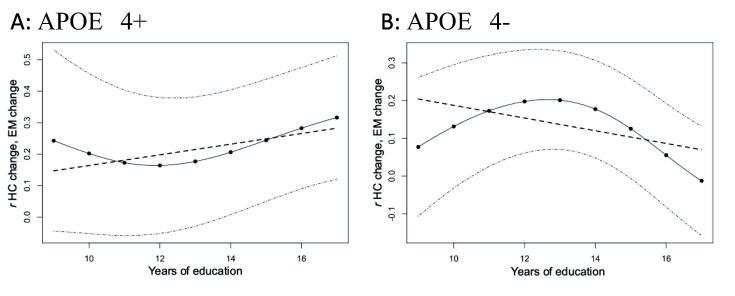
Contemporary accounts of factors that may modify the risk for age-related neurocognitive disorders highlight education and its contribution to a cognitive reserve. By this view, individuals with higher educational attainment should show weaker associations between changes in brain and cognition than individuals with lower educational attainment. We tested this prediction in longitudinal data on hippocampus volume and episodic memory from 708 middle-aged and older individuals using local structural equation modeling. This technique does not require categorization of years of education and does not constrain the shape of relationships, thereby maximizing the chances of revealing an effect of education on the hippocampus-memory association. The results showed that the data were plausible under the assumption that there was no influence of education on the association between change in episodic memory and change in hippocampus volume. Restricting the sample to individuals with elevated genetic risk for dementia (APOE ε4 carriers) did not change these results. We conclude that the influence of education on changes in episodic memory and hippocampus volume is inconsistent with predictions by the cognitive reserve theory.
当代关于可能改变与年龄相关的神经认知障碍风险的因素的描述强调了教育及其对认知储备的贡献。按照这种观点,受教育程度较高的个体,其大脑变化与认知之间的关联应比受教育程度较低的个体更弱。我们使用局部结构方程模型,在708名中老年人的海马体体积和情景记忆的纵向数据中检验了这一预测。该技术不需要对受教育年限进行分类,也不限制关系的形式,从而最大限度地增加了揭示教育对海马体 - 记忆关联影响的机会。结果表明,在教育对情景记忆变化与海马体体积变化之间的关联没有影响这一假设下,数据是合理的。将样本限制为患痴呆症遗传风险较高的个体(APOE ε4携带者)并没有改变这些结果。我们得出结论,教育对情景记忆和海马体体积变化的影响与认知储备理论的预测不一致。

 Zotero 插件