
综合肺指数预测术后早期即将发生的呼吸事件的能力。
Ability of the integrated pulmonary index to predict impending respiratory events in the early postoperative period.
作者信息
Probst Stephen, Romeiser Jamie, Gan Tong J, Halper Darcy, Sisti Andrew R, Morimatsu Hiroshi, Sugimoto Kentaro, Bennett-Guerrero Elliott
机构信息
Department of Anesthesiology, Stony Brook University Medical Center, 101 Nicolls Road, Stony Brook, NY, 11794, USA.
Department of Anesthesiology and Resuscitology, Okayama University Hospital, Okayama, Japan.
出版信息
Perioper Med (Lond). 2023 Jul 17;12(1):39. doi: 10.1186/s13741-023-00322-2.
BACKGROUND
In the early postoperative period, respiratory compromise is a significant problem. Standard-of-care monitoring includes respiratory rate (RR) and pulse oximetry, which are helpful; however, low SpO is often a late sign during decompensation. The FDA-approved Capnostream-20p monitor records four variables (SpO, RR, End-tidal CO, heart rate), which are combined by fuzzy logic into a single, unit-less value (range 1-10) called the integrated pulmonary index (IPI). No published studies have assessed the performance of a low IPI to predict impending respiratory events.
METHODS
In this investigator-initiated study, adult patients undergoing general anesthesia were monitored with the Capnostream-20p monitor for up to 2 h during their recovery room stay. The study coordinator, who along with clinicians, was blinded to IPI values, recorded the time of any respiratory event, defined a priori as any one of eight respiratory-related interventions/conditions. The primary sensitivity endpoint (early detection success) was defined as at least 80% of events predicted by at least 2 consecutive low IPI (≤ 7) values within 2-15 min before an event occurred. Late detection was defined as low IPI values occurring with 2 min prior to or 2 min after the event occurred.
DISCUSSION
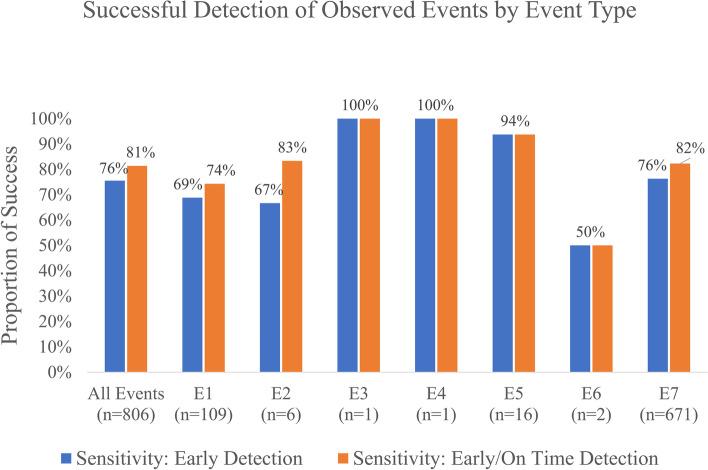
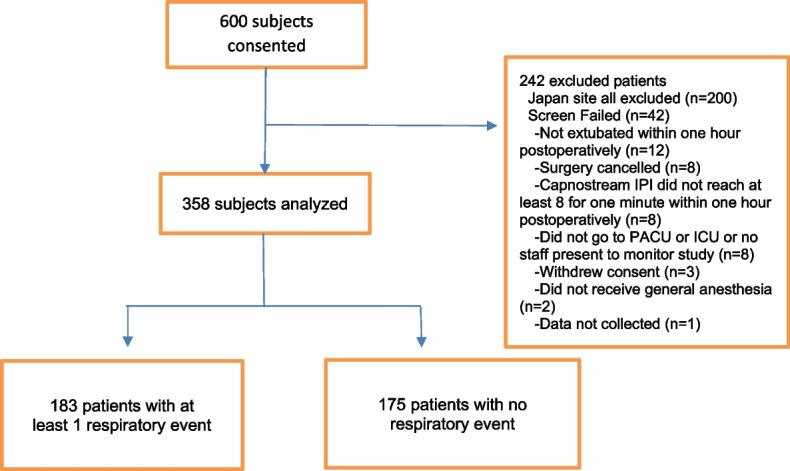
Of 358 patients, ≥ 1 respiratory event occurred in 183 (51.1%) patients. Of 802 total events, 606 were detected early (within 2-15 min prior to the event), and 653 were detected either early or late. Therefore, the sensitivity for early detection was 75.6% (95% confidence interval [CI]: 72.6-78.5%), which differed significantly from the 80% sensitivity goal by 4.4% (p = 0.0016). Sensitivity for total success (early or late) was 81.4% (95% CI: 78.7-84.1%), which was significantly different from the 90% on time sensitivity goal by 8.6% (p < 0.0001).
CONCLUSIONS
A low IPI was 75.6% sensitive for early detection (within 2-15 min) prior to respiratory events but did not achieve our preset threshold of 80% for success.
背景
在术后早期,呼吸功能受损是一个重大问题。标准护理监测包括呼吸频率(RR)和脉搏血氧饱和度,这些方法很有帮助;然而,低SpO₂往往是失代偿过程中的晚期体征。美国食品药品监督管理局(FDA)批准的Capnostream - 20p监测仪记录四个变量(SpO₂、RR、呼气末二氧化碳分压、心率),这些变量通过模糊逻辑组合成一个无单位的单一值(范围为1 - 10),称为综合肺指数(IPI)。尚无已发表的研究评估低IPI预测即将发生的呼吸事件的性能。
方法
在这项由研究者发起的研究中,成年全身麻醉患者在恢复室停留期间使用Capnostream - 20p监测仪监测长达2小时。研究协调员与临床医生对IPI值均不知情,记录任何呼吸事件的发生时间,呼吸事件预先定义为八种与呼吸相关的干预措施/情况中的任何一种。主要敏感性终点(早期检测成功率)定义为在事件发生前2 - 15分钟内至少2个连续低IPI(≤7)值预测的事件中至少80%。晚期检测定义为在事件发生前2分钟内或发生后2分钟内出现低IPI值。
讨论
在358例患者中,183例(51.1%)患者发生了≥1次呼吸事件。在总共802次事件中,606次被早期检测到(在事件发生前2 - 15分钟内),653次被早期或晚期检测到。因此,早期检测的敏感性为75.6%(95%置信区间[CI]:72.6 - 78.5%),与80%的敏感性目标相差4.4%,差异有统计学意义(p = 0.0016)。总体成功率(早期或晚期)的敏感性为81.4%(95% CI:78.7 - 84.1%),与90%的及时敏感性目标相差8.6%,差异有统计学意义(p < 0.0001)。
结论
低IPI对呼吸事件早期检测(在2 - 15分钟内)的敏感性为75.6%,但未达到我们预设的80%成功阈值。

 Zotero 插件