
直接作用抗病毒药物治疗丙型肝炎病毒合并精神障碍患者的真实世界疗效和安全性。
Real-world effectiveness and safety of direct-acting antivirals in hepatitis C virus patients with mental disorders.
机构信息
Department of Infectious Diseases and Hepatology, Faculty of Medicine, Nicolaus Copernicus University, Bydgoszcz 85-030, Poland.
Department of Infectious Diseases and Allergology, Jan Kochanowski University, Kielce 25-317, Poland.
出版信息
World J Gastroenterol. 2023 Jul 7;29(25):4085-4098. doi: 10.3748/wjg.v29.i25.4085.
BACKGROUND
It is estimated that 58 million people worldwide are infected with the hepatitis C virus (HCV). Patients with severe psychiatric disorders could not be treated with previously available interferon-based therapies due to their unfavorable side effect profile. This has changed with the introduction of direct-acting antivirals (DAA), although their real-life tolerance and effectiveness in patients with different psychiatric disorders remain to be demonstrated.
AIM
To evaluate the effectiveness and safety of DAA in patients with various mental illnesses.
METHODS
This was a retrospective observational study encompassing 14272 patients treated with DAA for chronic hepatitis C in 22 Polish hepatology centers, including 942 individuals diagnosed with a mental disorder (anxiety disorder, bipolar affective disorder, depression, anxiety-depressive disorder, personality disorder, schizophrenia, sleep disorder, substance abuse disorder, and mental illness without a specific diagnosis). The safety and effectiveness of DAA in this group were compared to those in a group without psychiatric illness ( = 13330). Antiviral therapy was considered successful if serum ribonucleic acid (RNA) of HCV was undetectable 12 wk after its completion [sustained virologic response (SVR)]. Safety data, including the incidence of adverse events (AEs), serious AEs (SAEs), and deaths, and the frequency of treatment modification and discontinuation, were collected during therapy and up to 12 wk after treatment completion. The entire study population was included in the intent-to-treat (ITT) analysis. Per-protocol (PP) analysis concerned patients who underwent HCV RNA evaluation 12 wk after completing treatment.
RESULTS
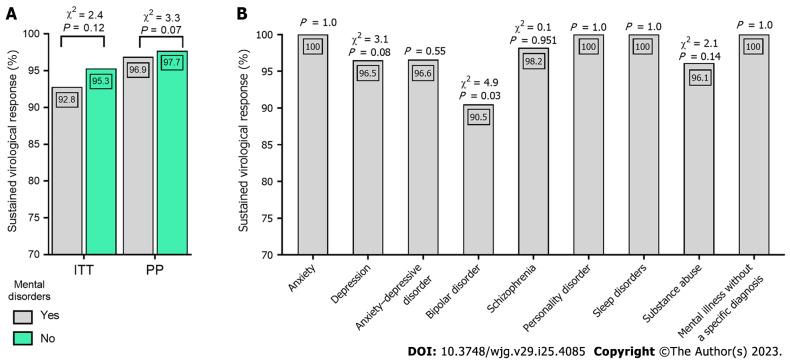
Among patients with mental illness, there was a significantly higher percentage of men, treatment-naive patients, obese, human immunodeficiency virus and hepatitis B virus-coinfected, patients with cirrhosis, and those infected with genotype 3 (GT3) while infection with GT1b was more frequent in the population without psychiatric disorders. The cure rate calculated PP was not significantly different in the two groups analyzed, with a SVR of 96.9% and 97.7%, respectively. Although patients with bipolar disorder achieved a significantly lower SVR, the multivariate analysis excluded it as an independent predictor of treatment non-response. Male sex, GT3 infection, cirrhosis, and failure of previous therapy were identified as independent negative predictors. The percentage of patients who completed the planned therapy did not differ between groups with and without mental disorders. In six patients, symptoms of mental illness (depression, schizophrenia) worsened, of which two discontinued treatments for this reason. New episodes of sleep disorders occurred significantly more often in patients with mental disorders. Patients with mental illness were more frequently lost to follow-up (4.2% 2.5%).
CONCLUSION
DAA treatment is safe and effective in HCV-infected patients with mental disorders. No specific psychiatric diagnosis lowered the chance of successful antiviral treatment.
背景
据估计,全球有 5800 万人感染了丙型肝炎病毒(HCV)。由于先前的干扰素为基础的治疗方案具有不利的副作用特征,患有严重精神疾病的患者无法接受治疗。随着直接作用抗病毒药物(DAA)的引入,这种情况已经发生了变化,尽管它们在不同精神疾病患者中的真实生活耐受性和有效性仍有待证明。
目的
评估 DAA 在各种精神疾病患者中的疗效和安全性。
方法
这是一项回顾性观察研究,包括 22 个波兰肝病中心的 14272 例接受 DAA 治疗慢性丙型肝炎的患者,其中 942 例被诊断为精神疾病(焦虑症、双相情感障碍、抑郁症、焦虑-抑郁障碍、人格障碍、精神分裂症、睡眠障碍、物质滥用障碍和无特定诊断的精神疾病)。该组与无精神疾病组(=13330)比较了 DAA 的安全性和有效性。如果在完成治疗后 12 周血清丙型肝炎病毒 RNA (HCV RNA)不可检测,则认为抗病毒治疗成功[持续病毒学应答(SVR)]。在治疗期间和治疗完成后 12 周内收集安全性数据,包括不良事件(AE)、严重不良事件(SAE)和死亡的发生率,以及治疗修改和停药的频率。整个研究人群均纳入意向治疗(ITT)分析。基于方案(PP)分析关注的是在完成治疗后 12 周接受 HCV RNA 评估的患者。
结果
在患有精神疾病的患者中,男性、初治患者、肥胖、人类免疫缺陷病毒和乙型肝炎病毒合并感染、肝硬化以及感染 3 型(GT3)的患者比例明显较高,而无精神疾病的患者中感染 GT1b 的比例较高。两组分析的 PP 计算的治愈率无显著差异,分别为 96.9%和 97.7%。尽管双相情感障碍患者的 SVR 明显较低,但多变量分析排除了其作为治疗无反应的独立预测因子。男性、GT3 感染、肝硬化和既往治疗失败被确定为独立的负预测因子。有和没有精神障碍的患者完成计划治疗的比例没有差异。有 6 例患者的精神疾病症状(抑郁、精神分裂症)恶化,其中 2 例因此停止治疗。精神障碍患者新发睡眠障碍的发生率明显较高。患有精神疾病的患者失访的频率更高(4.2% 2.5%)。
结论
DAA 治疗在患有精神障碍的 HCV 感染患者中是安全有效的。特定的精神科诊断不会降低成功抗病毒治疗的机会。
 Zotero 插件