
一场关于传授在急诊科领导对幼儿进行复苏的方法并提高住院医师舒适度的讲座。
A Lecture to Teach an Approach and Improve Resident Comfort in Leading Resuscitation of Young Infants in the Emergency Department.
作者信息
Whitehead Anne
机构信息
Indiana University School of Medicine, Department of Emergency Medicine, Division of Pediatric Emergency Medicine, Indianapolis, IN.
出版信息
J Educ Teach Emerg Med. 2022 Jan 15;7(1):L11-L18. doi: 10.21980/J8H36J. eCollection 2022 Jan.
AUDIENCE
The intended audience of this lecture is emergency medicine residents at all levels of training. It is also appropriate for practicing emergency physicians interested in improving comfort in resuscitating sick young infants, ages 0-60 days.
INTRODUCTION
The majority of sick and injured children in the United States are seen and treated in general emergency departments.1 This includes very young infants (0-60 days old) in need of immediate resuscitation. Resuscitation of children in this age group involves use of specific knowledge and skills that residents and emergency physicians in general have fewer opportunities to practice.2,3 Emergency medicine residents and practicing emergency physicians often report this as an area of particular discomfort in practice.4,5 It is important that the inconsistent and infrequent opportunities to resuscitate young infants during emergency medicine residency and beyond are supplemented by residency didactics that focus on improving comfort and skills with this population of sick children. This lecture focuses on a practical approach intended to improve the relevant knowledge, skills, and confidence required to stabilize a critically ill young infant in a general emergency department.
EDUCATIONAL OBJECTIVES
By the end of this lecture, participants should be able to:Apply a consistent approach to the initial resuscitation of a critically ill young infant in the emergency department.Select appropriate medications and equipment for use in resuscitation of critically ill young infants.Describe the components of the Pediatric Assessment Triangle,6 which can be used to identify critically ill infants and children.Improve comfort in resuscitating young infants in the emergency department.
EDUCATIONAL METHODS
This is a live lecture format using PowerPoint slides. The lecture emphasizes a practical approach to improve the skills and knowledge required for successful young infant resuscitation. It utilizes a case-based approach, and encourages the audience to determine next steps in care to mimic the real time decision-making required for care of critically ill young infants in the ED.
RESEARCH METHODS
Learners were asked to fill out anonymous pre- and post quizzes immediately prior to and directly after the lecture was given. These surveys included questions to assess resident knowledge as well as resident comfort as it pertained to resuscitation of critically ill young infants.
RESULTS
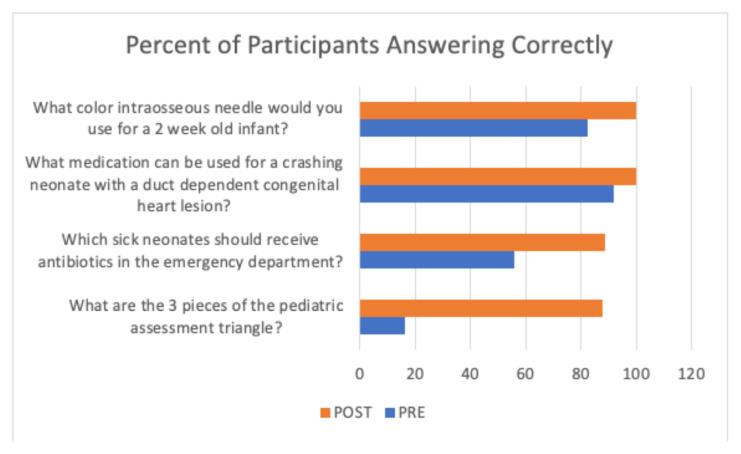
Resident comfort with resuscitation of young infants improved with a mean Standard Deviation (SD) pre-lecture rating of 23.1(14.9) on a 100-point visual analog scale and a mean (SD) post lecture rating of 46.7(14.6). Resident performance on all knowledge base questions improved on the post-lecture quiz for all four questions asked.
DISCUSSION
This lecture was effective in improving emergency medicine resident comfort and practical knowledge pertaining to resuscitation of young infants in the emergency department. The emphasis on a practical approach was well received by the resident audience, and they engaged well with audience participation portions of the lecture. The impact of the lecture can be enhanced by having the lecturer share their own real-world experience of resuscitation of young infants in the emergency department during the discussion portions of the lecture.
TOPICS
Neonatal resuscitation, infant resuscitation, pediatric assessment triangle, neonatal sepsis, congenital heart disease, congenital adrenal hyperplasia, non-accidental trauma, malrotation.
受众
本次讲座的目标受众是处于各级培训阶段的急诊医学住院医师。对于有意提高复苏0至60日龄患病幼婴能力和信心的在职急诊医师而言,本次讲座也同样适用。
引言
在美国,大多数患病和受伤儿童在综合急诊科接受诊治。这包括需要立即进行复苏的非常年幼的婴儿(0至60日龄)。对这一年龄组儿童进行复苏需要运用特定的知识和技能,而住院医师和急诊医师一般较少有机会实践这些知识和技能。急诊医学住院医师和在职急诊医师常常表示,这是他们在实际工作中特别感到棘手的领域。重要的是,在急诊医学住院医师培训期间及之后,对年幼婴儿进行复苏的机会不一致且不频繁,因此需要通过住院医师教学来补充,重点是提高对这类患病儿童的救治能力和技能。本次讲座重点介绍一种实用方法,旨在提高在综合急诊科稳定危重新生儿所需的相关知识、技能和信心。
教育目标
在本次讲座结束时,参与者应能够:对急诊科危重新生儿进行初始复苏时采用一致的方法。选择适用于危重新生儿复苏的药物和设备。描述儿科评估三角的组成部分,可用于识别危重新生儿和儿童。提高在急诊科复苏新生儿的信心。
教育方法
这是一种使用PowerPoint幻灯片的现场讲座形式。讲座强调采用实用方法来提高成功复苏新生儿所需的技能和知识。它采用基于案例的方法,并鼓励听众确定下一步的护理措施,以模拟在急诊科护理危重新生儿时所需的实时决策。
研究方法
要求学习者在讲座开始前和结束后立即填写匿名的课前和课后测验。这些调查包括评估住院医师知识以及与危重新生儿复苏相关的信心的问题。
结果
住院医师对新生儿复苏的信心有所提高,在100分的视觉模拟量表上,课前平均标准差(SD)评分为23.1(14.9),课后平均(SD)评分为46.7(14.6)。对于所问的所有四个知识基础问题,住院医师在课后测验中的表现均有所提高。
讨论
本次讲座有效地提高了急诊医学住院医师在急诊科复苏新生儿方面的信心和实践知识。对实用方法的强调受到了住院医师听众的好评,他们积极参与了讲座的互动环节。在讲座的讨论部分,让讲师分享他们在急诊科复苏新生儿的实际经验,可以增强讲座的影响力。
主题
新生儿复苏、婴儿复苏、儿科评估三角、新生儿败血症、先天性心脏病、先天性肾上腺皮质增生症、非意外性创伤、肠旋转不良




 Zotero 插件