
剪切波弹性成像用于评估慢性乙型和丙型病毒性肝炎的肝脏硬度。
Shear-wave elastography for evaluation of hepatic stiffness in chronic viral hepatitis B and C.
作者信息
Martonik Diana, Wandałowicz Alicja, Supronowicz Łukasz, Panasiuk Anatol, Parfieniuk-Kowerda Anna, Flisiak Robert
机构信息
Medical University of Bialystok, Bialystok, Poland.
Medical University of Bialystok Clinical Hospital, Bialystok, Poland.
出版信息
Clin Exp Hepatol. 2023 Jun;9(2):179-186. doi: 10.5114/ceh.2023.129112. Epub 2023 Jun 30.
AIM OF THE STUDY
To analyse the consistency between 2D shear-wave elastography (2D-SWE) stiffness and fibrosis in liver biopsy in patients with chronic hepatitis B virus (HBV) and hepatitis C virus (HCV) infections. The secondary aim of the study was to analyse the consistency between liver stiffness in 2D-SWE and transient elastography (TE) measurements in patients with chronic hepatitis B and C.
MATERIAL AND METHODS
The study compared the results of hepatic stiffness assessment with 2D-SWE to available past liver biopsy reports in 153 patients with chronic HBV ( = 51) and HCV ( = 102) infection. In 43 patients with both hepatitides HBV ( = 8) and HCV ( = 35) we performed FibroScan on the same day as 2D-SWE. The appropriate statistical tests were applied for the analysis.
RESULTS
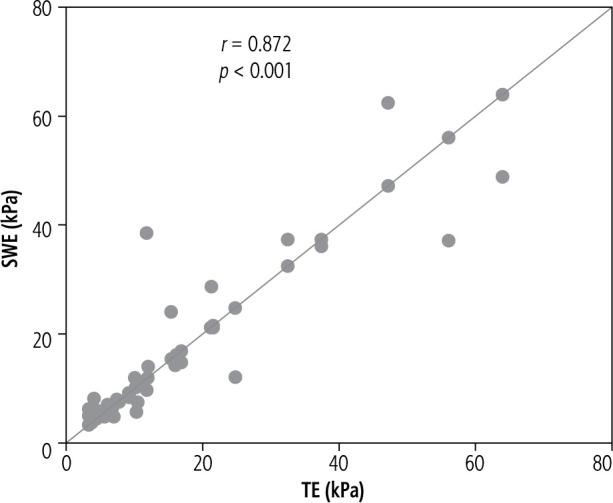
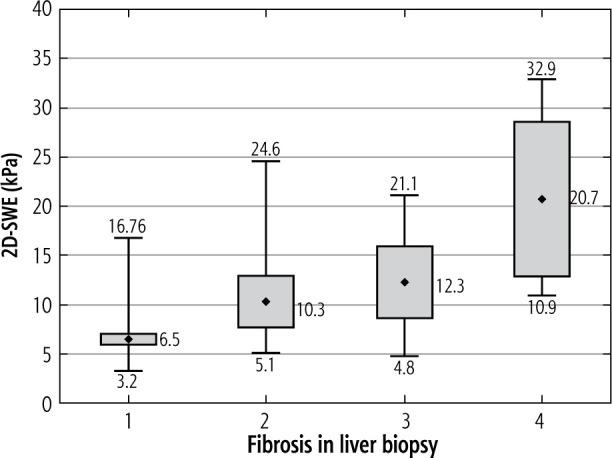
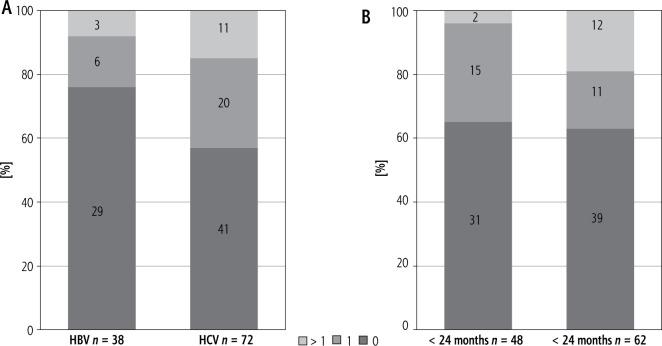
Stiffness values analysed in the whole studied population showed a significant positive correlation with a stage of liver fibrosis in biopsy ( = 0.555, < 0.001). If 2D-SWE was carried out within 24 months since liver biopsy the consistency of the results was 96%, and if the period between procedures exceeded 24 months the consistency was 81%. In 43 patients with both 2D-SWE and TE the coherence ( = 0.872, < 0.001) and consistency (95%) between these two methods were high.
CONCLUSIONS
Liver stiffness measured with 2D-SWE showed good consistency with stage of liver fibrosis in liver biopsies, particularly in HCV infected patients, and if the period between procedures did not exceed 24 months.
研究目的
分析慢性乙型肝炎病毒(HBV)和丙型肝炎病毒(HCV)感染患者肝活检中二维剪切波弹性成像(2D-SWE)硬度与纤维化之间的一致性。该研究的次要目的是分析慢性乙型和丙型肝炎患者二维剪切波弹性成像(2D-SWE)和瞬时弹性成像(TE)测量的肝脏硬度之间的一致性。
材料与方法
该研究将153例慢性HBV(n = 51)和HCV(n = 102)感染患者的二维剪切波弹性成像(2D-SWE)肝脏硬度评估结果与既往可用的肝活检报告进行了比较。在43例同时患有HBV(n = 8)和HCV(n = 35)肝炎的患者中,我们在进行二维剪切波弹性成像(2D-SWE)的同一天进行了FibroScan检查。采用适当的统计检验进行分析。
结果
在整个研究人群中分析的硬度值与活检中肝纤维化阶段呈显著正相关(r = 0.555,P < 0.001)。如果在肝活检后24个月内进行二维剪切波弹性成像(2D-SWE),结果的一致性为96%,如果两次检查之间的时间超过24个月,一致性为81%。在43例同时进行二维剪切波弹性成像(2D-SWE)和瞬时弹性成像(TE)的患者中,这两种方法之间的相关性(r = 0.872,P < 0.001)和一致性(95%)很高。
结论
二维剪切波弹性成像(2D-SWE)测量的肝脏硬度与肝活检中肝纤维化阶段具有良好的一致性,特别是在HCV感染患者中,且两次检查之间的时间不超过24个月。
 Zotero 插件