
卡培他滨联合芳香化酶抑制剂作为激素受体阳性、HER2 阴性转移性乳腺癌的一线治疗。
Capecitabine Plus Aromatase Inhibitor as First Line Therapy for Hormone Receptor Positive, HER2 Negative Metastatic Breast Cancer.
机构信息
Breast Tumors Unit, Instituto Nacional de Cancerología, Mexico City 14080, Mexico.
Gastrointestinal Oncology Unit, Instituto Nacional de Cancerología, Mexico City 14080, Mexico.
出版信息
Curr Oncol. 2023 Jun 24;30(7):6097-6110. doi: 10.3390/curroncol30070454.
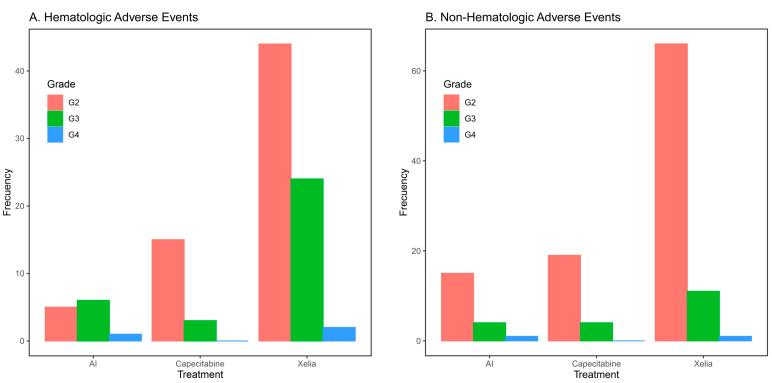
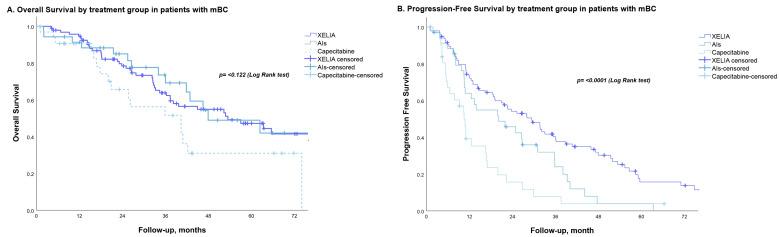
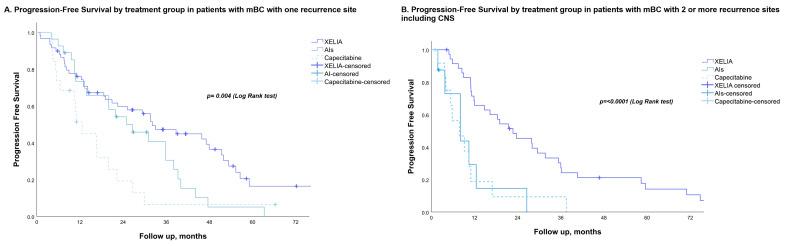
(1) Background: recent evidence suggests that long low-dose capecitabine regimens have a synergistic effect with endocrine therapy as aromatase inhibitors (AIs), and might increase overall survival for hormone-receptor-positive, HER2-negative, metastatic breast cancer compared to both treatments. We performed a retrospective study to confirm the efficacy and expand the safety data for capecitabine plus AI (a combination henceforth named XELIA) for this indication. (2) We conducted a single-center retrospective cohort study of 163 hormone receptor-positive metastatic breast cancer patients who received either the XELIA regimen, capecitabine, or an aromatase inhibitor (AI) as single agents in first-line treatment. The primary endpoint was progression-free survival, and the secondary endpoints were overall survival, best objective response, and toxicity incidence. (3) Results: the median progression-free survival for patients receiving XELIA, AI, and capecitabine was 29.37 months (20.91 to 37.84; 95% CI), 20.04 months (7.29 to 32.80; 95% CI) and 10.48 (8.69 to 12.28; 95% CI), respectively. The overall response rate was higher in the XELIA group (29.5%) than in the AI (14.3%) and capecitabine (9.1%) groups. However, the differences in overall survival were not statistically significant. Apart from hand-foot syndrome, there were no statistically significant differences in adverse events between the groups. (4) Conclusions: this retrospective study suggests that progression-free survival and overall response rates improved with the XELIA regimen compared to use of aromatase inhibitors and capecitabine alone. Combined use demonstrated an adequate safety profile and might represent an advantageous treatment in places where CDK 4/6 is not available. Larger studies and randomized clinical trials are required to confirm the effects shown in our study.
(1)背景:最近的证据表明,长疗程低剂量卡培他滨方案与芳香化酶抑制剂(AIs)内分泌治疗具有协同作用,与两种治疗方法相比,可能会增加激素受体阳性、HER2 阴性、转移性乳腺癌患者的总生存期。我们进行了一项回顾性研究,以确认卡培他滨联合 AI(以下简称 XELIA)治疗该适应症的疗效,并扩展安全性数据。(2)我们对 163 例接受 XELIA 方案、卡培他滨或单药芳香化酶抑制剂(AI)一线治疗的激素受体阳性转移性乳腺癌患者进行了单中心回顾性队列研究。主要终点是无进展生存期,次要终点是总生存期、最佳客观缓解率和毒性发生率。(3)结果:接受 XELIA、AI 和卡培他滨治疗的患者中位无进展生存期分别为 29.37 个月(20.91 至 37.84;95%CI)、20.04 个月(7.29 至 32.80;95%CI)和 10.48 个月(8.69 至 12.28;95%CI)。XELIA 组的总缓解率(29.5%)高于 AI 组(14.3%)和卡培他滨组(9.1%)。然而,总生存期的差异无统计学意义。除手足综合征外,各组间不良反应无统计学差异。(4)结论:这项回顾性研究表明,与单独使用芳香化酶抑制剂和卡培他滨相比,XELIA 方案可改善无进展生存期和总缓解率。联合使用显示出良好的安全性特征,在无法使用 CDK4/6 的地方可能代表一种有利的治疗方法。需要更大规模的研究和随机临床试验来证实我们研究中显示的效果。
 Zotero 插件