
沙特阿拉伯利雅得国王沙特大学医学城镰状细胞病患者中[具体病原体名称未给出]毒力基因的流行情况。
The Prevalence of the Virulence Genes of in Sickle Cell Disease Patients at KSUMC, Riyadh, Saudi Arabia.
作者信息
Abdulmanea Adel A, Alharbi Naiyf S, Somily Ali M, Khaled Jamal M, Algahtani Farjah H
机构信息
Department of Botany and Microbiology, College of Science, King Saud University, P.O. Box 2455, Riyadh 11451, Saudi Arabia.
Department of Pathology, College of Medicine, King Saud University and King Saud University Medical City, P.O. Box 2925, Riyadh 11451, Saudi Arabia.
出版信息
Antibiotics (Basel). 2023 Jul 22;12(7):1221. doi: 10.3390/antibiotics12071221.
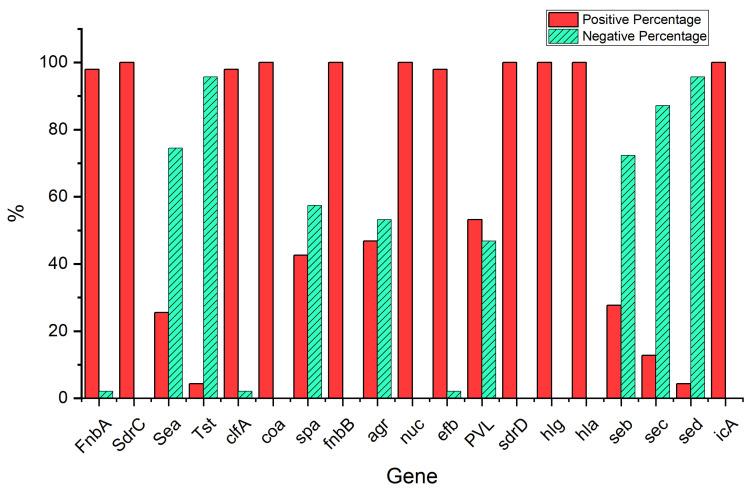
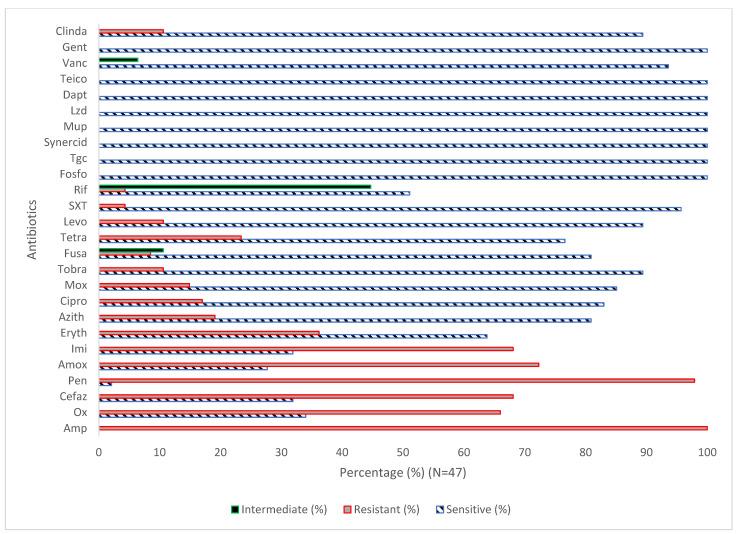
in the blood of sickle cell disease (SCD) patients may result in a significant increase in morbidity and mortality. strains contain various virulence characteristics, including the ability to create a variety of toxins and develop drug resistance. The current study sought to assess the prevalence of in SCD patients and to identify the pathogen's virulence characteristics. Between 2017 and 2021, blood samples and data were collected at King Saud University Medical City (KSUMC) in Riyadh, Saudi Arabia. The Vitek system PCR and gene sequencing methods were used for identification, antibiotic resistance patterns, and genetic analysis. During the study period, 47 blood isolates (methicillin-resistant (MRSA) 41.6% and non-MRSA 58.4%) were isolated from 2406 SCD patients. The prevalence percentages of virulence genes (, , , , , , , , , , , , , , , , , , and ) among all the isolates from the SCD patients compared with non-SCD patients (control group) were as follows: (100% vs. 100%), (100% vs. 100%), (100% vs. 100%), (100% vs. 87.5%), (100% vs. 81.3%), (100% vs. 100%), (100% vs. 100%), (100% vs. 100%), (97.9% vs. 81.3%), (97.9% vs. 100%), (97.9% vs. 87.5%), (54.3% vs. 56.3%), (46.8% vs. 75%), (42.6% vs. 43.8%), (27.7% vs. 0%), (25.5% vs. 12.5%), (12.8% vs. 6.3%), (4.3% vs. 12.5%), and (4.3% vs. 0%). Regarding the resistance genes (, , , , , , and ) of the strains isolated from the SCD patients compared with non-SCD patients (control group), the prevalence percentages were as follows: (100% vs. 100%), (100% vs. 56.3%), (0% vs. 31.3%), (31.9% vs. 18.8%), (40.4% vs. 25%), (0% vs. 0%), and (0% vs. 0%). As for the antibiotic (ampicillin, penicillin, amoxicillin, cefazolin, imipenem, oxacillin, erythromycin, tetracycline, azithromycin, ciprofloxacin, moxifloxacin, and levofloxacin) resistance of the strains isolated from the SCD patients compared with non-SCD patients (control group), the prevalence percentages were as follows: (100% vs. 100%), (97.9% vs. 100%), (72.3% vs. 25%), (68.1% vs. 37.5%), (68.1% vs. 25%), (66% vs. 25%), (36.2% vs. 18.8%), (23.4% vs. 12.5%), (19.1% vs. 12.5%), (17% vs. 12.5%), (14.9% vs. 25%), and (10.6% vs. 18.7%). This study concluded that several virulence genes were present in the strains recovered from the SCD patients at KSUMC, with all the isolates containing the , , , , , , , and genes.
镰状细胞病(SCD)患者血液中的(此处原文有缺失信息)可能导致发病率和死亡率显著增加。(此处原文有缺失信息)菌株具有多种毒力特征,包括产生多种毒素和产生耐药性的能力。当前研究旨在评估SCD患者中(此处原文有缺失信息)的流行情况,并确定病原体的毒力特征。2017年至2021年期间,在沙特阿拉伯利雅得的沙特国王大学医学城(KSUMC)收集了血液样本和数据。采用Vitek系统PCR和基因测序方法进行鉴定、抗生素耐药模式分析和基因分析。在研究期间,从2406例SCD患者中分离出47株血液分离株(耐甲氧西林(MRSA)占41.6%,非MRSA占58.4%)。与非SCD患者(对照组)相比,SCD患者所有分离株中毒力基因(此处列出多个基因,原文未明确基因具体名称)的流行率如下:(100%对100%),(100%对100%),(100%对100%),(100%对87.5%),(100%对81.3%),(100%对100%),(100%对100%),(100%对100%),(97.9%对81.3%),(97.9%对100%),(97.9%对87.5%),(54.3%对56.3%),(46.8%对75%),(42.6%对43.8%),(27.7%对0%),(25.5%对12.5%),(12.8%对6.3%),(4.3%对12.5%),以及(4.3%对0%)。关于从SCD患者分离出的(此处原文有缺失信息)菌株与非SCD患者(对照组)相比的耐药基因(此处列出多个基因,原文未明确基因具体名称),流行率如下:(100%对100%),(100%对56.3%),(0%对31.3%),(31.9%对18.8%),(40.4%对25%),(0%对0%),以及(0%对0%)。至于从SCD患者分离出的(此处原文有缺失信息)菌株与非SCD患者(对照组)相比对抗生素(氨苄西林、青霉素、阿莫西林、头孢唑林、亚胺培南、苯唑西林、红霉素、四环素、阿奇霉素、环丙沙星、莫西沙星和左氧氟沙星)的耐药性,流行率如下:(100%对100%),(97.9%对100%),(72.3%对25%),(68.1%对37.5%),(68.1%对25%),(66%对25%),(36.2%对18.8%),(23.4%对12.5%),(19.1%对12.5%),(17%对12.5%),(14.9%对25%),以及(10.6%对18.7%)。本研究得出结论,在KSUMC的SCD患者分离出的(此处原文有缺失信息)菌株中存在几种毒力基因,所有分离株均含有(此处列出多个基因,原文未明确基因具体名称)基因。
 Zotero 插件