
金羊毛困境:LPS 既是阳离子 AMPs 抗菌作用的初始靶标又是其屏障。
Goldilocks Dilemma: LPS Works Both as the Initial Target and a Barrier for the Antimicrobial Action of Cationic AMPs on .
机构信息
Department of Chemistry, Faculty of Science and Technology, UiT the Arctic University of Norway, 9019 Tromsø, Norway.
Department of Pharmacy, Faculty of Health Sciences, UiT the Arctic University of Norway, 9019 Tromsø, Norway.
出版信息
Biomolecules. 2023 Jul 20;13(7):1155. doi: 10.3390/biom13071155.
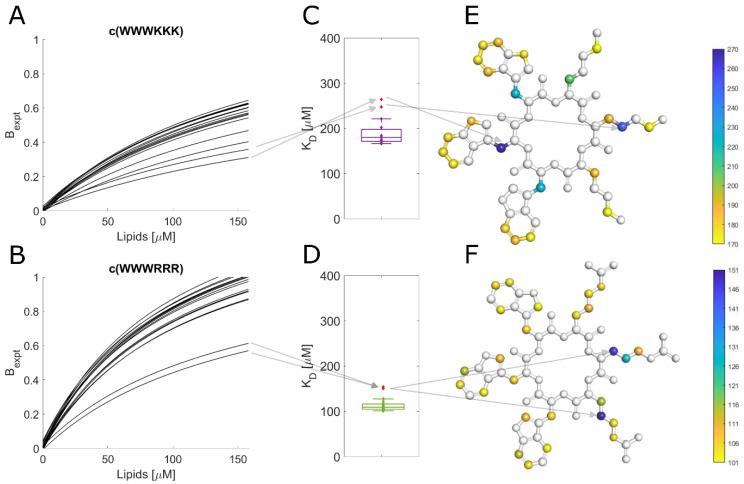
Antimicrobial peptides (AMPs) are generally membrane-active compounds that physically disrupt bacterial membranes. Despite extensive research, the precise mode of action of AMPs is still a topic of great debate. This work demonstrates that the initial interaction between the Gram-negative and AMPs is driven by lipopolysaccharides (LPS) that act as kinetic barriers for the binding of AMPs to the bacterial membrane. A combination of SPR and NMR experiments provide evidence suggesting that cationic AMPs first bind to the negatively charged LPS before reaching a binding place in the lipid bilayer. In the event that the initial LPS-binding is too strong (corresponding to a low dissociation rate), the cationic AMPs cannot effectively get from the LPS to the membrane, and their antimicrobial potency will thus be diminished. On the other hand, the AMPs must also be able to effectively interact with the membrane to exert its activity. The ability of the studied cyclic hexapeptides to bind LPS and to translocate into a lipid membrane is related to the nature of the cationic charge (arginine vs. lysine) and to the distribution of hydrophobicity along the molecule (alternating vs. clumped tryptophan).
抗菌肽 (AMPs) 通常是具有膜活性的化合物,可物理破坏细菌膜。尽管进行了广泛的研究,但 AMP 的精确作用模式仍然是一个极具争议的话题。这项工作表明,革兰氏阴性菌与 AMP 之间的初始相互作用是由脂多糖 (LPS) 驱动的,LPS 充当 AMP 与细菌膜结合的动力学障碍。SPR 和 NMR 实验的组合提供了证据,表明阳离子 AMP 首先与带负电荷的 LPS 结合,然后再到达脂质双层中的结合部位。如果最初的 LPS 结合太强(对应于低解离率),阳离子 AMP 就无法有效地从 LPS 转移到膜上,其抗菌效力也会降低。另一方面,AMP 还必须能够有效地与膜相互作用以发挥其活性。所研究的环状六肽结合 LPS 并转位到脂质膜的能力与阳离子电荷的性质(精氨酸与赖氨酸)以及沿分子分布的疏水性(交替与聚集色氨酸)有关。


 Zotero 插件